Nur al-Cubicle

A blog on the current crises in the Middle East and news accounts unpublished by the US press. Daily timeline of events in Iraq as collected from stories and dispatches in the French and Italian media: Le Monde (Paris), Il Corriere della Sera (Milan), La Repubblica (Rome), L'Orient-Le Jour (Beirut) and occasionally from El Mundo (Madrid).

Sunday, July 31, 2005

Interrogation of Osman Hussain in Rome.

Reporter Claudia Fusani wrote an article for the Rome newspaper, La Repubblica, with dribs and drabs of the confession of Osman Hussain, arrested in Rome, where he ended up after the 21 July bomb incident in London. The article is not particularly well-written but it is causing a sensation. Here's a translation of most of it.

Behind the scenes. Speaking good Italian, Osman Hussain [Hamdi Isaac] describes the do-it-yourself planning of the 21 July attempted bombings in England.
"We did not want to strike Italy"

by Claudia Fusani

The London basement, the leader, Muktar, the videocassette showing dead Iraqi women and children. "Hate" is aroused for American and British soldiers. It is in this cellar where the bombs meant to sow fear but not to kill took form--the bombs of 21 July which did not go off because it was pre-planned that they would be only duds.

The confession--Hussain tells everything he knows. Above all he was not in Italy to plan a bombing. The young 27 year-old man from the Horn of Africa, originally a Somali but then Eritrean but maybe also Ethiopian, puts his hands in the air, surrenders and begins to talk. It comes as a surprise to police when they find out he speaks good Italian. He lived in Rome for five years as an adolescent fleeing misery and famine in the Horn of Africa. As a nine year-old, Hussain arrived as a political refugee thanks to a falsified Somali passport.

He gives a ten-page confession that he then signs in front of Roman magistrates Franco Ionta and Piero Saviotti in which he describes himself as a do-it-yourself terrorist on the lam. A chilling narrative--because just like the conspiracy in Hussain's basement, there could be such meetings organized by anyone anywhere in Italy and in the West. It means, says an investigator, that there are dozens and dozens of timebombs in circulation which could go off at any time.

The interrogation begins at eight in the evening in the Rome offices of the Divisione Investigazione Generali e Operazioni Speciali, DIGOS, on the second floor in via San Vitale. But it is held up for procedural reasons concerning the type of arrest. There are three possibilities: Arrest for extradition, arrest for murder of Benedetta Ciaccia, killed in the bombings of 7 July, or arrest for international terrorism. This has not yet been resolved.

Osman begins his story a few months ago, in the Notting Hill neighborhood of London when Muktar, our leader, told us that he has some material for us to see but that we should be careful and not talk to anyone about it. Saeeed Ibrahim Muktar is the bomber who was to detonate his payload in Bus No. 26. In the photo distributed by Scotland Yard, Mukta is wearing a white cotton cap and is the most heavily built of the four. He is the deviser and the orchestrator of the cell. The cellar is a basement apartment in Notting Hill. Here Mukar summons Osman, Mohammed, Yassin Hassam and the others, all Muslims, all British citizens, and all barely making ends meet between subsidies and part-time jobs in English Londonstan.

More than praying we talked about things relates Osman, work, politics, the war in Iraq. Muktar always had some new film on the war in Iraq. We mostly viewed films showing women and children killed or wiped out by British and US soldiers, or weeping widows, mothers and children. He never spoke about Al Qaeda, Bin Laden and his lieutenants or the network. We never had contacts with Bin Laden's organization. We know it exists, we've read about it on the Internet, but nothing direct. This information worries investigators more than anything else. Actions are spontaneous and emulated. The facility with which a cell can form makes interception impossible.

The hatred felt in the Notting Hill basement begins with the political conviction that it is necessary to send a message, to do something. The bombings of 7 July, according to Osman's story, take him by surprise. We had no links to any Pakistanis, he repeats. But the bombings of 7 July were a message that the Pakistanis were doing their part by acting. Our leader, explains Osman, taught us how to make explosives by mixing fertilizers. It's child's play to get a backpack, fill it with explosive powder and regulate it with a timer. We did not want to kill, we only wanted to spread panic, he repeats.

Then came the escape. I came here only because I didn't know where to go and that here I would find a place to stay and some friends. I'd spend some time here and then move on. Italy and Rome were only stops on his journey. I know nothing of any planned bombing in Italy, he swears. In the apartment along the Casilina, police found no trace of explosives. But there are many questions to which Osman has not supplied an answer. Investigators are convinced that if they had more time, if they had been able to eavesdrop before making the arrest, they might have gathered important information without rushing. During the night, friends and acquaintances of Hussain are bought into police headquarters.

31 July 2005 Events in Iraq and in the Region

Damascus. Syria claims that 795 Syrians have "disappeared" in Lebanon.

Beirut. Maronite leader Michel Aoun calls for the return of Lebanese who sought refuge in Israel following the civil war. Amal and Hezbollah reject any idea of amnesty, saying it is a political, not a humanitarian, matter.

Teheran. The Secretary-General of Lebanese Hezbollah, sayyed Hassan Nasrallah, has begun an official visit to Iran where he hold talks with officials of the Islamic Republic.

Baghdad. If the Constitutional Drafting Committee does not request an extension for its work and if the draft text is not presented to Parliament before August 15th, Parliament will be dissolved, provoking an open crisis in the country.

Baghdad. The Sunni members of the Constitutional Drafting Committee have demanded that fired Waqf chairman Adnane Doulaïmi be restored to his position. Sheikh Ahmed Abdel Ghaffour al-Samarraï has been named to replace Doulaïmi.

Baghdad. 4,000 Iraqis have died in violence since the beginning of the year; more than half are civilians. July and May were the bloodiest months. Baghdad is the most often the city most frequently experiencing violence.

Algiers. The arrested former Number 2 of the dissolved Islamic Salute Front, Ali Belhadj, has been charged with apology for terrorist crimes, incitation to murder and the publication of writings constituting an apology for terrorism. His brother, Abdelhamid Belhadj, was also arrested for publication of writings constituting an apology for terrorism. Ali Belhadj was arrested after a statement to al-Jazeera on the kidnapping of two Algerian diplomatics in Baghdad just before their execution.

Baghdad. The Special Iraqi Tribunal has denied that Saddam Hussein was accosted by an unidentified person following a recent hearing.

Hassoua. A suicide carbomb exploded in front of a police checkpoint 50 km south of Baghdad killing 7.

23:59 New York. The Central Intelligence Agency was told by an informant in the spring of 2001 that Iraq had abandoned a major element of its nuclear weapons program, but the agency did not share the information with other agencies or with senior policy makers, a former C.I.A. officer has charged. In a lawsuit filed in federal court here in December, the former C.I.A. officer, whose name remains secret, said that the informant told him that Iraq's uranium enrichment program had ended years earlier and that centrifuge components from the scuttled program were available for examination and even purchase. The officer, an employee at the agency for more than 20 years, including several years in a clandestine unit assigned to gather intelligence related to illicit weapons, was fired in 2004. In his lawsuit, he says his dismissal was punishment for his reports questioning the agency's assumptions on a series of weapons-related matters. Among other things, he charged that he had been the target of retaliation for his refusal to go along with the agency's intelligence conclusions. [Another nail in the coffin for BushCo!--Nur]

23:57 Khartoum. Mystery surrounds disappearance of Vice President Garang. Contact has been lost with Garang's helicopter which took off from Kampala. Sudanese State Television is broadcasting conflicting information, suggesting that contact has been lost with the aircraft [The old Jordanian Helicopter Trick of getting rid of inconvenient people.--Nur]

22:48 Rome. A suspect package was found in front of Italian Senate building in Piazza Navona.

22:45 Cairo. The Arab League wants Algerian Presidnet Abdelaziz Bouteflika to chair the extraordinary Arab summit called for 3 August at Sharm al-Sheikh.

21:04 Baghdad. Trial of Saddam Hussein to be televised live. Iraqi National Security Advisor Muwaffaq Rubaie says the trial of Saddam Hussein will be televised live to prove that any judgement against him is "fair" and "just. Saddam will be tried for the massacre of 143 inhabitants of the village of Dujail.

19:16 London. Scotland Yard makes seven more arrests in Sussex linked to the 21 July attempted bombings.

19:11 Washington. Newsweek writes that the Pentagon is reparing to reduce troops strength in Iraq to 80,000 in mid-2006 and to 60,000 by the end of next year.

18:49 Cairo. A 4.6 earthquake measured on the Richter Scale struck the Egyptian capital. The epicenter was in Dashour, 55 km south of the capital.

18:43 London. The female partners of Muktar Said Ibrahim and Ramzi Mohammed, arrested for the attempted 21 July bombings, have been released by Metropolitan Police. They were arrested in Liverpool Street Station. The British press reports that they had their passports and were preparing to leave the country.

18:33 Rome. Deputy Speaker of the House and Forza Italia Party Chairman Alfredo Biondi criticized opposition leader Romano Prodi, saying he is "soft" on terrorism, divides Italy and offends the Truth. [I think we know who that is and it's not Prodi.--Nur].

17:44 Ramallah. The Palestinian general elections are scheduled to take place on 20 January 2006, says Palestinian Information Minister Nabil Shaath.

17:32 Baghdad. The bodyguard of Ahmed Chalabi was killed in an attack on Chalabi's convoy south of Baghdad.

16:04 Baghdad. The team drawing up Iraq's new constitution considered giving itself more time to write the document on Sunday, but still looked set to meet its mid-August deadline under intense U.S. pressure. Iraqi President Jalal Talabani, flanked by U.S. ambassador Zalmay Khalilzad, told reporters it was essential that the U.S.- backed timetable for writing the constitution was met and the document presented to parliament by the deadline of Aug. 15. Many of the 71 members on the drafting committee say they need more time, while others say the priority is meeting the deadline. The debate has come to a head because any extension must be requested by Aug. 1. [Hmm...I wonder what the odds are over at Ladbrokes--Nur]

16:02 Damascus.Lebanese Prime Minister Fuad Siniora met in the Syrian capital with his counterpart Mohammed Naji Otari. Siniora hopes Damascus will drop security checks on vehicular traffic entering Syria which has nearly blocked Lebanese exports.

16:00 Baquba. The Diyala provincial chief for Ansar al-Sunna was arrested along with 14 others. Majid Mohammed Hamid, his lieutenant Hassan al-Saadi and 13 others have been arrested by police, who say the group is responsible for the murder of provincial council chairman Nawfal Abdel Hussein on 1 January 2005.

15:58 Kuwait City. The U.S. embassy in Kuwait has warned Americans of possible attacks in the the pro-Western Gulf Arab state.

15:51 London. It may not have been a policeman but a member of the British special forces, the SAS, who shot Jean Charles de Menezes in the Stockwell Tube station, writes The Sunday Times. The British Defense Minister has admitted that the Army was cooperating with the Police in the operation which led to the death of Menezes. Based on a reporter's photograph, some men involved in the operaton carried weapons authorized only to the SAS, which is trained to shoot to kill.

15:42 Baghdad. The committee charged with drafting the new Iraqi consitution will meet all night to decide if it will request a 6-month extension. President Jalal Talabani urged the committee to wrap up its work without delay. However, Shi'ite members of the committee want an extension of two weeks to a month. There is talk going around that there will be a 30-day extenison, but it has not yet been confirmed, said "Shi'ite committee member Bahaa al Aradji. [There is a deadlock caused by Kurdish demands. I don't expect them to back down.--Nur]

15:34 Sanaa. The United States has agreed to hand over to Yemen seven Yemenis detained at the U.S. Guantanamo Bay base, the Arab state's foreign minister said on Sunday. Abubakr al-Qirbi told Reuters that Yemeni authorities received official notification about the handover, but that a date had yet to be set.

15:23 London. An abandoned satchel filled with false passports, credit cards and drivers' licences was found near Heathrow.

15:17 Washington Despite pouring more than $9 billion into rebuilding Iraq over the past two years, the United States has made only limited progress in key areas such as oil and power, according to new reports on U.S.-funded projects there. Soaring security costs are a major stumbling block in what is billed as the biggest U.S. foreign aid operation since the post-World War II reconstruction of Europe. [Whew--Nur]. When it's analyzed overall, it will turn out as being an expensive program in terms of what we actually got for our money, said one senior U.S. official, who asked not to be named because such a statement might be viewed as too negative by Bush administration officials. It will be high cost but that does not mean that we should not have continued, the official said of the rebuilding plan. Meanwhile Jim Crum, a senior U.S. official involved in Iraq reconstruction, said despite security problems he believed there had been great progress in rebuilding Iraq and he pointed to the more than 600 schools rebuilt using U.S. funds. [...And spread sunshine all over the place, just put on a happy face--Nur]

15:11 Jerusalem. The Israeli military said Sunday it is changing riot control methods, replacing its sometimes lethal rubber-coated steel pellets with compressed sand bullets. An Israeli human rights groups praised the decision, but said it was surprising that the army had taken so long to find non-lethal means of dispersing Palestinian demonstrators. The new round, in which the head of the bullet is made from compressed sand and can be fired from a regular rifle, has already been used in the West Bank against Palestinians protesting against the separation barrier Israel is building, the army said. The sand bullet, said to be extremely painful but less dangerous because it does not penetrate the skin, was developed and first used by Israel's Prisons Authority, the army said. [Oh happy day--not. Nur].

15:10 Jerusalem. The evacuation of Jewish settlements in Gaza, scheduled to take place in 2 weeks, could be temporarily suspended if there is a major outbreak of violence on the part of armed Palestinian groups sayd Israeli Deputy Defense Minister Zeev Boïm. In such an event, a massive deployment of Israeli troops is planned to deliver a knockout punch to the "terrorists."

15:01 Haditha. US marines killed 11 rebels who had taken refuge in a school. The rebels had fired mortar rounds at the Americans.

14:37 Teheran. Iran is able to produce enriched uranium in a very short time and sheltered from any possible military attack, said nuclear program director Hassan Rohani. As soon as we decide to proceed with enrightment, we will attain our objectives in a very short time and should our nuclear installations come under military attack, it should not impact production.

14:27 London. The UK warns Iran that its decision to start up its Ispahan uranium enrichment plant would be "uselsss and damaging" and would threaten its negotiations with the European Union.

Saturday, July 30, 2005

30 July Events in Iraq and in the Region

Baghdad. Kurds demand partial control of northern oilfields.

Gaza. Two UN workers in Gaza were released by their kidnappers.

Jerusalem. The Israeli military plans a vast ground offensive in the Gaza Strip before the evacuation but the Defense Minister opposes the move. Mr. Mofaz in under intense US pressure to avoid an escalation.

Sdérot. Two Qassam missiles were fired by Palestinian militants.

Ishaki. A roadside bomb killed several civilians near this town 100 km north of Baghdad.

Dour. A roadside bomb killed several civilians near this town 155 north of the capital.

Mosul. The casualty toll from a suicide bombing of Iraqi army recruits in the northern Iraq town of Raabia on Friday rose to 40 dead and 57 wounded.

Baghdad. Moderate Sunni leader Khalaf al-Ilayan, head of the National Dialogue Council, escaped an assassination attempt but his bodyguard was wounded. Men dressed in government uniforms attacked his car.

Basrah. A mine detonated as a British diplomatic convoy passed nearby, killing two private security guards. The pair were security contractors employed by Control Risks Group. There is no information on the wounded.

Baghdad. Sunni leaders accuse the government of arming death squads as a reprisal to insurgent actions.

Hit. A suicide bomber attacked a US convoy, wounding four marines.

Baghdad. The bodies of three civilians kidnapped a Baghdad Airport were found in the al-Amil area of Baghdad. They included Maher Yassine Jassem, director of Airport telecommunications.

Mahmudiya. A mine killed a civilian and wounded three others south of the capital.

23:30 Teheran. Iranian authorities have arrested human rights laywer Mrs. Shirin Ebadi, 2003 Nobel Peace Prize winner.

21:18 Teheran. Iran demanded that the European Union submit proposals in a dispute over its nuclear programme by Aug. 1 rather than take a week longer. The European Union -- represented by Britain, France and Germany -- is due to offer Iran a limited package of economic and political incentives to give up work that the United States suspects is a veil for efforts to build a nuclear bomb. In return, the EU wants Iran to agree to maintain indefinitely its suspension of uranium enrichment, nuclear fuel reprocessing and related activities.

20:44 Beirut. The new Lebanese government of Fouad Siniora was approved by Parliament with a strong majority.

20:12 Cairo. Anti-Mubarek protests. Dozens protested Hosni Mubarek and many were beated by police with clubs. Four protesters were arrested and briefly detained, including three Kefaya members: Kamal Khalil, George Ishak and Amin Iskander. Our question to Mr. Bush and Mrs. Rice is where are the democratic values you were taking about?, asked protester Adil Saïd at the end of the demonstration.

19:20 Rome. A British extradition request for Isaac Hamdi will be forwarded Monday or Tuesday.

16:51 Baghdad. Former dictator Saddam Hussein was agressed by an unidentified individual as he left the Iraqi Special Tribunal after a hearing, said Saddam's legal team in Amman. . Punches were exchanged. Neither the assailant not Saddam were injured. A member of Saddam's defense team, Khalil Doulaïmi said that Saddam was surprised to find three judges and a prosecutor whom before whom he had never appeared. Doulaïmi also said there was no notification of new charges and no time was given to Saddam to meet with his attorneys. Abdel Haq Alani, a British legal consultant to Saddam's legal team, said the incident was a "parody of justice." "This was a hearing, not a trial and there should have been no spectators. [I see. The idea is to have Saddam dispatched by a Jack Ruby-like incident.

16:32 Washington. The USA promises to arrest the executioners of of the two kidnapped Algerian diplomatis.

16:09 Cairo. The King of Bahrain, Sheikh Hamad ben Issa Al-Khalifa, will participate in the extraordinary session of the Arab Leage on August 3rd at Sharm al-Sheikh. Iraq, Jordan, Yemen, Palestine and the Emirates have confirmed their attendence.

15:43 Fallujah. Fifty Falljah tribal leaders have pronounced themselves in favor of the referendum on the Constitution but oppose a federal Iraq after a meeting with US officials at a US military base near the city. Sheikh Hamid Farhan Abdallah Al-Mehendi said that In our estimation a federalized Iraqi could divide the country. What kind of Constitution is one which permits the Kurds to adopt their own flag? The Kurds and those from Basrah get oil and all we get is the al-Anbar desert? For his part, Sheikkh Riyad Ali added, Our rights are ignored. The Sunnis have governed Iraq for the last four decades and now it seems we are forgotten in the new democratic process sponsored by the Americans.

15:34 Baghdad. Members of the committee writing Iraq's new constitution said Saturday major differences remain only two weeks before the deadline for parliament to approve the draft. A Sunni member said some issues may remain unresolved until after the December elections. There is a group that wants Iraq to be called "The Iraqi Islamic Federal Republic", while the other wants it called the "Iraqi Federal Republic" and another group rejects both names, said Kurdish legislator Hussein Mohammed Taha. He added that Kurds and Shiites agree that Iraq should become a federal state while Sunni Arabs still object, fearing it could lead to the division of the country. Another problem is the official language of Iraq and whether it should be Arabic alone or Arabic and Kurdish, he added. There are even differences over whether Iraq should be formally declared as part of the Arab and Islamic nation or whether the document should state that the Iraqi people are parts of those nations, he said. A serious point of disagreement also appears to be the role of Islam in the state.

15:17 Umm Qasr. A number of Iraqi homes and farms have slightly «encroached» into Kuwait at the border area of Umm Qasr in southern Iraq, Kuwait said Saturday, but insists the matter, which sparked Iraqi protests last week, will be resolved through dialogue.

14:39 Baghdad. A suicide bomber rammed a checkpoint near the National Theatre in the Karrada district of south Baghdad. The blast killed five people, including three
policemen, and injuring nine, including a mother and her two children.

13:06 Baghdad. A roadside bomb directed at a US military convoy in Baghdad's Doura district killed an Iraqi civilian and possibly killed or wounded several US soldiers.

12:01 Baghdad. The Director-General of the Health Ministry, Mrs. Iman Naji Abdelrazzak, was kidnapped by gunmen who stormed her home in the capital's upscale district of Mansour .

11:50 London. Two men were arrested in Leicester in the early hours of the morning in connnection with the 7 July bombings.

11:21 Baghdad. Gunmen spray Jordanian Embassy with gunfire

The Textual Analysis of Terrorism

Sphinx has a masterful discussion the hermeneutics of Muslim extremism in his explication of Oliver McTernan's article today in The Guardian.

Sex, Qat, Bombs--and Rap Sheets

Go read Postman Patel today.

Friday, July 29, 2005

29 July Events in Iraq and in the Region

Cykla. Two U.S. soldiers were killed on Thursday when their unit came under attack by small arms fire and rocket propelled grenades in Cykla, about 200 km (120 miles) west of Baghdad, a U.S. military statement said.

Baghdad. One U.S. soldier died on Thursday when the vehicle he was driving was involved in a single-vehicle accident off base in central Baghdad around 11:30 p.m.

Basrah. An Iranian lieutenant and a solider were arrested by Iraqi border guards when they crossed the border into Iraq.

Baghdad. Deep differences continue to divide the committee drafting the Iraqi Constitution, notably federalism, distribution of wealth between the central goverernment and the regions, the role of Islam and even the name of the country. I fear that even in six month we cannot resolve so many complicated things, said Salah al-Moutlaq, spokesman for the Council on National Dialog, a Sunni organization. Kurdish member Mahmoud Osman, joked about US pressure on the committee to finish its work on time: The Americans are merely interested in fast food and a fast Constitution.

Baghdad. The head of the Iraqi Waqf, Adnan Doulaïmi, was fired by Prime Minister Ibrahim al-Jaafari for his increasingly frequent declarations concerning the arrest and assassination of Sunnis by Iraqi security forces.

Baghdad. Moqtada Sadr says he has gathered one million signatures on a petition demanding the pullout of foreign troops from Iraq.

Washington. The Inspector-General for Reconstruction in Iraq, Stuart Bowen, confirms that millions of dollars have been siphoned off by US officials and contractors. The US has granted $23 billion in reconstruction money for Iraq.

Baghdad. Sheikh Faisal Khazali, chieftain of the Khazal tribe, was shot dead behind the wheel of his car while driving though the al-Alam districe of southwest Baghdad

23:46 San Salavdor. Salvador has decided to keep its contingent in Iraq for another 12 months. The participation of Salvador in the Iraq war is important for the United States because the conflict is very unpopular in Latin America. Norman Quijano, an MP reprenting the Parti Arena (right wing, currently in power), made the announcement. Salvador has 380 soldiers in Iraq. Nicaragua, Honduras and the Dominican Republic removed their troops after the Spanish pullout last year

23:30 Washington. The CIA has concluded that newly-elected Iranian President Mahmoud Ahmadinejad was not the hostage-takers shown in an old photo of the beseiged US Embassy in Teheran dating from 1979 and pulished last month in the US media.

22:31 Washington. US Secretary of State Condoleezza Rice phoned French FM Philippe Douste-Blazy to discuss the results of her trip to the Middle East. [This was likely some howling about Lebanon's refusal to disarm Hezbollah--Nur]

20:37 Baghdad. Three people were killed and 17 wounded when a carbomb targeted an outdoor bar along the Tigris. The vehicle expolded near a bridge in the Sunni Adhamiyah quarter and set three parked cars ablaze.

18:50 Rome. A suspect in the 21 July attempted bombings in London Osman Hussain, was arrested in a apartment close to the central railway station in Rome. He was in his brother-in-law's apartment. British police informed the Italian agency Ucigos that a cellphone registered to Hussein had been used in Italy. Italian police did not expect to find both Hussein and his brother-in-law.

16:07 Rome. The Italian Senate has adoped a new anti-terrorism law granting the military power of arrest and detention.

16:07 Karachi. Pakistani President Pervez Musharraf announced that 1,400 foreign students studying at some of Pakistan's 10,000 madrassas are ordered out of country. Musharraf also said that no visas for religious study in Pakistan would be granted.

15:54 The Hague. The United States has asked Dutch authorities to extradite a Dutchman of Iraqi descent suspected of helping plot attacks on American convoys in Iraq, the Justice Ministry said Friday. Wasem al Delaema, aka Wesam Khalaf Shayed Delaeme, was arrested in May during a raid on his home in the Dutch city of Amersfoort. U.S. authorities informed the Netherlands on Wednesday that they want to prosecute al Delaema in the United States and have asked Dutch prosecutors to drop their case against him. he US has demanded the extradition of a Dutch citizen of Iraqi origin, Wesam al Delaema, suspected of involvement in attacks on the US military in Iraq. Delaeme had fought in Falloujah, according to the US Justice Dept. This is the first time the US Justice Department has pursued an individual for alleged terrorist activities in Iraq.

15:45 Baghdad. Hundreds of Iraqis protested arbitrary arrests and police brutality. The protest was called by the Islamic Party. Over 1,000 Sunni protesters accused the government of pursuing sectarian policies and torturing and killing in "the new Iraq of fire and steel". Simulating torture, they dressed up as soldiers and used drills, wooden clubs and electric wires to act out what they said were the techniques used by government forces against them.T he protest took place outside the heavily fortified Green Zone, which houses the Iraqi government and Western embassies.

15:37 London. Police arrest two presumed terrorists responsible for the bungled bombings of 21 July.

15:32 London. Iraq's Kurds want at least partial control over northern oil resources in a post-war political system that ends uneven distribution of wealth, Planning Minister Barham Salih said on Friday. If this succeeds, foreign oil firms will have to negotiate about developing fields in the country with the second largest reserves in the world with provincial governments eager to raise their share of oil revenue, as well as with central government. We call for allowing the provinces to participate in managing the oil sector because the strict central system of managing it has proved its failure, said Salih, who was in Amman after meeting British Prime Minister Tony Blair in London. A senior Shi'ite official, who declined to be named, told Reuters the oil devolution scheme was likely to succeed, although there was concern it could increase the politicization of the sector and rob it of direction.

15:30 London. Liverpool Street station closed.

14:28 Gaza. Two UN aid workers, an Australian woman and a Palestinian were kidnapped by masked men in front of a hotel in Gaza.

14:04 Mossul. A suicide bomber killed a group of 25 police recruits in Mosul and wounded 35. Police said the attack occurred outside a municipal building in Rabiaa, a town 80 km (50 miles) northwest of Mosul, Iraq's third largest city and a focus of an 18-month-old insurgent campaign against U.S.-backed Iraqi security forces.

13:16 Diyarbakir (Turkey). A bomb explodes under a car in the city of Hakkari in southeast Turkey. One person is killed.

13:12 Baghdad. Special tribunal questions Saddam Hussein for 45 minutes on suppression of the Shi'ites in the south in 1991.

10:40 Mosul. Nth lieutenant of al-Zarqawi arrested. Ammar Abu Bara, aka Amar Hussein Hasan was arrested on Wednesday

09:00 Haditha. U.S. and Iraqi forces killed nine insurgents, including five Syrian fighters, in a small village northwest of Baghdad. The insurgents fired rocket-propelled grenades and small arms at a U.S. and Iraqi patrol.

Thursday, July 28, 2005

28 July 2005 Events in Iraq and in the Region


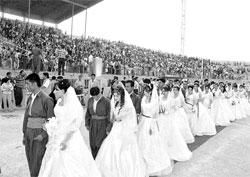
Mass wedding in Kurdistan

Baghdad. U.S. Marine jets dropped laser-guided bombs and other ordnance on insurgent positions northwest of Baghdad, killing nine insurgents, including five Syrians, the U.S. military said. The airstrike was launched after troops from the U.S. 3rd Battalion, 25th Marine Regiment and the Iraqi 1st Division came under fire in a village west of Haditha, 140 miles (225 kilometers) northwest of Baghdad. Jets from the 2nd Marine Air Wing dropped three laser-guided bombs and one global positioning system guided bomb, destroying all three buildings, the statement added.

Baquba. Insurgents launched coordinated attacks against four Iraqi army checkpoints along a road between Baquba and Baghdad, killing six Iraqi soldiers. At least eight people-- three soldiers, four policemen and one civilian -- were wounded as fighting continued into late afternoon.

Riyadh. Saudi Arabia's King Fahd requires constant medical attention after a tracheotomy.

Algiers. Al Qaeda's killing of two Algerian diplomats in Iraq has thrown into doubt a government amnesty proposal and forced a rare debate on President Abdelaziz Bouteflika's handling of Algeria's own Islamist threat.

Baghdad. Shi'ite leaders told a conference the Constitution due to be completed next month will solve many of Iraq's problems. About 700 members of the Gathering of Islamic Students of Iraq packed the auditorium of a hotel once frequented by Saddam Hussein's agents, and listened to Shi'ite politicians and clerics predict a bright future once Iraq's new constitution is drafted and approved.

Teheran. Iran's former president Akbar Hashemi Rafsanjani called for the release of jailed journalist Akbar Ganji, whose family says he has been on hunger strike for over six weeks. Ganji, an outspoken critic of the Islamic state's clerical leadership, was jailed in 2001 following a series of articles he wrote linking officials to the murder of political dissidents.

Diyarbakir (Turkey). Kurdish guerrillas have kidnapped the mayor of a town in eastern Turkey and police and troops have launched a search, security officials said. Hasim Akyurek, mayor of Yayladere in Bingol province and a member of Turkey's ruling Justice and Development Party, was abducted on Wednesday while on his way to inspect preparations for a local festival, the officials said.

London. Turkish Prime Minister Tayyip Erdogan said he might take action against Kurdish guerrillas in Iraq if U.S. forces did not stop the rebels infiltrating across the border into Turkey.

Menoufiya. (Egypt) President Mubarak, 77, announced that he would run for president a fifth time in his hometown, 80 km north of Cairo. Mubarek also announced that he would replace the current State of Emergency with anti-terrorism laws. [Le plus ça change...--Nur]. The Kefaya (« enough») movement said it would boycott the elections. The Kefaya spokesman, George Isaac told AFT that Mr. Mubarek had only "empty words" for democratization. The Marxist movement Tagammou and the Nassirites have decided to boycott both the presidential and the legislative elections to protest the restrictions place on independent candidates by the recent amendment to the Constitution. Meanwhile, the head of the al-Ghad Party (liberal), opposition leader Ayman Nour, said he wound announce his candidacy for the presidency on Saturday.

Cairo. Mohammed Mehdi Akef, the spiritual head of the Muslim Brotherhood, condemned the Sharm al-Sheikh bombings.

Jerusalem. Prime Minister Ahmed Qoreï assured that the Palestinian authority would intervene against armed Palestinian groups to prevent attacks during the Israeli evacuation of Gaza. Meanwhile, Ariel Sharon announced that "thanks to the Gaza evacuation" Israel would never return to its 1967 borders nor permit the return of Palestinian refugees.

Gaza. Gunmen kidnapped a intelligence colonel in a Palestinian refugee camp in Gaza. Witnesses say the kidnappers were members of al-Fatah.

Jerusalem. Israel announced that a triple barrier will be built around Gaza. An Israeli military source days a triple barrier would be built around the Gaza Strip to stop infiltration by militants following the Israeli evauation. The plan will add two barbed-wire barriers, observation towers, cameras and remote controlled machine guns. At certain points along the barrier, 20-foot high concrete walls will be constructed. The cost is expected to be $20 million and be completed by spring 2006. The Jewish state said it would maintain control of Gaza airspace and the coastline. [This is really bad news. We have Sharon smirking about how he hornswaggled Bush with the Gaza pullout while Peres is grubbing for money. Bush is a naieve man.--Nur]

Ramallah. A 25 year-old Palestinian were shot dead by Israeli soldiers near Tulkarem. The Israeli military claimed that Mouayad Moussa was a member of Islamic Jihad.

Ramallah. Palestinian Authority orders 100,000 flags. Gaza factories are preparing 60,000 Palestinian flags. 35 000 others will be made with the al-Fatah logo while another 20,000 will carry a portrait of Abbas and Yassir Arafat.

Jerusalem. The Knesset has adopted a retroactive law limiting the claims of Palestinians injuried or suffering losses as a result of Israeli actions during the Intifada. The Justice and Defense ministries hope to avoid millions of dollars in damages.
.
Jerusalem. The Knesset extend a law by nine months which prohibits residency in Israel of any Palestinian spouse of an Israeli Arab.

Baghdad. The Iraqi authorities have requested the Multinational force to protect diplomatic missions.

Baghdad. A group linked to al-Zarqawi uploaded a video showing a hostage, presented as a Kurdish member of PKK working as anti-insurgency spy.

Baquba. Four soliders and a policemen were killed and another policeman wounded in two attacks targeting checkpoints in Baquba and Khani Bani Sadr.

23:54 Washington. The Iraqi insurgency gets most of its money through the delivery of cash from neighboring states, notably Syria, said US Treasury official Daniel Glaser. Iraqi rebels are suppored by charity organizaiton and Iraqi expatriates, said Glaser. They also finance themselves through criminal activity such as drug smuggling. Glaser told the US House of Representatives that a signficant number of former Iraqi political figures are held or monitored by the Syrians but blamed the Syrians for not interdicting the funds going to the rebellion.

23:51 London. The estimate of 25,000 Iraqi civilians killed in Iraq since March 2003 is "the absolute minimum" reports The Lancet

23:47 Washington. Iranian cadres are training Hezbollah fighters in Lebanon, said Assistant Secretary of State David Welch to the House International Relations Committee. Welch also testified there was «a continuing covert Syrian presence there» despite the withdrawal of Syrian troops from Lebanon. And, Welch said, there are armed Palestinian groups in Lebanon, as well. He said the United States would have no contact with Lebanon's energy and water minister, Mohammed Fneish, who is a member of Hezbollah. Welch reiterated the long-standing U.S. view that Hezbollah is a terrorist organization. But Welch and James Kunder, an assistant administrator of the U.S. Agency for International Development, said the administration had asked Congress to approve $35 million in U.S. aid and $1.7 million in other support.

23:46 Baghdad. The U.S. military is considering offering protection to foreign diplomats in Baghdad after al-Qaida agents killed three Arab envoys this month, said US Ambassador Zalmay Khalilzad.

23:26 Washington. U.S. investigators want Israeli diplomats to tell them about any contact they had with a U.S. analyst charged with disclosing classified data, a diplomatic source close to the probe said on Thursday. The U.S. government recently contacted the Israeli Embassy in Washington to request information about any meetings between embassy diplomats and the Defense Department analyst, Lawrence Franklin. Franklin worked on the Iran desk within the Office of the Secretary of Defense at the time the government says he disclosed to an unidentified foreign diplomat classified information about a Middle Eastern country's activities in Iraq. A six-count indictment charged him with conspiracy to share classified information with people not authorized to receive it. Though the individuals were not named in the court documents, federal law enforcement officials said they were two senior employees of the influential American Israel Public Affairs Committee, or AIPAC, a pro-Israel lobbying group. Franklin has pleaded not guilty to the charges. His trial date was set for Sept. 6. He faces a maximum sentence of 55 years if convicted of all counts.

22:50 Vatican City. Responding to Israeli criticism, the Vatican on Thursday said it hasn't condemned every strike by Palestinian militants against the Jewish state because Israel's military response to the attacks has sometimes violated international law. Israel's Foreign Ministry had complained Monday that Benedict, in a public appearance at his Alpine vacation retreat on Sunday, «deliberately» didn't mention a July 12 suicide bombing in the coastal city of Netanya while the pontiff did refer to recent terror strikes in Egypt, Britain, Turkey and Iraq.

22:54 Paris. At least seven people from France have been killed in Iraq after joining insurgents there, French interior minister Nicolas Sarkozy told a newspaper Le Parisien. The interior minister also said he wanted to reinforce surveillance of flights to Syria, Pakistan and Afghanistan, which he said are stopovers for Europeans heading to Iraq to join militant groups .

22:15 Baghdad. Millions of dollars in reconstruction aid to Iraq have been skimmed of by American officials and entrepreneurs. In the region of Hilla alone $7 million was siphoned off by US contractors and officials. US Department of Justice official will publish a detailed report on Saturday.

21:49 Paris. Prime Minister Ariel Sharon appealed to French Jews to move to Israel while avoiding the suggestion of anti-semitism in France.

21:16 Paris. Israeli Prime Minister Ariel Sharon says it is his goal to transport 1,000,000 Jews to Israel during a meeting with the Jewish community of France. However, the President of the Representative Councils of Jewish Institutions in France, Roger Cukierman, stated that French Jews do not share a common view on Israel. Meanwhile David de Rothschild, the President of United Jewish Appeal of France, said that Jews should strive to maintain their communities outside Israel. [Monsieur, je suis français...--Nur].

16:37 Jerusalem. Israeli Vice Premier Shimon Peres on Thursday urged the international community to donate tens of millions of dollars to upgrade border crossings in the Gaza Strip, a move he said is critical for boosting the Palestinian economy after Israel's upcoming withdrawal from the area. Peres said roughly US$120 million is needed to improve the three major crossings into Gaza. He said the money would be used on new technology that would allow goods to move quickly in and out of Gaza, and to reduce the wait times for Palestinian laborers entering Israel. He said Israel would be willing to contribute funds and suggested that US$50 million pledged by the United States for the Palestinians be put toward the effort. To reduce Gaza's isolation after the withdrawal, Israel and the Palestinians are discussing other measures, such as reopening Gaza's airport and building a seaport. [Not happening--Nur]. There is also a proposal to establish a rail link between Gaza and the West Bank, a project Peres said would take three years to complete and cost US$400 million. Israel has also announced that it plans to withdraw from the Philadelphi corridor along Gaza's border with Egypt, which has agreed to station about 750 soldiers in the area to prevent weapons smuggling into Gaza. However Israel has conditioned its offers of eased movement on improved Palestinian efforts to rein in militants--a major sticking point in current talks. Palestinian negotiator Saeb Erekat expressed disappointment over those talks, saying the arrangements for a safe passage between the West Bank and Gaza and other measures have fallen short of what had been negotiated before the outbreak of violence in 2000.

16:32 Baghdad. General Petraeus will be replaced by Maj. Gen. Martin Dempsey, who commanded the 1st Armored Division in Iraq, at the end of the summer.

15:57 Beirut. Lebanon's new government defended the right of Hizbollah guerrillas to resist Israel and pledged solid ties with Syria on Thursday. Hizbollah often clashes with Israeli troops in the Shebaa Farms, a border area Beirut says is Lebanese soil still occupied by Israel. The United Nations says Israel's withdrawal from Lebanon is complete and Shebaa is Israeli-held Syrian land.

14:20 Baghdad. Train tank car bombing kills one and wound four.

14:08 London. Three Turkish nationals were arrested this morning by British police at the Tooting Broadway station. The three are workers in a kebob and hamburger stand.

10:17 Baghdad. A huge fire broke out this morning the the Dura neighborhood of south Baghdad after a train transporting tank cars filled with petroleum what struck by a bomb layed along the tracks. The bomb exploded when the locomotive of the train was 1km away from the Dura refinery. An enormous black cloud covers the area.

08:13 Baghdad. Two US soldiers killed by a bomb in north Baghdad.

07:13 Jerusalem. Palestinians fire three homemade rockets at the Israeli town of Sderot.

07:31 Kabul. A US combat helicoper caught fire as it was landing in Spin Boldak, on the border with Pakisatn. The 31 people aboard were unharmed.

09:57 Cairo. Egyptian President Hosni Mubarak has call an extraordinary meeting of the Arab League in Sharm el Sheik on 3 August.

Living with Terrorism

Le Monde's Editor-in-Chief Jean-Marie Colombani does a talking points analysis of the War on Terror. In fact, says Colombiani, it's not a war and to call it such is dangerous. It is an attempt at subversion and it is resisted by supporting moderate imams and intellectuals in the Muslim world and correcting our "pedagogy of modernism" at home.

Colombiani's arguments show that among our worst enemies are reactionaries such as Bush, the Religious Right and individuals such as General Boykin who are playing the game of radical Islam.

Living with Terrorism

We’ve known it since 9-11. The London and Sharm al-Sheikh bombings, on the heels of Madrid, Bali, Casablanca, are only the confirmation that we live in extraordinary and profoundly destabilizing times in a complex age, which will test the ability of our societies to survive. I’m going to attempt an analysis through a few bullet-points.

1. Islamic terrorism is here to stay
It is dangerous to entertain any illusion concerning this fact. One of them is to imagine that France is sheltered from the terrorists who have struck in England and in Egypt. The French authorities do not entertain such an illusion, and they are correct.

Because is no form of diplomacy which by its nature is able to protect a “Western” country from an offensive led in the name of resisting the "West". Because it is really is a struggle led by small groups of Islamist terrorists against democracies and what they represent: moral freedom, materialism, equal status for women, and the resolute separation of the spiritual and the temporal. They have one objective: to kill the largest numbers of civilians possible in the West—Americans or Europeans-- where they live or where they vacation en masse. The killing could also be carried out to punish or destabilize regimes in the Arab world whom they accuse of impiety or pro-Western attitudes. But it is always the same enemy: the West and enlightenment. Enlightenment is a threat to the kind society which they want to create and impose in the Arab-Muslim world: a dictatorial, interfering system founded on the refusal to separate Mosque and State, tradition instead of reform and The Rule instead of life.

2. Islamic terrorism may not be reduced to a single cause.
Behind the actions of autonomous cells of young Sunni Moslem men, a terrorist generation which strikes at us today, there is a odd mixture of feelings making for a dangerous cocktail. The West is perceived as dangerous because it seduces and it attracts; detestable because it causes jealousy. It is considered illegitimate and humiliating by these young people, who are brought up on scripture claiming that Sunni Islam is the highest and most complete form of monotheism.

How does one explain the backwardness observed in the Arab-Muslim world if it is the repository of the most recent and most perfect among revealed religious? The terrorism that besets us today cannot be explained without an examination of the relationship between Islam and modernity and between the Muslim world and the West. Here and there around the world, the globalization of the Western way of life provokes frustration, marginalization, alienation and competing feelings of seduction and rejection when it collides with other cultures. They imagine that this globalization is first and foremost a globalization of values perceived as a destabilizing enterprise meant to target their religiosity. Their targets are all symbolic places representing contemporary cosmopolitanism.

3. Islamist Terrorism may not be reduced to regional conflicts taking place in the Arab Muslim world from Kashmir to Palestine and from Afghanistan to Iraq.
The Sunnis involved in radical Islam have selective outrage: the martyrdom of Shi’ites or Kurds in Iraq never caused them to shed a tear. They only remembered the Israeli-Palestinian conflict when they wanted to use it to justify the attacks of 9-11. But it is true that these conflicts do lead to paranoia, conspiracy theory and persecution complex among those whom they wish to recruit as terrorists. But terrorism may not be reduced to these conflicts alone. Their hatred for the West and for democracy will persist even after the Gaza evacuation. But it has eaten its fill. Each step towards resolving these conflicts is in itself an important step for those who desire peace and those who are fighting terrorism in engaging public opinion. As eminently desirable as it is, especially in the Middle East, each step is only a small part of the response.

4. Iraq was not and is not the answer to terrorism.
The US military intervention into that country, as the Europeans predicted, has only exacerbated the rancor of the Islamists militants: it is playing the role of “recruiting sergeant” for terrorism, as the Chatham House report says. The war reinforces the hatred for the United States Iraq felt by a good many in the Arab-Muslim world and evidently serves as a pretext. Even worse, in a world of instantaneous global reach of the visual image, the responsibility for each car bombing in Baghdad is not blamed on this or that group of insurgents: it is blamed on the US occupation and is considered as an extra proof of the “war” waged by the West on the Muslim world. Hundreds of millions of television viewers blame the United States for the daily carnage in Iraq. We can reject the validity of their reasoning, but it is the predominant perception and cannot be ignored.

From this point of view, it is vain on the part of Tony Blair to deny the evidence: the link between the London bombings and the British involvement with George Bush is a strong possibility. But it would be dangerous to draw the conclusion that the only exit is retreat. Although it is true that the Americans and the British invaded Iraq for the wrong reasons, they now have the obligation of assisting the birth of a future democratic Iraq. It is a task which will require long, patient and painful efforts.

5. Westerners don’t have all the answers.
Of course, the West must get more involved in regional conflict resolution, better integrate their Muslim populations and distance themselves from regimes considered longtime friends that are obstacles to reform in the Arab-Muslim world.

But the West doesn’t hold all the answers. The struggle against Islamist extremism must be waged within the Arab-Muslim world, and it is outside the reach of the United States and Europe. It is a struggle of progressives vs. autocratic and dictatorial regimes; it’s a battle of reforming imams versus fundamentalists, of pragmatism versus purity. These changes are slow, because they are decisive.

6. The fight against Islamist terrorism is not a war.
It’s not WWIII or WWIV. It’s unfortunate as well as dangerous to use these expressions. A war ends when one of the belligerents surrenders or by negotiation. But this is not applicable to Islamist terrorism. This struggle requires multiple, multiform and diplomatic (resolving regional crises) as well as police work (infiltration and surveillance of the terror networks) but above an all ideological response (supporting moderates in Saudi Arabia and in Pakistan). The people who want to adopt the al-Qaeda label work in autonomous cells and do not obey a central authority. Al Qaeda is less of an organization than a label. This label designates a struggle against democracy and all forms of liberty.

7. The focus of their hatred is on Europe, perhaps more than the United States.
This reality was suggested by the events September 11, even if certain sectors of opinion had and still have difficulty allying themselves with the United States in this struggle. The hatred germinates in Europe. The first al-Qaeda militants, veterans of the war against the Russians in Afghanistan in the early 80s, have passed the standard to a new generation. Researcher Olivier Roy calls them disenfranchised nomads, victims of globalization. They come from the ranks of immigrants to Europe. It is not in the Maghreb or in Pakistan but in Europe that they rediscover Islam, forging a naive and ultra-radical vision. They become, in their absurd dialect, “good Muslims” which translates into “good fighters”. It is in Europe that they intend to deepen the fissures which isolate Europe’s Muslim communities. Islamophobia is the objective of the terrorists. If it develops they will have realized their ambition in creating a clash of civilizations and placing the The Old Continent in their sights.

8. Our “models” are in question, right here and now.
In many regards we are facing endogenous terrorism. Born in our cities, narratives abound of young men who waiver between the most complete integration and irreparable marginalization. We must realize that this internal struggle within the Muslim world—the struggle between a modernity that subverts and the usage which radicals intend to make of tradition (i.e., the takeover of Muslim society by the Sunni radicals)—is taking place in our European cities and recruits our young people. Both the British model—remaining at arm’s length from communities--or the French model–- interventionist--are attempts at integration but we continue to have our heads in the sand. We must question the pedagogy of modernity, which by all evidence is insufficient or unsatisfactory. When our educational system produces so many marginalized, what is it that we need to do to counter the influence of those who claim that integration is a waste of time and that “truth” may be found elsewhere?

What everyone must realize, in any case, is that there is no salvation outside of modernity and the vivification of our republican ideals.

9. The epicenter is Pakistan.
As research by Bernard-Henry Lévy on the assassination of US journalist Daniel Pearl has shown and as we witness every day in reports, Pakistan is a roiling caldron and a sort of huge factory producing fighters for holy war. Despite efforts by General-President Musharraf, Pakistan is the place from which the most radical ideology emanates, where the worst of the Salafist organizations rule the streets and where nuclear weapons are produced. This is one of the many contradictions of the Bush government’s war on Iraq when it should have focused its attention on Pakistan.

10. Resist regression, and ever-present risk
Nothing could be worse in the War on Terror then to renounce our values by placing restrictions on personal freedom, canceling habeas corpus, torturing or prisonment without due process.

In an article in the journal Commentaire (Summer 2005), Pierre Hassner writes: The dialectic of terrorism and counterterrorism on the worldwide scale, beginning with September 11 and President Bush’s War on Terror, risks being written as the catastrophic version of what we call the dialectic of the bourgeois and the barbarian. If modernity was an immense undertaking to bourgeois-ify the barbarian, then it may produce the opposite reaction of barbar-ifying the bourgeois in his response to terrorism.

Let us be on our guard to resist the temptation roll back our freedoms.

Wednesday, July 27, 2005

27 July 2005 Events in Iraq and in the Region

Washington. Eleven American soldiers serving in Iraq have been charged with mistreating detainees while on operations in the Baghdad area. The soldiers are from a National Guard unit, the 184th Infantry. The abuses were allegedly carried out while the soldiers were on an operation, not in a detention facility. The Los Angeles Times newspaper has reported allegations that the troops used a stun gun to administer electric shocks to the suspected insurgent.

Baghdad. The two Algerian diplomats kidnapped a week ago in Baghdad by a group linked to al-Zarqawi have been executed. The news was confirmed by the President of Algeria. On Wednesday 27 July your brothers of the armed wing of al-Qaeda in Mesopotamia have carried out the the verdict of the Islamic tribunal. The Algerian head of mission Ali Belaroussi and diplomat Azzedine Belkadi have therefore been executed. The two were executed at the request of the Salafist Preaching and Combat Group, the most violenct terrorist organization in Algeria. This group held Belkadi responsible for the frightening massacre of Benthat (23 September 1997) in which 250 people, mostly women and children were slain. Algerian Islamists have always claimed that the massacre was carried out by Algerian Army special forces disguised as terrorists. How things traspired were never clarified but what is certain that the soldiers at the city barracks did not intervene during the two hours of killing, despite cries for help, screams, flames and smoke from buildings set on fire by the perpetrators. According to the Salafist Preaching and Combat Group, Belkadi was also responsible for the massacre of al-Rais (28 August 1997) in which 300 were killed. At their website, the group had requested al-Zarqawi to "dispense justice" to the two diplomats, whom they said were responsible for the deaths of hundreds of Algerian Muslims.

Beirut. A group calling itself el-Qaëda wal-jihad fi bilad al-Cham, katibat Omar fi wilayat Loubnan sent a fax to the Jaafari Mufti of Tyr and Jabal Amel, Ulema Ali el-Amin, saying that several cells had been created by Abu Musab al-Zarqawi to assassinate 9 leading Shi'ite figures: Ulema Ali el-Amin, Parliament Speaker Nabih Berry, Vice Chairman of the Senior Shi'ite Council Abdel Amir Kabalan, spiritual guide Sayyed Mohammed Hussein Fadlallah, MP Mohammed Raad, Hezbollah Shura Council member Mohammed Yazbeck and the leader of the Islamist Party of south Lebanon Sheikh Nabil Kaouk. However, Hezbollah MP Mohammed Raad said the nine were "targets of Israel."

Baghdad. A US soldier was killed and five others wounded by a roadside bomb which struck their patrol.

Baghdad. At least 10 people were killed by mortar round which struck the Baghdad bus terminal.

Baghdad. The manager of telecommunications for Baghdad Airport, Maher Yassine Jassem, was kidnapped together with two other employees.

Baghdad. The commander of US forces in Iraq, George Casey, suggested a drawdown of US troops in 2006. Meanwhile Prime Minster Ibrahim Jaafari says he hopes for a rapid withdrawal of the Multinational Force. A high-ranking security official, Mouaffak al-Roubaï, said that the Multinational Force would transfer control of ten major cities to Iraqi forces in December.

Washington. Donald Rumsfeld says he hopes Iraqi leaders will adopt the new Constitution without delay, saying an 6-month extension would be very damaging.

Baghdad. President Jalal Talabani announced an end to nighttime arrests, after men dressed in police uniform killed several peopel in nocturnal raids.

Hillah. An Egyptian lieutenant to Ayman al-Zawahiri was arrested south of Bagddad. A 35 year-old Egyptian named Tantawi was arrested at a farm in Youssoufiyah near HIllah.

Washington. A poll conducted by USA Today/CNN/Gallup shows that a majority of Americans believe that the US will not achieve its aims in Iraq.

London. Bombing suspect Yasin Hassan Omar immigrated to the UK from Somalia in 1992 with his father when he was 11 years old. Two two were given refugee status in and in May 2000 were granted permanent residency. Omar received a regular poverty subsidy from the British Government: £25,000 per household and £13000 in aid per person for more than 6 years.

Grantham. Two men were arrested during the night at the Grantham railway station aboard a train from Newcastle heading for London.

London. Luton Airport closed. British police close London's Luton Airport to prevent an unnamed bombing suspect from flaying to Nimes in France.

Birmingham. A giant manhunt ordered by Scotland Yard led to the arrest in Birmingham of four people. One of the arrested is Yasin Hassan Omar, a 24 year-old Somali sought in the 21 July attempted bombings.

23:55 Washington. The Pentagon is running short on ammunition. The House Budget Office said the Pentagon's request for small-caliber munitions has risen from 730 million to 1.8 billlion and medium caliber from 11.7 to 22 million in a year's time.

23:55 London. Following a meeting with Tony Blair, Turkish Prime Minister Recep Tayyip Erdogan said in an interview with The Times that the tolerance of Turkey had its limits concerning PKK camps in northern Iraq. There is a limit in terms of time and there is a limit to our tolerance.

23:36 Kuwait City. The US remains on high alert in Kuwait without mentioning a terrrorist threat.

22:36 Paris. Ariel Sharon called Jacques Chirac a "one of the greatest leaders in the world" and thanked him for the "precious assistance" in resolving the Israeli-Palestine crisis [What does he want??--Nur]

23:01. Tuscon. "Raging Grannies" arrested. Police arrested American peace activists aged between 57 and 92 for trying to enlist an Army recruiting center. Spokesgranny Better Schroeder, a retired nurse, said the group's action was very serious, we really wanted to enlist. We think its better if old folks get killed rather than our young people.

19:28 Cairo. Egyptian Prime Minister Ahmad Nazif said he believed that the resolution of the Iraq and Palestine crisies would help the war on terror. Nazif aslo said that Egyptian police had several "serious leads" in the Sharm al-Sheikh bombings.

18:57 Paris. Ariel Sharon said he would adhere to the Road Map after the August evacuation from Gaza. As to his talks with Jacques Chirac, Sharon said, My meeting with Chirac was very cordial and friendly. We spoke about Syria, Lebanon, the Palestinian question and bilateral relations....The French understand the danger posed by Syria and by Lebanese Hezbollah.

18:51 Jenin. A Palestinian teenager was killed by gunfire between Israeli and Palestinians in the northern West Bank. Youssef al-Hassis, 15, a bystander, succumbed to his wounds. Seven palestinians and two Israei soldiers were wounded as Israelis went to arrest Hamza Sami of Islamic Jihad. Soldiers arrived at his home in 30 armored carriers escorted by four bulldozers. When the convoy entered the city armed Palestinians threw bombs and opened fire.

18:44 Paris. Israeli Prime Minister Ariel Sharon, said in Paris that he was not worried by Jewish extremists who threaten to oppose the August pullout form Gaza. Meanwhile the "Pulsa Denura" curse layed on Sharon by extremist rabbis was denounced by several Israeli MPs on the right and left as well as by Grand Ashkenaze Rabbi Yona Metzger.

18:42 Baghdad. The committe charged with drafting the new Constitution will decide on the 1 August deadline whether or not to extend its task by six months

19:02 Jerusalem. Defence Minister Shaul Mofaz has cancelled a trip to Washington because of a dispute with the United States over Israeli arms sales to China, the Haaretz newspaper said on Wednesday. Washington, Israel's closest ally and provider of $2 billion in annual defence aid, was still restricting arms deals with Israel as a result of the disagreement. The United States demands Israel adhere to U.S. regulations. Washington torpedoed Israel's multibillion-dollar sale of Phalcon strategic airborne radar systems to China in 2000, citing fears it could upset the regional balance of power.

18:51 Washington. The State Department said Wednesday Syria could face additional U.S. penalties if refuses to transfer to Iraq $262 million in funds the US says it obtained in violation of U.N. Security Council sanctions against Iraq. Elizabeth Dibble, a deputy assistant secretary of state, told a hearing of two House subcommittees that the United States has repeatedly pressed Syria to transfer these assets to the Development Fund for Iraq, or DFI. She said $121 million has been turned over to the fund, but $262 million remains in the Commercial Bank of Syria. The Syrian government has said repeatedly that it is committed to transfer these funds and did so again this month during a meeting between senior Iraqi and Syrian leaders, Dibble said. She added that despite Syrian efforts to improve anti-money laundering and terrorist finance controls, U.S. sanctions provided for under the USA Patriot Act «could be triggered if Syria does not follow through with the transfer of this remaining amount to the DFI.» Syria already is under a variety of trade and other sanctions imposed under the Syria Accountability Act, approved by Congress in 2003, and under legislation that targets nations on the State Department list of state sponsors of terrorism. Syria is one of eight countries on the list. Dibble testified before a joint hearing of the House International Relations subcommittee on investigations and oversight and the subcommittee on the Middle East and Central Asia. Rep. Ileana Ros-Lehtinen, who chairs the Middle East panel, said former Iraqi President Saddam Hussein found the Syrian regime «perhaps his most favored and profitable collaborator» in circumventing the 1996 U.N. Oil-for-Food program. Investigators discovered that Iraq began illegally exporting oil to Syria in the fall of 2000, generating about $1 billion in profits. Trade agreements Iraq signed with Syria and other countries enabled Iraq to buy goods, services and cash outside of the oil sales and purchases approved by the UN. Rep. Gary Ackerman, a Democrat, said the United States, as a member of the U.N. Security Council, knew about the illegal Syrian activities but apparently did nothing about it. Rep. William Delahunt, D-Mass., said the United States could be vulnerable to charges of hypocrisy if it goes after rival governments, such as Syria, for violations of the Oil-for-Food program while ignoring similar activities by friendly countries. In this category, he named Jordan, Egypt and Turkey.

18:41 Teheran. Iran said Wednesday that it will restart some nuclear activities perhaps as soon as August and announced that it has developed solid-fuel technology for its ballistic missiles, increasing the accuracy of missiles already able to reach Israel and U.S. forces in the Gulf. The Shahab-3 missile--able to fly up to 1,930 kilometers (1,200 miles), putting the entire Arabian Peninsula, the Levant and even parts of Greece and Egypt within its range--is capable of carrying a nuclear warhead. The Shahab, whose name means shooting star in Farsi, was last successfully tested in 2002 before equipping its elite Revolutionary Guards with it in July 2003. Iran launched an arms development program during its 1980-88 war with Iraq to compensate for a U.S. weapons embargo. Since 1992, Iran has produced its own tanks, armored personnel carriers, missiles and a fighter plane.

18:40 Baghdad. Two suicide attackers who targeted the Iraqi military blew themselves up in quick succession on Wednesday in northern Baghdad, killing two soldiers and wounding eight. A suicide car bomber rammed his explosive-laden vehicle into several army vehicles parked in front of Numan Hospital. Minutes later, a second suicide attacker on a motorcycle detonated himself in the same spot. The incident occurred in the northern Sunni neighborhood of Azamiyah.

18:21 Baghdad. Most Iraqis want Islam to be designated as the state religion but don't want a society modeled after theocratic Iran or secular Turkey, the head of the committee drafting the constitution said Wednesday. Sheik Humam Hammoudi also said political leaders would meet soon to discuss two contentious issues standing in the way of agreement on whether Iraq will develop a federal state: distribution of wealth and authority of regional administrations. Hammoudi said there was broad agreement on the committee to designate Islam as the state religion since 95 percent of Iraq's 27 million people are Muslim.

18:02 Algiers. The Algerian president's office confirmed Wednesday that two diplomats in Iraq had been killed by their kidnappers.

US Should Pull Out of Iraq Now

Columbia University's Jeffrey Sachs has written an editorial for the Lebanese paper, L'Orient Le-Jour, calling for the immediate pullout of US troops from Iraq.

Iraq: Make Politics, Not War

Once again, the United States must come to terms with the limits of its power. In Iraq, America has undisputable control of the skies but holds nothing on the ground. Its very presence incites violence.

While President George W. Bush believes that he is protecting America in taking the war to the enemy, more than 1,700 Americans have died in the Iraq War, which has also caused the terrorist attacks on the allies of the United States. The horrible London bombings were probably inspired by British co-direction in the war.

The error of the Bush Administration was to have ignored political considerations in his war calculations or to have blindly followed the dictum that war is the pursuit of politics by other means. In fact the war represents the end of politics and of political imagination. Given the self-satisfaction of Bush and his advisors and their lack of cultural and historical sensibility, the believed that the invasion of Iraq would be easy, that Saddam Hussein’s army would collapse and that the United States would be welcomed as a liberator.

For these reasons, the Iraqis naturally view the occupation as merely new chapter in the long history of foreign exploitation by the United States. Oil is generally recognized as the basis for this war, not terrorism. The war was prepared by Bush One’s advisors in the 90’s and made possible by the Republican win of the presidency in 2001. During the 90’s, US Vice President Dick Cheney and others clearly indicated that the regime of Saddam Hussein threatened America’s oil security by forcing it to over-rely on Saudi Arabia. They believed that the vast Iraqi oil reserves could not be reliably developed until Saddam was overthrown. The September 11th terrorist attacks in the United States gave them the green light, but their motives were intrinsic.

And the Iraqis are aware of all this. The refusal of Mr. Bush to set a date for troop withdrawal is not seen as "determination" but as America’s declaration of its intention to remain in Iraq, to establish a puppet government, to take control of the oil reserves of the country and to build permanent military bases.

It won’t work. Simply stated, there are too many real political forces at work on the territory of Iraq for the United States to manage and these forces are becoming more and more insistent upon a schedule for the withdrawal of US forces, as are the legions of Iraqis participating in public protests and religious activities at the mosque. Each time the United States refuses to set a deadline for the withdrawal of its troops it only feeds the opposition, not to mention the insurrection. Plenty of Iraqis are prepared to fight and die to oppose the US presence. Only politics, not arms, can cool things off.

Vietnam was a veritable precedent for the current situation. The Vietnamese dead and wounded surpassed US dead and wounded by a ratio of twenty to one, yet the United States could not get the better of the nationalist enemy which it faced. The United States bombed Vietnamese cities and reduced them to cinders--just as they could in Iraq--but that would accomplish nothing except the deaths of a great number of innocent victims and confirm the United States as an occupier in the eyes of everyone.

All this has an economic angle. US foreign policy doctrine instructs that national security rests on three pillars : Defense, diplomacy and development. Economic aid to poor nations is essential because poverty is the firmament of violence, conflict and terrorism. However, diplomacy and development are obliged to yield to defense, or, more precisely, to the military, and find themselves relegated to second and third place in US foreign policy budget.

The United Staes is going to lay out more than $500 billion, or 5% of its GNP, on military spending this year, half the aggregate total in the world. In other words, the United States spends as much per year on weaponry as the rest of the world combined. However, they are spending only $18 billion, barely 0.16% of GNP, on assistance and development. Europe spends approximately 2% of its GNP on defense and 0.4% on GNP on assistance and development and this may rise to 0.7% of GNP by 2015.

Should the United States decide to engage itself politically rather than militarily, as it does today, then it will come to understand that American interests are better served by greater spending on development and by using the lever of trade as an approach in Asia, Africa and the Middle East. The bombing of Libya did not return Qadaffi to the fold. It was peaceful diplomacy which accomplished that by demonstrating to Qadaffi that the restoration of diplomatic relations with the West and the abandonment of his nuclear plans held certain advantages for his future and for that of his country.

The same approach towards Saddam Hussein would have been less costly and more promising. Vast sums of money and millions of lives would have been spared if this approach has been attempted with Ho Chi Minh in the 1950’s.

No one questions the necessity of intelligence and policework in the fight against terrorism. But the war in Iraq with its phenomenal military spending represent something else. The United States Armed Forces can protect America against conventional military threats and protect the accessiblity of sea lanes so that rivers of oil and other essential resources may flow. But it cannot protect the United States from politics. For this, America must show more acuity and invest in peaceful development projects rather than in the construction of military bases in the heart of country which it exploits as it has always done. The US must withdraw from Iraq immediately. Afterwards, it can and must use its economic and political weight in the management of this complex and difficult situation, which it was largely responsible for creating, even if it was not completely at fault. US domination in Iraq will be limited but a pullout will make this domination more workable than it is today and far less costly in terms of money and human lives—American, allied and Iraqi.

Monday, July 25, 2005

Epigram of Our Times

Update 27 July: Jean Charles de Menezes, the Brazilian shot dead in the head, was not wearing a heavy jacket that might have concealed a bomb, and did not jump the ticket barrier when challenged by armed plainclothes police, his cousin said yesterday. Speaking at a press conference after a meeting with the Metropolitan police, Vivien Figueiredo, 22, said that the first reports of how her 27-year-old cousin had come to be killed in mistake for a suicide bomber on Friday at Stockwell tube station were wrong. "He used a travel card," she said. "He had no bulky jacket, he was wearing a jeans jacket."

Surely the most frightening thing is how quickly we have come to share the terrorists' evident belief that innocent people must die.
Robin Saltonstall, Beverley, UK [Found at BBC's Have Your Say on the public execution of Jean Charles de Menezes]

Meanwhile, Bill Clinton thinks like a terrorist in suggesting that "many more people will die". More good news from Big Dog: "Open society is unsustainable."

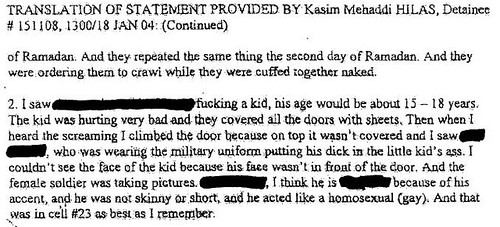
Abu Graib Scandal Returns to Horrible Life

The latest.

25 July 2005 Events in Iraq and in the Region

Tel Aviv. Cabalistic curse placed on Ariel Sharon. Yossef Dayan, an extremist Israeli rabbi, layed a Cabalistic curse of pulsa de-nura ("whip of fire") on Ariel Sharon to prevent the evacuation of Jewish settlements in the Gaza Strip. Dayan had been threatening to invoke the curse for more than a year. The ceremony was conducted in the cemetery of Rosh Pinna, in Upper Galilee, in the presence of 10 rabbis. It was a poignant ceremony, said Dayan. We had moments of apprehension when one of the participants raised doubts on the Jewishness of Sharon." (The curse only works on Jews). We have only to wait and see if our prayers will be answered. A similar ceremony was organized against Labour Prime Minister Yitzhak Rabin a few weeks before his assassination. Already on Sunday Sharon was forced to publically deny reports that he had had a heart attack.

London. Friends and family of slain Brazilian electrician Jean Charles de Menezes want to know how exactly police ordered him to halt and why he wasn't arrested during the 15-minute bus ride to Stockwell Station. An independent commission has already questioned a hundred witnesses.

Jerusalem. Israel is putting the final touches on planned evacuation from the Gaza Strip. The evacuation will not be phased and a massive troop deployment of 60,000 is envisioned beginning 17 August. A portion of the troops will be involved in evacuation operations while others will be charged with maintaining order. The evacuation is to last three weeks. 5,000 Palestinian police will also be deployed to prevent militants from attacking the evacuees and Palestinian President Mahmoud Abbas will move his residence to the Gaza Strip.

Ramallah. Palestinian President Mahmoud Abbas confirms that Israeli still has not furnished a reply on several key questions concerning the Gaza Strip evacuation, notably the reopening of Gaza Airport and unfettered passage between the West Bank and Gaza.

Gaza. Israeli Army arrests 10 Palestinian militants, including nine members of Islamic Jihad.

Paris. Sharon favorable to a role for France in the settlement of the Palestinian crisis. Sharon is in France until Friday. Meanwhile spokesman Michael Jankelowitz of the Jewish Agency announced that several hundred French Jews would resettle in Israel this summer.

Cairo. Arab League to call an extraordinary summit on the Palestinian question. Secretary-General Amr Moussa announces a plan to discuss the Israeli evacuation from Gaza and its follow-up. The summit will be held within the next two weeks.

Milan. Preliminary Investigating Magistrate Chiara Nobili of Milan has issued arrest warrants for US CIA agents responsible for the kidnapping of a Muslim cleric, Abu Omar. Eliana Castaldo, Victor Castellano, John Thomas Gurley, James Robert Kirkland, Anne Lidia Jenkins and Brenda Liliana Ibanez were named in the warrants. A total of 19 warrants have been issued.

Baghdad. Sunni members of the constitutional drafting commission are expected to return to the body after a meeting held by all Sunni factions, said Salim Abdallah of the Islamic Party. Sunni members have several demands following the assassination of two of their colleagues last Tuesday.

Baghdad. Australian Premier John Howard made a surprise visit to Baghdad to meet with Premier Ibrahim al-Jaafari.

Algiers. Algeria has evacuated its diplomatic staff from Baghdad. Meanwhile the Interior Ministry announced that two suspects arrested in the kidnapping of two Algerians diplomats are being questioned.

Baghdad. The draft Iraqi Constitution will make it impossible for Iraqi Jews to recover their nationality, said Monzer al-Fazel, a Kurdish member of the drafting committee. Jews in Iraq numbere, 134 000 in 1948 but most (more than 123,000) left in 1952. Twenty years later their numbers had dwindles to 500. However, the Constitution will permit Iraqis to hold dual nationalty, forbidden by Saddam Hussein.

Baghdad. The Iraqi Special Tribunal questioned six lieutenants of Saddam Hussein: The dictator's half-brothers Watban and Barzan Ibrahim Hassan al-Tikriti, ex-Vice President Taha Yassine Ramadan, his cousin Ali Hassan al-Majid, Ahmad Hussein Khodeir al-Samarraï and Samir al-Aziz al-Najm, Chairman of the Baath Party.

Stockholm. Sweden has refused to serve as venue for the trial of Saddam Hussein or to hold the Iraqi ex-President in its jails.

23:56 Baghdad. Al-Qaeda condemns Iraqi Constitution: Drafting the constitution is the worst of the initiatives against Islam....It is a baseless lie to affirm that elections constitute the best solution to save the Sunnis from the crisis.

23:56 Sharm al-Sheikh. Armed clashes took place between Egyptian police and Bedouin tribesmen. 25 Bedouins were arrested in the el-Rouwaisat hills. The authorities were attempting to retrace the itinerary of two vehicles used in the resort bombings and suspect that the bombers came from Ras Sidr on the western side of the Sinai Peninsula. The Egyptian Interior Minister denied an earlier report by sources close to Israeli security that six Pakistanis were sought in the bombings. Arab television was also reporting that nine Pakistanis had stayed in local hotels after entering Egypt with false Jordanian passports. A spokesman for the Pakistani embassy in Cairo told Reuters that his government has requested more information. The Pakistani Foreign Ministry in Islamabad had expressed doubt on the involvement of Pakistani nationals in the bombings, for which reponsibility was claimed by two Islamist movements: the Mujahedeen of Egypt and the Abdullah al-Azzam Brigades.

22:44 Sharm al-Sheikh. Egyptian police are looking for six Pakistani's suspected in the bombings at the Red Sea resort. [Yeah right. They're probably minimum wage housekeeping staff. The Bedouins wouldn't give them the time of day.--Nur]. Security forces conducted a raid in a mountainous area near the Bedouin communities of Khouroum and el-Ruwaisat, 30 km from Sharm al-Sheikh, where authorities claimed the Pakistanis were hiding. The suspects are Rashid Ali, 26, Mohammed Anwar, 30, Mohammed Ikhtar, 30, Tasadaq Hussein, 18, and Mohammed Aref, 36. A sixth man may have been killed in the bomb blasts. The bombers used more than 600 kg of explosives and used an Isuzu pickup truck.

22:43 Washington. Iraq's police service has accepted recruits with criminal backgrounds and even insurgents planning terrorist attacks because of poor vetting procedures, according to a U.S. government report released on Monday. The 96-page report, based on a study by the Pentagon and State Department Inspector Generals' offices, said that too many recruits were "marginally literate" and some had reported for training with criminal records and physical handicaps. The formation of an effective police force is a mainstay of the U.S. strategy for making Iraq increasingly self-reliant in combating the insurgency. As of 18 July, 65.000 police have been trained by the Coalition. The training budget is thought to be $510 million in 2005 and $566 million in 2006.

23:37 Washington. U.S. President George W. Bush has chosen two key Iraq policy advisers to serve as America's envoys to Israel and Egypt. Richard Jones, who currently serves as the Secretary of State's senior advisor and policy coordinator on Iraq, will be nominated as ambassador to Israel, the White House said. Jones previously served as deputy administrator for the Coalition Provisional Authority in Baghdad. The White House said Bush also intended to nominate Francis Ricciardone, who helped set up the U.S. embassy in Baghdad and served as special coordinator for the transition, as the U.S. ambassador to Egypt.

23:03 London. UK will pay an indemnity to the family of Jean Charles de Menezes. During a press conference with Brazilian Foreign Minister Celso Amorim, Jack Straw also announced that the remains will soon be transferred to the de Menezes family.

22:49 Stockholm. Saddam wants a change of venue for trial. Lawyer Giovanni di Stefano, a member of of Saddam's legal team, says he has forwarded a request to the Iraqi government and the United Nations. However, Premier Jaafari has excluded moving the trial outside the country.

22:32 London. Eight out of ten British Muslims believe that the decision by Tony Blair to participate in military operations in Iraq is one of the reasons behind the London terrorist attacks. However, the vast majority believe that the wave of suicide attacks in unjustified.

22:17 Hollywood. A TV series on the War on Iraq will premier on the FX Channel. The series is produced by Steve Bochco who financed "Hill Street Blues" and "NYPD Blue". FX is part of the Fox News Corporation. This is the first time a serialized dramatization of an ongoing conflict will be aired on US television.

22:04 Umm Qasr. Hundreds of Iraqis destroyed a metal and concrete barrier installed by Kuwaiti authorities inside Iraqi territory. Hundreds of Iraqis rallied at city hall in Umm Qasr before leaving to dismantle the barrier installed 100 meters north of the official border. Kuwaiti border guards deployed along the frontier pointed their weapons at the demonstrators but did not open fire. Kuwait has started construction of a metal barrier to replace a 3-meter high wall of sand marking the 200 km frontier. Kuwaiti Interior Minister Nawaf al-Ahmad al-Sabah ordered authorities to accelerate the construction of a high-tech security system to monitor the frontier with Iraq.

21:29 Neve Dekalim (Israel). Jewish settlers threw scrunched-up garbage bags in the face of Israel's top army rabbi on Monday in protest at his visit to discuss removing graves during the planned Gaza Strip pullout.

21:09 Baghdad. A group linked to al-Qaeda has published the photo and ID of the kidnapped Algerian charge d'affaires

19:10 Rome. Italian Senate approves 350 million euro measure extending Italian military mission in Iraq until 31 December 2005

18:48 London. Investigation by Independent commission reveals that the Brazilian executed in Stockwell Station was shot 8 times. 7 bullets in the head and 1 to the shoulder.

18:46 London. Jack Straw cautiously backpedals from Tony Blair's position on no link between terrorism in London to the war in Iraq: "It is not possible to affirm" that there is no link between the London terrorist attacks and the British presence in Iraq.

18:31 Rome. Pope Benedict XVI prayed for the deaths, destruction and suffering in Egypt, Turkey, Iraq and the UK during yesterday's Angelus. The Israeli Embassy protested because there was no mention of Israel.

16:08 London. Scotland Yard says 5 bombs were prepared on 21 July.

13:46 Samarra. US soldier killed by roadside bomb.

10:44 Fort Knox. An Indiana national guardsman charged with murder in the death of an Iraqi police officer pleaded guilty at his court-martial Monday to a lesser charge of negligent homicide. Cpl. Dustin Berg, 22, testified that he felt he did not properly assess the threat that he faced and acted rashly. Berg, who changed his story multiple times for investigators, initially said the Iraqi police officer had pointed an AK-47 at him to prevent Berg from reporting insurgent activity. On Monday, however, Berg said that Iraqi police officers as a matter of habit carried their guns with the barrels pointed slightly upward.

08:30 Suicide carbomb rams a patrol of Iraqi police special forces in south Baghdad, killing two and wounding eleven.

06:16 Suicide minibus rams the hotel al-Sadeer, killing 12 and wounding 16. The hotel is commonly used by American and foreign security contractors.

Sunday, July 24, 2005

24 July Events in Iraq and in the Region.

London. The transportation sector trade union, RMT, reports that a Tube motorman was threatened at gunpoint by British security forces.

Baghdad. Iraqi police infiltrated by rebels. Time Magazine reports fact.

Damascus. Syria sends 60 tons of humanitarian aid to Iraq, including food, tents, blankets and medical supplies.

Sharm el-Sheikh. The recent bombings have hurt both the regime of Mubarek and the Opposition, say political analysts. Nabil Abdel Fattah of the al-Ahram Center for Strategic Studies said that the attacks aimed to discredit the Egyptian régime by challenging its capacity to ensure its own security at a time when Egypt pretends that it is the regional guarantor of security. Egypt has entered the scene as an indespensible mediator between Israel and the Palestinian Authority, particularly in the approach of the mid-August Israeli evacuation from Gaza. Reacting to the bombings, Israeli Parliamentary Foreign Affairs and Defense Committee Chairman Youval Steiniz says the attacks represent a major failure of Egyptian intelligence services. The Saudi newspaper Saudi Gazette wrote that the bombers wished to disrupt the 7 September presidential elections. Egyptian analyst Diaa Rashwan confirmed that the bombings would have a negative impact on the vote. This attack by virtue of its size is unique in Egyptian history. It will have a major impact on the political life of the country. The regime now has every reason to maintain the State of Emergency. This is intimidating for the Opposition and negative for democracy. Rifaat al-Said, chairman of the opposition party Tagammou (leftist), said that the Islamists have caused democracy to fail and have handed the government a reason to reinforce the state of emergency.

Jerusalem. Israeli Prime Minister Ariel Sharon has threatened the Palestinians with new military measures following an ambush which killed a Jewish couple. However, after talks in Ramallah, Condoleezza Rice announced that there should be no lock-down of the Gaza Strip following the evacuation. Meanwhile, Israeli Foreign Minister Sylvan Shalom has blamed the Palestinian Authority for the attack.

Jerusalem. Talks between Palestinians and Israelis collapse. Talks on the Gaza evacuation between Israeli Defense Minister Shaoul Mofaz and Palestinian Interior Minister Nasr Youssef have produced nothing and have failed, says Tawfik Abu Khussa, a Palestinian spokesman.

Jerusalem. Sharon denies that he is ill. Sorry, but I am as fit as a fiddle, said Sharon concerning rumors of his ill health.

Damascus. Syrian Transport Minister Makram Obeid says the delay in crossing the frontier by commerical truck traffic is a "pseudocrisis". Meanwhile, the Syrian press denounces Lebanese politicians who have "insulted Syria".

Damascus. The Syrian Transport Minister, Makram Obeid, asserting that the "security of Syria is sacred", said that trucks from Lebanon are undergoing both customs and security searches. Obeid added that contacts were underway between the Lebanese carrier, Middle East Airlines, and Syrian Airways aiming at privatization.

Beirut. The Bekaa Agricultural Association says farmers are collectively losing $1 million per day due to the slow pace of inspections at the Syrian border.

Beirut. The largest Palestinian refugee camp in south Lebanon, Aïn el Héloué, home to 50,000 Palestinians, has blocked access to the camp to protest the recent control on the comings and goings of residents carried out by the Lebanese military. Camp residents set fire to tires and stopped traffic for three hours. Security around the camp was imposed following the attempted assassination of Élias Murr. Mr. Murr said in a television interview that he was in possession of information proving the terrorists sought by law enforcement are inside the camp.

Ar Rutbah. A US marine was killed by a bomb near the Jordanian frontier.

Baghdad. Sunnis appear to wish to return to the Constitution draftting committee, which they have boycotted since Thursday.

Baghdad. Iraqi President Jalal Talabani announced that security measures would be boosted for members of the Constitution drafting committee.

Baghdad. Americans and Iraqis have formed a joint committee to establish the criteria for a US pullout, said US Ambassador Zalmay Khalilzad. The chaiman of the committee is Mouaffak al-Roubaï, Iraqi Security Advisor.

23:12 Jerusalem. Prime Minister Ariel Sharon threated the Palestinians with "a new military type of reply" following an attack on an Israeli couple at the Kissoufim crossing in the Gaza Strip.

21:47 Jerusalem. Israeli Prime Minister Ariel Sharon denounced what he consideres to be an attempted takeover by extremists in the Palestinian territories at a conference in Afoula in northern Israel.

21:31 Washington. The new Saudi Ambassador to the United States, Turki al-Faisal, said that the Iraqi government must do more itself to secure its frontiers.

21:34 Najaf. Abu Salam al-Kubaisi of the Committee of Iraqi Ulema met with Shi'ite leader Moqtada al-Sadr and announced that Iraqis cannot freely draft a Constitution while US troops are present in the country.

21:29 Balad. A Task Force Liberty soldier was killed and two others wounded by mortar fire directed at their base.

20:46 London. Police apologize but firestorm continues over death of Brazilian. The mea culpa of Scotland Yard has not mollified Brazilian anger at the death of Jean Charles de Meneze. Meanwhile dozens of Brazilians residing in Britain demonstrated in front of Scotland Yard demanding justice.

20:35 London. The Brazilian government has requested the details concerning the death of Jean Charles de Menezes, 27, executed by police. Brazilian Foreign Minister Celso Amorim says the UK government has pledged a full investigation.

20:19 Sharm al-Sheikh. Residents demonstrate against bombing.

20:09 London. British security forces make another arrest in the area of Tulse Hill.

18:28 London. Police carried out a controlled explosion of a suspect package in west London.

18:03 Islamabad. Pakistani authorities arrest 210 persons in connection with the 7 July London bombings.

16:16 Baghdad. At least 40 people have been killed by a suicide bomber who blew up a truck laden with explosives at a police station. More than 30, mostly civilians, were injured in the blast in the eastern al-Mashtal area. The explosion was so powerful that body parts were thrown onto the roofs of adjacent buildings. The blast - which came in the middle of a sandstorm - left a giant blackened crater at the scene. 25 parked cars were demolished.

15:19 Cairo. A homemade bomb exploded in Cairo, wounding the Eqyptian who was transporting it in the Qerdassa district in the south of the capital.

12:22 London. Scotland Yard apologizes for the death [execution] of a Brazilian electrician at the Stockwell Tube station.

09:48 Haswa. A roadside bomb exploded near an Iraqi checkpoint, kiling a child and wounding six civilians travelling in a minibus.

09:38 Baghdad. A police official and a patrolman were shot dead by insurgents.

Failure of Condoleeza Rice's Near East Mission

Condi's humiliating Middle East tour resulting in shambles will likely not discussed in the US press. Not since Richard Nixon's 1958 tour of South America during which he faced rioting, rock-throwing mobs in Peru and Venezuela has there been a more violent and discourteous treatment of a high-ranking US official. Here is my take on nine disastrous and damaging incidents:

1) Sudan security toughs rough up her press entourage in Khartoum, including the wife of the Chairman of the Federal Reserve Board, Andrea Mitchell.

2) Sharon convokes Condi to his 600-acre Negev Desert ranch, The Sycamores, where Condi is placed in the proper psychological setting to be "sicced" by Sharon's mastiffs. She will negotiate a big fat nothing. Among several points of intransigence, Sharon will refuse to evacuate the promised four settlements on the West Bank and to return to the Road Map negotiations.

3) This is where Defense Minister Rice Shaul Mofaz says no deal to easing controls of Palestinians travelling from the West Bank to Gaza.

4) Condi's announcement with fanfare of an international summit to follow the Gaza Strip evacuation fades to silence.

5) The scorching Condi received while sequestered among Sharon's thugs prompts her to "do a Rummy". (When Donald Rumsfeld is pee-ohed, he grabs the nearest military transport heading for Iraq for a "surprise" visit.) Condi makes totally unplanned and unannounced 7-hour visit to Beirut. Now, we can't really think the visit was meant to support Emile Lahoud and the new Lebanese cabinet of Fuad Siniora, can we? Because it wasn't. Condi needed to convince herself that she can indeed talk tough. So she flew to Beirut to strongarm that new government at the Sérail to dump the Hezbollah Minister of Electric and Water Resources--or see the US will scrub that $5 billion loan. In all likelihood, Lebanese politicians said "No" to to dumping Hezbollah. Condi also got in some Syria bashing. Feel the power! S-s-s-s-s-s-yria is a badass-s-s-s-s-s-s.

As Condoleezza was about to raise her cudgel on Hezbollah and Syria during a public press conference, Mrs. Rice was cut short by Prime Minister Fuad Siniora:
  • Hezbollah: I would like to remind everyone that Lebanon, thoughout its history, has respected international law and will continue to do so. Everyone knows very well that UN Resolution 1559 contains some clauses which have been already implemented and others which require resolution from inside Lebanon within the framework of national unity and dialog. There will be serious debate among Lebanon's different political parties...This requires patience and understanding.
  • Syria: We are determined to cultivate healty relations between [our country and Syria] and to promote financial and trade relations which are mutually beneficial.
Siniora outclassed Rice by his smooth rhetoric loaded implication. He is a man who believes in democracy.

But then like clockwork, a carbomb strikes the upscale Monnot quarter and wounds 12.

6) Returning to Palestine, Rice shows up empty-handed in Ramallah. She was to have conveyed the Israeli reply on the Gaza airport, seaport and border and security arrangements. [Sharon made a separate, illegal security deal with Egypt, BTW, in violation of the fundamental Camp David accords]. She had absolutely nothing. Just the ususal rhetoric about rounding up Hamas agitators, which by this time must be half the country.

7) But there was one proposal! Rice's suggestion to Palestinians to purchase Israeli-owned greenhouses in the Gaza Strip with US money. But this proposal was shot down. How do you make a legal purchase of illegal structures?, the Palestinians wanted to know.

8) Farewell salvo: The Sharm el-Sheikh bombings.

In the background, it appears to me that Condi's boss, George W. Bush, is balking at the Israeli suggestion that he should pay the $1.7 billion pricetag for the Gaza Strip evacuation, including demolitions (dynamiting the roads, utilities, synagogues, mikvahs and settler housing), disposing of rubble and debris, contruction of new military bases within Israel proper, and alternative luxury housing for the settlers. An astronomical figure like that makes the $200 million granted to the Palestinians by Congress and personally lobbied by Bush very look paltry.

And the President himself? Mrs. Rice's trip is a crucial and ill-timed failure that will have nefarious upshots. Condi had been publically announced to be Bush's personal representative for the Israel-Palestine crisis, beyond her Cabinet status. She achieved nothing and left the region in humiliation.

We should all take heed. A weakened US government has been destabilized.

Shoot-to-kill-to-protect

That little gem is from a character named Lord Stevens.

Let us frame things: Mr. Menezes was pinned, immobilized, to the ground by ununiformed police.

My town is famous for justifying murder by police. Last week our local police shot dead a 13 year old girl (black, of course) for "menacing" them with a can of spray paint. An acquaintance of mine remarked that town police use more deadly force than that permitted to the US miltary. That's saying something! Unnecessary force coupled with the perverse attitude of absolving the police from inappropriate conduct and action has its champions in Britain, too:

London Mayor Ken Livingstone absolves police: This tragedy has added another victim to the toll of deaths for which the terrorists bear responsibility.

Glen Smyth: Police officers in these circumstances are expected to make split-second decisions that have life-long consequences.

Home Office washes its hands: It was an operational matter for the police.

As to the police work required to nab suicide bombers, these people don't just get up in the morning and say, Gee it's a great day to bomb the London Underground. I think I'll get that suicide vest out of the basement! No, no, no! They discuss. They plan. They use stealth. Their plot evolves incrementally, over months and sometimes years. What is needed is human intelligence--within the community. Not a gang of cops in scruffy plain clothes from the suburbs profiling dark-skinned urban men attired in baggy outfits and then shooting them in the head point-blank--a nice little recommended tactic from Israel and a convenient endrun around Britain's long-standing legal tradition of habeas corpus.

Update: Did Tony Blair really say this? "Our men will continue, if necessary, to shoot suicide bombers, aiming for the head. But, shooting them in another part of the body is okay too, if it keeps them from carrying out their deadly mission." What kind of dumbass micromanaging is that? The point is, the headshot is Israeli operating procedure adopted by Operation Kratos allegedly used to prevent a suicide bomber from detonating his payload. (Not that it has ever been very successful). I should like to inform Mr. Blair that the error is the hysterical, profiled, and circumstantial grounds on which deadly force is used.

Saturday, July 23, 2005

Lawless Britain

A hapless dark-skinned fellow, racially and religiously profiled in an economically profiled neighborhood from a profiled tenement wearing bulky attire profiled for suicide bombing, was Executed in Public by five bullets to the brain by plainclothes police in the Stockwell Underground Station in London on Thursday. In a crowd of dozens of onlookers. It turns out that the young man, a Brazilian electrician, was innocent.

This particular variant of "law enforcement" the headshot, is borrowed from Israel. It's drawn from "Operation Kratos", where a suspect is shot in the head on the chance that he might be wearing a suicide vest. It allegedly is meant to prevent detonation.

Update 3: From La Repubbica:

The victim was in no way connected to the London bombings. Neither was he a terrorist nor carried explosives on his person. British police have admitted that the man killed in the Underground station at Stockwell had nothing to do with the deaths and climate of fear in London. A tragic error has occured. British law enforcement has expressed regret but this is unsufficient to quell public debate.

The police directorate is looking into a case of professional misconduct while an independent commission is investigating in order to understand how it was possible that a person--who perhaps had something to hide because he fled from police [plainclothes police!--Nur]--was murdered with five bullets fired a point blank to the head in the presences of dozens of terrified bystanders.

The victim is Brazilian. Scotland Yard has confirmed his identity after the man's cousin came forward. He is Jean Charles de Menezes, 27, an electrician from Minas Gerais, Brazel. His cousin, Maria Alves, said that de Menezes had been working--fully documented--for five years in London

It is a tragedy that someone lost his life in this way, and the police express their regret, said a British police communique. We are now certain that he was not connected with the bombings of 21 July. The dynamics of the event are as follows: The man exited a home in Tulse Hill which was under surveillance as part of the 21 July bombings investigation. He was tailed to the Underground station by metropolitan police. His attire and behavior raised the suspicions of the police.

Yesterday the head of London police, Ian Blair, announced that the shooting was "directly linked to the terrorism investigation" but many questions were being asked immediately after the episode, which acutely raised tensions in London.

The man was "iced" according to the dictates of Operation Kratos, which grants the anti-terrorism team licence to kill possible bombers. But the man who was killed has no explosives on his person.

In a country where weapons are carried only by certain elite police unites (like SO-19, which was involved in the Stockwell Station shooting) and where persons killed by police is a rarity, the shooting has caused a great deal of consternation and the admission of the error will inflame public debate, especially within the Muslim Community.

Azzam Tamimi, the spokesman for the Association of British Muslims, has demanded a change in instructions to police. This should happen. The directive to shoot to kill is very dangerous. For Iqbal Sacranie, Secretary-General of the Council of British Muslims, While we accept the fact that the police are under tremendous pressure to capture the criminals who wish to bomb the streets of London, it is absolutely vital to insure that innocents are not killed by an excess of zeal.

For Myriam Ibrahim, spokesperson for Muslim Public Affairs Committee, The police are working in a moment of crisis and we would prefer not to criticize them. However, we live in a country where one is innocent until proven guilty.

Update 2: The victim was a Brazilian national working as an electrician in Britain for the past three years.

Update: And these dark comment from posters @ Atrios' Eschaton:

  • It's the grand new policy of pre-emption. How do we know he wouldn't be a terrorist someday?
  • So it's Israeli (and now British) cowboy policy to go for the headshot? Against the CW (aim for the center of mass) of LEA worldwide? And at a moving target? In a crowd? Oy!

23 July Events in Iraq

Baghdad. An Interior Ministry employee was gunned down.

Baghdad. Body of a 50 year-old man, bound and bullet-riddled, was found outside the capital.

Baghdad. The body of the brother of two kidnapped and slain police was recovered.

Beirut. Several hurt in Beirut car blast. Several people have been injured in an explosion on a street in the Lebanese capital by a bomb placed under a car near Rue Monot. The street, filled with restaurants and nightclubs, has a bustling nightlife. The explosion came hours after US Secretary of State Condoleezza Rice left the city after a brief, unannounced visit.

23:59. Sharm el-Sheikh. 35 arrested by Egyptian authorities in dragnet on Sinai peninsula.

23:35 London. Scotland Yard admits execution of a Brazilian electrician in the Stockwell Underground station was an error.

23:30 Jerusalem. In her visit to the Middle East, US Secretary of State Condoleezza Rice relayed a concern expressed by Palestininans by demanding that the Gaza Strip not be isolated following the Israeli pullout. "We want to see links between Gaza and the West Bank so that Palestinians may enjoy openness and freedom of movement." However, no agreement was reached concerning such links.

23:27 Gaza. Armed Palestinian militants shot dead an Israeli couple at the Kissoufim passage used by settlers of Goush Katif as US Secretary of State concluded her visit to the region. Meanwhile, three Israelis were wounded in a mortar attack less than two kilometers from the checkpoint.

22:05 Dubai. Video released by group linked to Abu Musab al-Zarqawi showing execution of Egyptian charge d'affaires Ihab al-Sharif by his kidnappers. The video also makes reference to the Israeli presence on the Sinai Peninsula and an "agreement" between Egypt and Israeli to divide up the peninsula into four sectors, including a visa-free area accessible to foreigners and Israelis.

21:21 London. Several Muslim organizations express indigation at the execution of a man by British police in the Stockwell Underground station. The Islamic Commission on Human Rights, The Muslim Council of Britain and the Muslim Association of Britain express concern at slaying based on suspicion.

21:09 Istanbul. Two dead in restaurant explosion near the historic Galata Bridge.

21:02 Jerusalem. Egypt and Israel will conclude an agreement next week nfor the deployment of 750 Egyptian border guards in the Gaza Strip near the Palestinian city of Rafah. Sharon is said to have spoken about it with US Secretary of State Condoleezza Rice during her visit to Sharon's estate, The Sycamores. [This deployment is illegal per the Camp David accords--Nur].

19:29 London. British police conduct raid in southwest London.

18:25 London. A man shot in the head five times by police in the Stockwell Underground Station had nothing to do with the failed bombings of 21 July 05.

17:52 London. Police cordon off Wormwood Scrubs park because of a suspect package.

13:07 Baghdad. Al-Qaeda claims credit in kidnapping of Algian diplomat Ali Belaroussi and another embassy member, kidnapped from a restaurant in the al-Mansur district where they were dining.

12:19 London. Chinese yuan rises after London's 21 July failed bombings. Chinese revaluation of their currency also causes a $1.52 increase in the price of light crude per barrel (now at $58.00) and a $1.82 increase in Brent (now at $57.58 per barrel).

12:07 Sharm el-Sheikh. Death toll rises to 83.

12:00 Moscow. Putin decries bombing attacks "on the civilized world."

11:58 Olbia (Sardinia). Former Premier Jose' Maria Aznar is on vacation along the Costa Smeralda and a guest of Silvio Berlusconi at his sprawling estate, La Certosa. Aznar arrived Thursday with his family. [Guess Berlusconi wants to poke Zapatero, who is declared persona non grata in Washington, in the eye.--Nur]

11:24 Sharm el-Sheikh. "The Martyr Abdullah Azzam Brigades" have claimed credit for the resort bombings. Meanwhile Egyptian authorities are rounding up Beduins suspected of involvement in the bombings. [See Juan Cole's site for details and analysis--Nur].

10:35 Karma. Three police killed by rebels near Fallujah.

12:16 London: Mile End Underground Station evacuated after unidentified "incident".

12:08 Baghdad. Indian businessman kidnapped.

10:26 Sharm el-Sheikh. Death toll in bombings rises to 75. [I would like to editorialize here. Following the Indian Ocean tsunamis, the press carried photos of vacationers sunning themselves as soon as the dead were carted off the beach. This seemed callous, incredibly self-centered and totally oblivious to the magnitude of tragedy. Well, today there are busloads of Israeli tourists at the crossing into Egypt heading for Sharm el-Sheikh for a vacation, despite the carnage. What a prevalent, hard-hearted attitude: Who cares? As long as I get mine!]

08:29 Washington. Bush administration opposes prisoner treatment legislation. A bill is before US Congress outlawing "cruel, inhuman or degrading" treatment and encouraging Red Cross monitoring of prision conditions". To head off passage of the bill, Vice President Dick Cheney has met with Republican legislators Sen. John Warner of Virginia, Sen. John McCain of Arizona [He should have a vested interest, wouldn't you say?--Nur] and Lindsay Graham of South Carolina, all members of the Senate Armed Services Committee.

07:22 London. In a report in the Times, police claim suicide bombers may have access to a "dirty bomb" using biological, chemical or nuclear components.

07:14 Sharm el-Sheikh. At least 50 are dead and 200 wounded in a series of attacks targeting outdoor markets and hotels in the resort town of Sharm el-Sheikh. A suicide carbomb was driven into the lobby of the Hotel Ghazala Gardens - Naama Bay, killing French, Dutch, Qatari, Kuwaiti, Egyptian, British, Spanish, Saudi, Ukranian, Russian tourists. Shocked survivors described scenes of deflagration and body parts lying in the street. A bomb in a cafe in the resort's souk killed several Egyptian workers.

04:02 Washington. A growing number of Americans fear the war in Iraq is undermining the fight against terrorism and raising the risk of terrorist attacks in the United States, a poll found. Almost half, 47 percent, say the war in Iraq has hurt the fight against terrorism _ the highest number to say that since the war began in March 2003, according to the Pew Research Center for the People & the Press.

Friday, July 22, 2005

22 July Events in Iraq

Amman. Iraqi Foreign Minister Hoshyar Zebari met with accredited Arab and Asian ambassadors to Iraq to discuss the security situation for foreign missions in Baghdad.

Baghdad. Two police commandos shot dead.

Baghdad. Two civilians killed by a roadside bomb south of the capital.

Washington. Pentagon paints uncertain picture for Congress. The Pentagon presented a confidential list of needs for securing Iraq to US Congress, with no mention of a possible end to the US military mission there. Its report on the readiness of Iraqi troops was vague.

Ankara. Turkey presses Syrian to enforce border security. Abdullah Gül, Turkish Minister for Foreign Affairs, delivered the message to Walid Mouallem, Deputy Syrian Foreign Minister, in Ankara.

Baghdad. Saddam Hussein questioned on crimes against Shi'a Kurds, the Failis, committed in the early 80's. Al-Arabiya aired a video of the interrogation. Saddam Hussein responded to the charges by accusing the current government of being a puppet of the Americans.

Baghdad. Gunmen reportedly opened fire on a car carrying a newlywed couple and family in the Dora area of the city.

Baghdad. Three police officers were killed in two separate shootings - one in the Ghadeer neighbourhood, the other in the eastern Baladiyat district. Three more officers directing traffic were then killed in nearby Mashtal.

Baghdad. The bodies of two policemen, who were brothers, were discovered east of the capital. They were shot through the chest and head, having been taken from their home by gunmen on Thursday.

Latifiya. Two civilians are reported to have been killed by a bomb explosion that was aimed at but missed a police convoy.

Algiers. The Algerian foreign ministry has said it is doing all it can to free its two diplomats kidnapped in Baghdad on Thursday. But a spokesman said there had been no claim of responsibility for the kidnap and it was still unknown who was behind it. Chargé d’affaires Ali Belaroussi, 62, and Azzedin Belkadi, 47, were kidnapped by armed men as they were in their car 100 meters from the embassy.

21:18 Aden. Shopkeepers have closed their businesses in this south Yemen port city out of fear of looting by rioters protesting the hike in gasoline prices.

15:51 London. Underground train drivers prepared to go on strike. Hundreds of tube drivers refused to go to work citing fear of terrorist attacks. Bobby Law, spokesman for the Railway and Maritime Transit Workers, says train operators stopped work "out of fear for their lives."

15:32 Fallujah. A US Marine was killed by a homemade bomb.

15:29 Stockholm. A Swedish national of Lebanese origin, Osama Abdullah Kassir, suspected of links to the July 7 London bombings has promised "punishment" to Sweden should he be extradited to Britain.

15:51 Baghdad. A prominent Sunni Arab cleric Friday denounced Kurdish proposals to transform Iraq into a federal state as a plot to deny other Iraqis «our wealth and resources.» «There are conspiracies being prepared to deny us our wealth and resourses,» Sheik Mahmoud al-Sumaidaie told worshippers during a sermon at the Umm al-Qura mosque.

15:42 Damascus. Syria claims its border guards have been fired on by U.S. and Iraqi troops and has accused the United States and Britain of failing to give it required equipment to keep insurgents from crossing from here into Iraq. Syrian Deputy Foreign Minister Walid al-Moualem said Syrian border guards had been fired on «not only by infiltrators but by U.S. and Iraqi forces.» It cited «about 100 armed clashes, some of which were carried out by American soldiers who opened fire randomly on those present near the (sand) barrier as a result of losing control,» said the statement.

14:37 Tikrit. No friends or relatives were present at the tombs of Saddam Hussein's sons Udaï, Qussaï and his grandson Mustafa, on the anniversay of their death in a siege of their residence in Mossul. We cannot go because we're afraid that the Americans have installed hidden cameras in the graveyard and plan on arresting us, said Ahmad al-Khattab, a cousin.

14:22 Rome. Foreign Minister Gianfranco Fini dismisses the equation Islam = terrorism.

13:54 Beirut. US Secretary of State Condoleezza Rice made a surprise noonday visit to Beirut. Rice called on Saad Hariri, leader of the largest coalition in Lebanese parliament. She then visited the tomb of Rafik Hariri, following by talks with President Emile Lahoud, pro-syrien.

13:17 London. British police confirm that its agents have killed a man in the Stockwell underground station.

12:49 London. Report of bomb at a mosque in Whitechapel was a hoax. Police had evacutated the area.

10:29 Samarra. Four dead, including police and insurgents, in clashes. Eleven are wounded.

09:49 Beijing. The explosive used in the 7 July London bombings was not of Chinese manufacture, says Chinese Foreign Ministry.

09:37 Jerusalem. U.S. Secretary of State Condoleezza Rice flew by helicopter for talks at Sharon's ranch in southern Israel. Sharon's office said the two also discussed U.S. aid to help pay for the withdrawal. The Jewish state is seeking hundreds of millions of dollars to help relocate army bases and develop regions where many of the settlers are likely to be moved. [$1.2 billion, to be precise--Nur]. A senior U.S. official denied Israeli media reports that Rice had proposed a summit to bring together Israel and Arab countries after the pullout, saying the U.S. focus after the withdrawal would be on revitalising the road map.

09:03 Baghdad. At least five people were killed in two separate attacks in which automatic weapons fired from speeding cars. Assailants opened fire on a police patrol car in the western district of al-Baladayat, killing two police and wounding a third. A half-hour later in the same neighborhood, another policeman was killed behind the wheel of his patrol car; two bystanders were also killed.

08:41 Baghdad. Attack on police patrol gravely wounds one.

06:34 Washington. US Treasury blocks funds of six nephews of Saddam Hussein. Six sons of Sabawi Ibrahim Hasan al-Tikriti, the step-brother of Saddam Hussein, have had their assets frozen on the grounds that they support the insurgency in Iraq.

Wednesday, July 20, 2005

20 July 2005 Events in Iraq

London. The Mayor of London, Ken Livingston, says Western meddling in Middle Eastern affairs is behind the terrorist attacks.

London. UK government proposes international conference on combatting religious extremism.

Canberra. The Mufti of Australia supports expulsion of radical Islamists. Sheikh Taj al-din al- Hilali tells the newspaper, The Australian, that radical Islamists are worse than AIDS.

Rome. Prodi against suspension of the Schengen Accords. Italian opposition leader Romano Prodi opposes suspension of Schenger Accords: The experience of London shows us that there are other solutions.

Paris. Radical imams under surveillance in France. French intelligence is monitoring a dozen radical imams in that country.

Washington. Congressional Republicans asked to codify the current detention policy for prisoners in Guantanamo

New York. UN freezes accounts of Saudi exile group. The UN has frozen the accounts of the Movement for the Reform of Islam in Saudi Arabia, headquartered in London.

Riyadh. The US embassy says it has information on "planned attacks" targeting US citizens in Saudi Arabia.

Jerusalem. The Israeli Knesset rejected several requests for delay of the Gaza pullout.

Khartoum. Condoleezza Rice says that time is running out for making preparations for the Israeli evacuation of Gaza.

Gaza. Seven people were killed in gunfire between Hamas and Fatah near the residences of Security Chief Rashid Abu Shbak and Fatah official Abdallah Franji.

Baghdad. The draft of the new Iraqi Constitution will be presented to Parliament in August, says Houmam Hammoudi, chairman of the drafting committee, saying that President Jalal Talabani and Premier Ibrahim Jaafari received an initial draft yesterday. Meanwhile, The New York Times reports that the new Constitution will severly limit women's rights.

Mosul. A policeman was killed by gunmen

Baghdad. Iraqi government protests reports on deaths of civilians. Oxford Research Group and Iraq Body Count claim that more civilians have been killed by the Multinational Force than by the insurgency.

London. Blair says Iraq is not headed towards civil war. UK Prime MInster Tony Blair has rejected statesment that Iraq is headed for civil war during Question Time in the House of Commons. Jordanian Prince Hassan, the paternal uncle of King Abdallah II, told the BBC yesterday that "civil war has begun in Iraq."

Baghdad. Egyptian diplomat may still be alive. Egyptian telecommunications magnate Naguib Sawiris believes that Egyptian chargé d’affaires Ihab esh-Shérifmay still be alive. Cairo confirms that his body has never been found.

Arbil. The PKK is prepared to face the Turkish Army should it enter Iraq. PKK rebels are ready to transform northern Iraq into "hell on earth" should Turkey lauch a cross-border operation to defeat them. We have a certain degree of tolerance for the moment, but we cannot continue like this forever, said Turkey Prime Minister Recep Tayyip Erdogan during an official visit to Mongolia. "We must put the PKK problem behind us", he continued. Erdogan believes that international law would authorize a Turkish incursion into northern Iraq as legitimate self-defense against the PKK.

Baghdad. At least eight recruits were killed and 26 wounded when a suicide bomber wearing a bomb vest entered a recruiting center in Mouthanna on Wednesday morning.

Samarra. An Iraqi solider was killed and four others wounded during clashes with insurgents.

Balad. One rebel was killed and two Iraqi soldiers were wounded.

Touz. A truck driver was killed and seven escorts were wounded when two bomb blasts targeted a convoy transporting supplies for the Iraqi Army.

Baiji. Three customers at a gas station were killed and two employees wounded when fights broke out over who was first at the pump.

Dour. An Iraqi businessman, Hadi Saad, 38, working for the US Army was kidnapped in front of his residence.

Moussayeb. Two insurgents suspected in last week's bombing which killed 83 and wounded 151 were killed and a third arrested.

Basrah. Hussein al-Daraji, a member of the Shi'ite Fadhila (Virtue) Party and assistant to the mayor, was shot dead by gunmen who entered his office.

15:18 London. The charges field on Tuesday against three British soldiers for war crimes is only the "tip of the iceberg, says a lawyer for the victims. Lord Goldsmith has said that eight other soliders, including a retired colonel, will face court-martial in the same affair. Donald Payne, 34, a corporal of the Queen's Lancashire Regiment is charged with the murder of Iraqi prisoner Baha Moussa, who died while in the custody of British forces in September 2003 in Basrah. Corporal Wayne Crowcroft, 21, and Soldier Second Class Darren Fallon, 22, both members of the First Batallion, Queen's Lancashire Regiment, are charged with prisoner abutse. General Geoffrey Sheldon of the Queen's Lancashire Regiment says the murder of ,Baha Moussa was a "tragic incident when never should have happened." Among the accused is Col. Jorge Mendonca, who intiated the inquest into the death of Moussa.

15:11 Baghdad. Arrest warrant for Mayor of Baghdad. Ala'a Al Timini is under arrest for adminsitrative corruption and financial fraud, says a report by Radio Nawa.

11:25 Baghdad. Three minutes of silence in the National Assembly commemorating the childrend killed last week in a bombing.

10:15 Baghdad. Sunnis quit committee drafting the Constitution. Four Sunnis have decided to quit the Constitutional Committee. A spokesman for the Sunni political movement, National Iraqi Dialog, says they will longer attend committee meetings.

08:41 Baghdad. Oil pipeline sabotaged north of Baghdad. Guerrillas attacked a pipeline supplying a power station north of Baghdad with mortar rounds.

02:21 Gaza. Cease-fire concluded between Hamas and al-Fatah.

Monday, July 18, 2005

18 July 2005 Events in Iraq and In the Region

London. Experts believe that security raids on Londonstan has resulted in an exodus of radical Islamic preaching to the Internet. The international Jihadist movement and the exiled opposition have adapted to the beefing up of the arsenal of laws and repression put in place since 9-11. In the 1990s British intelligence knew perfectly well that London served as a base to individuals engaged in the promotion, financing and preparation of terrorism in the Middle East and elsewhere, says a report by Chatham house. Nevertheless these individuals were not considered to be a threat for internal British security and were left to pursue their activities with relative impunity. "Since the closing of the Finsbury Park mosque, activists have regrouped in informal circles, study groups and youth centers, says Magnus Ranstorp of St. Andrews University.

Beirut. UN Special Representative Terjé Roed-Larsen invited Hezbolla to integrate itself into the Lebanese Army.

Teheran. Iranian Foriegn Minister Kamal Kharazi asked Iraq to try Saddam Hussein for crimes against the Islamic Republic, including the use of chemical weapons.

Brussels. The European Council of Foreign Ministers called on Syria to support the newly-elected government in Lebanon and to permit transit throught its territory of Lebanese goods. The following items were contained in the Council's communiqué:
-Reaffirmation of the importance of total adherence to UNSC Resolution 1559
-Forceful condemnation of all assassinations since October 2004.
-Request for full and constructive relations between Lebanon and Syria.
-Readiness to assist in Lebanese political and economic reform.
-Insistence on the disarming of Lebanese militias.
-Expression of concern over the recent attack by Hezbollah along the Blue Line.

Cairo. Hosni Mubarak to run for Egyptian President in the 7 September elections. The Electoral Commission will meet on Sunday to decide the deadline for candidate registration. Five persons had previously announced their intention to run: Ayman Nour, Chairman of the center-left al-Ghad Party; Talaat el-Sadat, nephew of Anwar el-Sadat; jailed activist Abboud al-Zoumor; Egyptian-American Saadeddin Ibrahim, Director of the Ibn Khaldoun Center for the Defense of Human Rights, (he will be barred from running due to his dual nationality) and a woman, Nawal Saadawi, who threw in the towel yesterday saying whe would not participate in the "parody of an election."

Karachi. Pakistani President Musharraf accuses madrassas of involvement in terrorism. Meanwhile, the Minister for Religious Affairs, Mohammad Ejaz ul-Haq, said madrasses in violation of Pakistan's education laws would be closed. Pakistani security has been given a list of phone numbers called from the UK by those responsible for the London bombings but have come up with little useful information. Six individuals were questioned after a list of calls made by Shehzad Tanweer was handed to Pakistan.

London. Youssef al-Qardawi, an influential Qatari cleric of Egyptian origin will be in London on 7 August for a conference on Islam. Mr. al-Qardawi is forbidden to enter the United States.

London: An Afghan warlord has been found guilty of a "heinous" campaign of torture and hostage taking in his homeland after a landmark case at the Old Bailey. Faryadi Zardad, 42, of Streatham, south London, was convicted in a retrial of pursuing a reign of fear at Afghan checkpoints between 1991 and 1996. It is thought to be the first time a foreign national has been convicted in a UK court for crimes committed abroad.

Berlin. Chairman of the U.S. Joint Chiefs of Staff, Gen. Richard Myers, said a recent spike in suicide bombings wouldn't derail the drafting of a constitution or progress toward democracy. But he warned of more violence ahead.

Baghdad. Al-Qaeda in Iraq reported that one of its «field commanders» had been killed by coalition forces in western Iraq. The statement did not say when the man, Abi Salih al-Ansar, was killed.

Najaf. Following a weekend meeting with al-Sistani in Najaf, Vice President Adil Abdul-Mahdi, a top Shiite politician, said the cleric had urged the government to protect the people in «this genocidal war.»

Amman. Iraq's Planning Minister Barham Salih criticized the shortfall in donations pledged by foreign countries to rebuild his country, telling a global reconstruction conference that most aid had been spent on security. Of $32 billion in loans and grants pledged two years ago, Iraq has received only $7 billion.

Rawah. A car bomb targeted U.S. and Iraqi troops in Rawah, northwest of Baghdad. At least one person, believed to have been a civilian, was killed.

Baghdad. Eight policemen died in a gunbattle with insurgents in Khadra district in the west of the capital.

Baghdad. Three civilian government employees were killed in separate ambushes.

Taji. A policeman died in a shootout between insurgents and security forces.

Samarra. Gunmen killed a police colonel, an Interior Ministry official and three Iraqi soldiers in a series of attacks.

Mosul. Gunmen killed two Iraqi soldiers in eastern Mosul and assassinated Abdul-Ghani al-Naimi, whose brother is a member of the Iraqi parliament.

Ramadi. A U.S. Marine died in a non-hostile incident on Sunday at a U.S. base. At least 1,766 members of the U.S. military have died since the beginning of the Iraq war in March 2003.

Baghdad. New offensive against the insurgents in Baghdad. Operation Thunder began last week on the west side of the Tigris River, which divides the city. 50 suspected insurgents, including two Syrians, were captured in the opening days of the operation, which will be expanded over the next few days.

23:59 Washington. Experts testify before Congress. Retired General Barry McCaffrey tells Congress that the insurrection will "peak" in six months and that the US will inevitably being to withdraw its troops within a year. Anthony Cordesman testified that the next 6 to 18 months would be a crucial test of failure or success of current stategy. Cordesman said the odds were 50-50. Kenneth Pollack of the Brookings Institution said that by prioritizing counterinsurgency actions, the US would progressively win terrain and sap the courage of the rebels.

23:50 Beirut. Christian and Shi'ite Muslim gunmen exchanged fire across Beirut's old Green Line on Monday, wounding at least three people, security sources said. The violence began when sticks and rocks were used in fighting between members of the Shi'ite Amal movement and Maronite supporters of former warlord Samir Geagea.

23:45 New York. U.N. Secretary-General Kofi Annan's special adviser for North Korea, Canadian businessman Maurice Strong, has not had his contract renewed amid investigations about his ties to a suspect in the scandal-tainted oil-for-food program.

23:37 Baghdad. 18 people (7 police, 8 troops, a Turkish truck driver and three civilians were killed and another 12 wounded in a series of attacks by insurgents.

23:30 Moqtada Sadr grants an interview to BBC. Sadr has appealed for calm after a wave of suicide bombings killed scores of people across Iraq. In an interview with BBC television broadcast on Monday, the cleric said the Iraqi people had the right to fight U.S.-led forces, but urged them to show restraint. I believe America does not want confrontation, so I call on the Iraqi people to exercise restraint and not get enmeshed in the plans of the West or the plans of the occupation that wants to provoke them, Sadr said. The cleric also appeared to defend armed attacks against the U.S.-led forces in Iraq. Resistance is legitimate at all levels, be it religious, intellectual and so on, Sadr said. The first person who would acknowledge this is the so-called American President (George W.) Bush who said, if my country is occupied, I will fight.

22:26 Baghdad. The World Bank said it would unblock $500 million in credits for Iraq for the first time since 1973.

22:15 Damascus. Syria vowed to do its utmost to pursue good ties with Iraq, an apparent response an Iraqi minister's accusations it was doing too little to prevent militants crossing their shared border. The vow followed comments to the media by Iraqi Interior Bayan Jabor in which he accused Syria of not making a serious effort to prevent insurgents from crossing into Iraq.

23:13 Amman. A lawyer for Saddam Hussein says Iraq's insurgency has made Baghdad far too dangerous a venue for the former leader's trial, and that the proceedings should be moved to another country. «Do you fancy spending a year or more in Baghdad, going to court five days a week? Would you feel safe there?, lawyer Giovanni di Stefano said in an interview with The Associated Press on Monday. «Baghdad couldn't even prevent the recent kidnapping and killing of the Egyptian ambassador. There are also many Iraqis who want to see Saddam executed and many others who want to see him freed. That means the defense and prosecution would both be in danger there,» di Stefano said. He said Saddam's defense team has contacted the Swedish government about the possibility of holding such a trial in Sweden. But in Stockholm on Monday, Swedish Justice Ministry spokesman Alexander Valentin said that he was not aware of any official request.

22:02 Gaza. Thousands of right-wing Israeli demonstrators begin a march towards the main settlement block in the Gaza Strip, Netivot, defying 20,000 Israeli police and troops. Meanwhile, two Israeli soliders shot dead a Palestinian at a checkpoint in the southern Gaza Strip.

22:01 Beirut. A powerful blast was heard inside a radical pro-Syrian Palestinian base in eastern Lebanon. The explosion occurred in side a base belonging to the Popular Front for the Liberation of Palestine.

16:41 Amman. Two lawyers for Saddam Hussein say that his trial is unlikely to take place before autumn. Iraqi legal procedure requires 45 days after formal charges have been laid before hearnings may take place. Emmanuel Ludot and Giovanni Di Stefano say they have received no trial documents or notices. Raid Juhi, chief judge of the tribunal, announced that charges have been filed against Saddam for the 25 year-old massacre of an estimated 150 Shiites in Dujail, 50 miles (80 kilometers) north of Baghdad. However, Mr. Ludot observed that "The first trial is a trial baloon to see how the resistance reacts". The defense team believes that Iraq's government now has 7,000 witness statements and 2 million documents related to the prosecution of Saddam, none of which have been shared with the defense.

16:33 Mashhad (Iran). Supreme Guide Ayatollah Ali Khamenei accused US troops of causing great harm to Iraqis and other peoples of the region as he received Iraqi visiting Premier Ibrahim Jaafari in the holy city of Mashhad. Many Muslims and Islamic countires are unhappy with US actions in Iraq, said Khamenei to al-Jafaari. The first priority for the Islamic Republic of Iran is to see an independent, united, stable and prosperous Iraq. But there is a desire to prevent the establishment of stability in Iraq which we see at work in blind terrorism and other actions likely planned by Zionists. Khamenei asked Jaafari to support the cause of Palestine, an important axis of the Islamic world despite the actions of the United States against it.

16:32 Damascus. Syria frees nine fisherman arrested yesterday for fishing in Syrian territorial waters.

16:24 Salaheddin. Kurdistan's two leaders, Jalil Talabani and Massoud Barzani, again insisted on the annexation of Kirkuk to their super-province, saying that they would made the city a "model of coexistence."

16:01 Beirut. Samir Geagea was granted amnesty by the Lebanese Parliament after serving 11 years in prison. Geagea was a warlord allied with Israel and an opponent of Syria. Samir Geagea was a politico-military cadre within the Forces Libanaises (FL), founded by Bashir Jamayel. Geagea was sentenced to prison in 1994 on charges of setting off a bomb inside a church, killing 11 people.

14:40 Brussels. Foreign Minister Jack Straw rejected an analysis by Chatham House sayting that the war in Iraq has made Britain more vulnerable to terrorism. Defence Minister John Reed also rejected the analysis, saying Britian had been targeted by Islamic terrorist well before the invasion. Meanwhile, Interior Minister Charles Clarke is consulting with the opposition on a set of new anti-terrorism laws which will include criminalization of three activities: design of products or techniques for terroristic purposes, indirect incitation to terrorism, and participation in the planning of acts of terrorism.

14:21 Islamabad. Afghanistan Justice Project has issued a report in Kabul on "warcrimes and crimes against humanity" committed in Afghanistan between 1978 and 2001. Several men accused in the report are still in power. In 170 pages, the report details unpunished "incidents in which high-ranking officers and commanders ordered actions amounting to war crimes" yet ordinary people are still threatened by these men. The crimes consist of summary executions, rape, disappearanced, systematic destruction of property, etc. Among the names mentioned are Vice President Karim Khalili; Abdul Rasul Sayyaf, Advisor to President Hamid Karzaï ; Abdul Rashid Dostom, a high-ranking Defense Ministry official; General Baba Jan, Police Chief of Kabul; and "Marshal" Fahim, former Vice President and Defense Minister who is now enjoying a comfortable retirement in Kabul. One of the more cruel incidents is the Qala-i-Janghi massacre in 2001 and the death by suffocation of hundreds of Taliban fighters taken prisoner by General Dostum which was ignored by the Americans. The US Army is also mentioned in the report for the use of torture and secret prisons.

10:45 New York. The Pakistani Ambassador to the United Nations, Munir Akram, says that Britain should reflect on its errors rather than to blame other countries for the London bombings of July 7.

The Shiite Crescent

Today's editorial in Le Monde says King Abdullah's fears of a Shiite crescent in the region are overblown:

Are the fears expressed by Sunni monarch King Abdallah II of Jordan of increasing instability in the Middle East caused by the emergence of a “Shiite crescent”, dominated by Iraq and Iran, being realized? It is too early to say. But the “historic” visit to Teheran by Iraqi Premier Ibrahim al-Jaafari, the only Shiite head of government outside of Iran, was a spectacular demonstration of warming relations between the two countries, who from 1980 to 1988 fought a pitiless war in which more than a million people died.

Shortly after his invasion of Kuwait in August 1990, condemned as military aggression by Teheran, Saddam Hussein made a half-hearted attempt to reestablish diplomatic relations with his large neighbor but only at the level of chargé d'affaires and with plenty of reciprocal acrimony. In March 2003, Teheran condemned the US invasion of Iraq for its illegality while observing the fall of the “impious” Ba’athist regime from the sidelines of declared neutrality--but not without a certain amount of satisfaction. In November 2003, a year and a half later, Iran was one of the first nations to recognize the Provisional Governing Council put in place by the Americans and dispatched its first ambassador to Baghdad since 1980. Since then, normalization between the two regional powers has only accelerated.

Normalization with Iran was imposed on the US occupier by Ayatollah Ali al-Sistani, the spiritual guide for Iraq’s Shi’ite majority. Iranian by birth, Ayatollah al-Sistani is nevertheless regarded with circumspection by the leaders of the Islamic Republic because he opposes “a cleric-led government.” Iran supported the Iraqi elections in January and welcomed the ascent to power of its Shiite “brethren,” who had long lived in exile--many of whom in Iran. Ibrahim al-Jaafari himself spent half of his 20-year exile in Teheran before going to London.

Today in Baghdad power is dominated by the Shi’a. A minority among Muslims worldwide (an estimated 25% of all Muslims), the Shi’a are numerous in Lebanon and in Bahrain. With the knowledge that the Shi’a account for an important share of minorities elsewhere, the fears of Sunni regimes are understandable fearful. But perhaps unnecessarily.

Iran and Iraq are not yet ready to begin discussions towards a formal peace treaty. There remain many issues to be settled between the two nations. But history between 1980 and 1988 has shown that a shared religion among the Arab Shi’a of Iraq and the Persian Shi’a of Iran does not prevent them from engaging in warfare. While 90% of all Iranian combatants in the war was Shi’a, so were three-quarters of middle ranking officers in Iraq.

A rapprochement and a warming of relations have certainly taken place. But if Iraq is able to avoid civil war, ancient Mesopotamia would not appear to be on the eve of surrendering its interests and its nationalism to an alliance of religion with its neighbor.

Sunday, July 17, 2005

Terror and Injustice

This article was published the other day by L'Orient-Le Jour:

Experts and Muslim spokesmen say that those responsible for the bombings in London, as in Madrid or New York, were propelled by a sentiment of injustice and that their motives are more political than religious. While unequivocally condeming the use of blind violence, these observers believe that in order to defeat the terrorists, it is crucial to understand their motives, which are dominated by anger and frustation towards the West.

We must investigate what pushed these persons to undertake such actions and how they came to hate the West to such a degree, comments Imran Wahid, representative of radical Islamist Hizbi Tahrir in Great Britain. Islam forbids the murder of civilians, but these events (the London bombings) have occured in a specific context. The reality is that last week 200 Afgan civilians were killed (..) –this did not produce four times more pain and anguish than for fifty civilians in London, said Wahid.

François Burgat of France’s Centre National de la Recherche Scientifique, one of the most respected French experts of the modern Arab world, has the following to say: The state of mind in the Arab street is rather homogenous : everyone shares a profound sentiment of injustice and resentment against the several and vascillating pressures on them exerted by the West. This goes for 95% of the Arab population. Reason No. 1 for the radicalization of the current generation is Palestine and the refusal by the international community to enforce rules which it says are universal against Israel. Reason No. 2 is Iraq. First, the Iraqi children who died as a result of the embargo and then in the war. Reason No. 3 is Western support for the maintenance in power of regimes seen as illegitimate.

The Islamist rhetoric of Osama Bin Laden is less important than political demands, says reporter Robert Fisk, one of the rare Westerners to have interviewed the world’s most wanted man. They are trying to push British public opinion towards forcing Tony Blair out of Iraq, out of the alliance with the United States and out of his support for Bush policies in the Middle East. It’s easy for Tony Blair to call the bombings barbaric but how many civilians were killed in the Anglo-American invasion of Iraq? Or children decapitated by cluster bombs? When they die, they’re only collateral damage. When we die, we’re victims of barbaric acts of terrorism. Osama bin Laden said in a recent video : «If you bomb our cities, we will bomb yours, says Fisk. Just before the US presidential elections, Bin Laden said, « Ask yourselves why we don’t target Sweden. »

For Ghayasuddin Siddiqui, Speaker of the Muslim Parliament of Britain, the keyword is injustice. There is an immovable sentiment that injustices have been committed against Muslims in Palestine, Chechnya and elsewhere. And there are ghettos in those countries. If we don’t resolve the social alienation of our youth, it will be possible for demogogues within our own communities to exploit them for their own aims.

17 July 2005 Events in Iraq and in the Region

Tel Aviv. Israeli newspaper Maariv, citing sources within Israeli intelligence, reports that Mohammed Sidique Khan, responsible for the bombing at the Edgware Road Underground station in London (7 dead), was in Tel-Aviv where he assisted in the prepartions of a 2003 bombing of a bar in that city.

Brussels. The political stalemate in Lebanon will be discussed in a meeting of EU foreign ministers.

Washington. National Security Council Spokesman Frederik L. Jones II accuses Damascus of undermining the Lebanese economy by blocking exports through Syria. Hundreds of trucks transporting manufactured and agricultural goods to Syria, Iraq and the Gulf States are held up on the Syrian frontier for "security" searches.

Amman. Commercial traffic between Jordan and Syria has been held up at the Syrian border for "security searches."

Damascus. Syrian Coast Guard arrests five Lebanese fishermen for "fishing in Syrian territorial waters."

Beirut. Washington has held discussions with one of Lebanese Hezbollah's closest allies, outgoing Labour and Agricultural Minister Trad Hamadi. Hamadi has met several times with senior State Department officials as well as with Jeffrey Feltman, US Ambassador to Lebanon. This is considered to be an end-run around Washington's official "no contact" position vis-a-vis Hezbollah. The Bush Adminstration has threatened to boycott Lebanon and place the country on the list of nations refusing to cooperate in the War on Terror if any ministerial positions in the new government are handed to Lebanese Hezbollah. Washington also insists that Hezbollah militias be disarmed.

Baghdad. Suicide car bombing kills two police and one civilian in east Baghdad. Thirteen others were wounded.

Baghdad. Suicide carbomb targets police convoy in south Baghdad. Three police and four civilians were killed and three civilians wounded.

Madrid. The Zapatero government will place restrictions on cellphones. Communications companies will be required to archive calls for one year, reports El Pais. Of 39 million cellphones in Spain, 15 million use anonymous prepaid phone cards. In Europe, so far only Sweden demands a form of identity for the purchase of airtime.

Baghdad. Five persons including a police commando were killed and seven civilians wounded in a suicide bombing in west Baghdad.

Kan Sara. A suicide bomber targeted an elections office southeast of Baghdad.

Baghdad. Six persons, including two soldiers and two truck drivers were killed in separate ambushes north of the capital. Meanwhile, the bodies of three truck drivers were recoverd.

Baghdad. Two US soldiers were killed and two others wounded by a suicide carbomb north of the capital on Saturday.

Baghdad. Iraqi Parliament announces one minute of silence on Wednesday for the victims of Saturday's Moussayeb carbombing.

Teheran. Premier al-Jafaari signs a number of deals as Iran promises to do everything possible for reconstruction and security in Iraq. Iran will cooperate with Iraq in intelligence-sharing and border monitoring, said Iraqi Foreign Minister Hoshyar Zebari. Ten ministers accompanied al-Jafaari to Teheran. Iraqi Oil Minister Ibrahim Bahr al-Ouloum says a memorandum concerning petroleum has been signed. A agreement for the supply of electric power from Iran has also been reached and several other protocols were initialed. Iran is to rebuild Najaf Airport and visas will no longer be required for commercial and passenger traffic between the two countries. Mr Jaafari, who is scheduled to leave on Monday, is expected to hold further talks with the president-elect of Iran Mahmoud Ahmadinejad, supreme leader Ayatollah Ali Khamenei and Foreign Minister Kamal Kharazi.

23:59. Baghdad. Moqtada al-Sadr says Iraqi resistance is legitimate in an interview with BBC. [US Historian Juan Cole says that Sadr is referring to Shi'a resistance only.]

23:50 Washington. Reporter Seymour Hersh published an article in the New Yorker saying that the Bush Administration issued secret instructions to influence the January Iraqi elections, over the objections of Congress. Hersh reports that the Bush Adminstration was worried about a Shi'a victory at the polls.

23:49 Balad. US soldier killed by a bomb blast in Balad. Two others were wounded.

23:40 Washington. Bush Adminstration attempted to subvert the January elections in Iraq through clandestine operations to prevent a Shi'a landslide, reports the New Yorker. The Bush Adminstration attempted to funnel money to Iyad Allawi and other Iraqi political figures considered close to Washington through NGOs but the NGOs balked and the State Department's Richard Armitage vetoed the plan. However, the White House issued a secret presidential finding authorizing the CIA to funnel money and give assistance to candidates throughout the Middle East who seek to "spread democracy". Iyad Allawi is thought to be the chief recipient. The New Yorker also reports that Democratic Whip Nancy Pelosi objected to the measure but was overridden by President Bush.

21:18 Paris. Prime Minister Dominique de Villepin has sent condolances to Iraqi Prime Minister Ibrahim al-Jaafari after yesterday's fuel truck suicide bombing in Moussayeb which killed more than 70 people.

21:02 Moscow. Russia will investigate delays in the construction of the Bouchehr nuclear facility in Iran and the disappearance of millions of dollars. Former Russian Atomic Energy Minister Evgueni Adamov is suspected of diverting funds.

23:58 London. The Chatham House and Economic and Social Research Council report says the invasion of Iraq has al-Qaeda: There is no doubt that the situation over Iraq has imposed particular difficulties for the UK, and for the wider coalition against terrorism....It has been a booster for al-Qaeda recruitment and fund-raising and has caused a rift within the Coalition.. A problem for the UK is that the British are conducting an anti-terrorism policy hand in hand with the United States, yet has no parity with Washington in decision-making; Britain is like a back seat passenger, leaving the driver's seat to its ally. The UK is in a particularly risky situation because it is a close ally of the United States and has deployed its army in campaigns in Afganistan and Iraq. The report was drafted by Paul Wilkinson, Chairman of the Terrorism Research Center at St. Andrew's University, and Frank Gregory of the University of Southhampton.

19:08 Cairo. The Grand Mufti of Egypt, Ali Gomaa, says Koranic ringtones for cellphones are "vulgar" and are prohibited.

18:42 Kabul. Arrests are made in the case of kidnapped Italian aid worker Clementina Cantoni.

18:27 Rome. The upcoming vote on refinancing the Italian contingent in Iraq will be a test of the foreign policy of the Berlusconi government.

16:58 Basrah. Oil exports will be halted for 24 hours due to a strike by 15,000 petroleum sector workers called against the Southern Oil Company.

16:11 Basrah. Oil export resume. A four-hour strike by petroleum sector workers halts oil exports for four hours.

15:51 Jerusalem. Ariel Sharon repeats that he has ordered Israeli armed forces to attack Palestinian terrorists "without restrictions."

15:35 Kusadasi (Turkey). PKK denies reponsibility for the bombing of minibus at a seaside resort. Another group, the Falcons for the Liberation of Kurdistan has also denied responsibility.

14:53 Gaza. Hamas claims credit for mortar attack on Neweh Deqalim, a Jewish settlement in the Gaza Strip. Meanwhile, two Qassam II rockets were fired at Sderot.

13:42 Jerusalem. Mortar rounds fired by Palestinians wounded eight Israelis in the Neve Dekalim settlement on the Gaza Strip.

12:54 Baghdad. Saddam Hussein will be tried "within a few days," says Raed Jouhi of the Iraqi Special Tribunal. The first charges will include then 1982 murder of Shi'ite residents of Doujail, a village north of Baghdad.

12:03 Mussayeb. Yesterday's suicide attack killed 98 and wounded 156.

10:37 Mahmoudiya: Six civilians killed in a fourth suicide attack this morning.

07:54 Baghdad. Two police commandos and one civilian were killed in the first of three suicide bombings. A police convoy was targeted. 13 others were wounded, including nine police.

07:00 Kirkuk. A US soldier died in a bomb blast in Kirkuk.

06:48 Kabul. Bomb blast wounds four US soliders.

03:32 Srinagar (India). 17 suspected Islamic terrorist arrested in Indian Kashmir.

00:06 The Hague. Hundreds of militants ready to strike. Dutch Interori Minister Johan Remkes says hundreds of Islamic radicals are prepared to strike Holland.

Saturday, July 16, 2005

16 July 2005 Events in Iraq and in the Region

Mosul. Carbomb at police barracks kills 4 police and wounds another 18.

Baghdad. Two suicide bombs killed a total of 11 persons, including 7 police and four civilians.

Balad. US Army clashes with insurgents.

Dhoulouiyah. A foreign truck driver was killed by a roadside bomb in a convoy under US escort.

23:57 London. One of the four suicide bombers responsible for the 7 July London bombings, Mohammad Sidique Khan, was under surveillance by MI5 in 2004.

23:45 London. Former minister Clare Short says there is no doubt that the London bombings are linked to the war in Iraq.

23:36 Washington. US Deputy Secretary of State for the Middle East David Welch says he hopes that Israel will withdraw "entirely" from the Gaza Strip.

23:22 Mussayib. At least 60 are dead and 85 wounded following a bombing near a Shi'ite mosque. A suicide bomber blew himself up next to a fuel truck outside a Shi'ite mosque. An immense fireball ensued, ravaging nearby homes and businesse and seriously damaging a mosque. Parents were seen throwing their children out the window to save them from the flames. The blast was followed by a mortar attack.

23:10 Jerusalem. 11 Palestinians killed and six Israelis killed in four days of violence.

22:01 Kingston (Jamaica). Nationality of fourth London suicide bomber confirmed. A spokesman for Jamaican Premier PJ Patterson says Germaine Lindsay was born in Jamaica.

21:11 Mussayib. Death toll ries to 58 dead in a suicide bombing near a Shi'ite mosque.

20:26 Mussayib. Death toll rises in attack on Shi'ite mosque in Baghdad. 54 are dead and 82 wounded.

19:54 Iskandariya. Fifth carbombing of the day. 10 dead and 20 wounded. A suicide bomber rammed a roadblock manned by Iraqi police and soldiers.

18:48 London. British security forces conduct new raids in north Leeds.

17:27 Kusadasi (Turkey). British tourist dies in aftermath of suicide bombing.

17:18 Teheran. Ibrahim Jaafari in in the Iranian capital for talks.

17:10 Moscow. Al-Qaeda No. 2 Ayman al-Zawahiri, was trained by the ex-KGM in 1998, says former agent Alexander Litvinenko, in an interview with the Polish daily Rzeczpospolita. [Now who's gonna believe a lie like that?--Nur]

16:37 Al-Iskandria . A suicide bomber kills 9--6 police and 3 civilians--south of Baghdad.

16:13 Warsaw. Poland exploring for oil in northern Iraq, reports financial daily, Varsavia Parkiet.

16:21 London. Three of the four suicide bombers responsible for the London bombings had been banished from the Leeds mosque, acccording to Razaq Raj, an academic at Metropolitan University of Leeds.

15:15 Kusadasi (Turkey). A suicide bombing gravely wounded 7 British tourists in northwest Turkey.

15:03 Teheran. Iran says it has arrested and expelled 3,000 suspected al-Qaeda members.

14:03 London. Oil under $60 per barrel.

14:26 London. It will soon be a crime to call a suicide bomber a "martyr" in a new series of anti-terrorism laws proposed by Labour.

14:07 Samarra. Two Iraqi soldiers killed by mortar rounds.

12:54 Jabalya. Third suicide bombing wounds 2 police and 4 civilians.

12:42 Kusadasi. Five British tourists were wounded in a suicide bombing targeting a minibus.

12:38 Kusadasi (Turkey). Two British nationals were among 14 wounded in a bombing at a coastal town on the Aegean.

12:28 Baghdad. A suicide bombing occured in a busy commerical district near Baghdad Airport.

11:49 Baghdad. Father and son shot dead. Akram Ahmed Rasul al-Bayati, one of Saddam Hussein's generals and one of his sons were shot dead in front of their home after their release from jail. Al-Bayati and his two sons were arrested last Sunday.

11:25 Leeds. Investigators concentrate efforts on a youth club in Beeston, a Leeds suburb, where three of the four suicide bombers were recruited.

11:15 London. The parents of Mohammed Sidique Khan believe their son was "brainwashed."

10:50 Kirkuk. Three Iraqis were killed and two US soldiers were wounded by a bomb blast

09:04 Al-Amarra. Three British troops were killed in a rebel offensive in southern Iraq. The victims were part of Task Force Maysan within the First Battalion, Staffordshire regiment. The bomb exploded in the Al-Rissala quarter, a fief of Moqtada Sadr, who is hostile to the presence of foreign troops in Iraq. The Imam Husseïn Brigades claimed credit for the blast.

08:33 Baghdad. 11 US soldiers accused of violating the Military Code of Conduct. 11 Marines were relieved from duty for violating the US miltiary code during Operation Lighting pending an inquest.

Friday, July 15, 2005

15 July 2005 Events in Iraq and in the Region

Haswa. A suicide car bomb killed five Iraqi soldiers and one civilian and wounded 17 civilians in Haswa, 48 km. south of Baghdad, officials said.

Baquba. Gunmen killed three Iraqi policemen Friday at a checkpoint near Baquba, 56 km north of Baghdad.

Baghdad. During a Friday sermon at a mosque, a prominent Sunni cleric condemned the violence, especially the Wednesday suicide bombing that killed the 18 children. Sheik Ahmed Abdul Ghafour al-Samarrai, a moderate member of the Association of Muslim Scholars, called the attack Wednesday a «crime» but added that the Americans and their international partners share some of the blame. The (U.S.-led) occupation that has destroyed the country and turned things upside down is responsible for that, al-Samarrai said.

Baghdad. U.S. Maj. Gen. Joseph J. Taluto said the level of violence in his sector, which includes the key cities of Tikrit, Kirkuk and Samarra, remains about where it was prior to the January election.

Al-Sharqat. Two Iraqi soldiers were killed and a third wounded by a suicide carbombing at a checkpoint.

Latifiya. Three Iraqis were killed by unknown gunmen.

Samarra. Two persons were killed in clashes between rebels and US troope.

Bourhouz. Three police were killed and two wounded in clashes.

Teheran. Premier Ibrahim al-Jaafari starts an official visit to Iran to discuss water and power supply, as well as security.

Amman. Jordanian officials claim Islamists are training in Syria and that more and more foreign fighters are transiting through Syria.

Washington. Former CIA Director John Deutch tells the New York Times that the US should pull out of Iraq now and should renounce the use of its military strength to impose its will on other countries.

Washington. Pew Institute survey says most Muslim countries fear radical Islam. Morocco (73 %) and Pakistan (52 %) believe Islamism is a threat to their nations.

Baghdad. Mortar shells exploded near the headquarters of an Iraqi commando battalion in the Sunni neighborhood of Azamiyah of north Baghdad. Three mortars also fell across the Tigris River in the Shiite Kazimiyah district.

23:58 Cairo. Magdy al-Nashar, a chemistry student arrested in Egypt on suspicion of a connection to the London bombings, had no link to al-Qaeda, say Egyptian authorities.

23:45 Baghdad. Casuality toll mounts. At least 30 people were killed and 111 wounded in at least twelve car bombs and explosions in the capital.

23:23 Magdy Nashar, arrested in Cairo and questioned on his role in the London bombing, was an extremely pious chemistry student with no criminal record, reports the British press. His father, Mahmoud Nashar, worked for the civil engineering firm of Othman Ahmed Othman company, one of the largest Arab contracting firms in the Middle East, known among other things for constructing many missile bases, reports the Daily Telegraph. Egyptian Interior Minister Habib al-Adly said that Mr. Nashar had no link to al Qaeda in an interview with the Egyptian daily, al-Goumhouriyam. Mr. al-Adly said that information published about Nashar by the media was baseless and a result of "hasty conclusions."

23:10 Baghdad. Iraqi Interior Minister Bayan Jabr told al-Hurra TV that Abu Musab al-Zarqawi, was in Baghdad two weeks ago and escaped the capital.

23:05 Ottawa. Canada to send a contingent of 2,000 troops and special forces to Afghanistan over the next few months, says General Rick Hillier, chief of the defense staff.

22:22 Baghdad. 28 dead, including 17 soldiers and police, in 12 carbombings targeting security forces.

21:17 Kirkuk. Two suicide bombers were killed in Kirkuk as the bombs which they were transporting detonated prematurely.

20:52 London. Explosive used in London bombing was not of military orgin. BBC reports that the explosive used was homemade.

19:40 Jerusalaem. Premier Ariel Sharon says he is given the Israeli Army "carte blance" to combat Palestinian radicals.

19:02 Baghdad. Five corpses recovered. Five corpses, shot in the neck and wearing handcuffs, were found in the Maamel quarter of Baghdad. The victims are between 30 and 40 years of age. It is not known if they were Shi'a or Sunni.

19:24 Baghdad. Talabani escapes assassination attempt. President Jalal Talabani escaped a bomb placed on the Hussein Bridge. Three of bodyguards were killed and numerous bystanders wounded.

17:55. Baghdad. Three people were killed, including 2 police, and 36 wounded, including another 7 police, by a suicide carbomber who rammed an elite police detachment in the Bayaa of southwest Baghdad.

17:45 Baghdad. A suicide carbomber detonated his vehicle behind a US Humvee in the Amariyah quarter of west Baghdad while US soldiers were conducting house-to-house searches. An Iraqi civilian was kiiled and five others wounded.

17:05 Baghdad. 6 Iraqi police killed in west Baghdad when suicide carbomber rammed their patrol. Eleven others were wounded.

17:00 Balad. A suicide motorcycle bomb rammed an Iraqi military convoy, killing two soldiers and wounded two others, including a civilian.

14:00 Baghdad. A booby-trapped car exploded as a US convoy passed nearby in the Hay Hay al-Amanah quarter of southeast Baghdad. Three civilians were injured.

16:05 Rome. Injured Italians evacuated to Rome. Following a road accident near Nassiriya, Caporalmaggiore Valentino Michielotto and Caporalmaggiore Paolo Chiarillo were evacuated to Italy, along with the corpse of Sergente Davide Casagrante.

15:17 Nablus. Three Hamas militants were killed in a blast in an abandoned building near the town of Salfit.

14:54 Cairo. Magdi el-Nashar, said to have fabricated the bombs used in the London bombings, was arrested in Cairo, where he is being interrogaged.

14:48 Teheran. Ayatollah Ahmad Jannati, an ultraconservative and head of the Council of Guardians, says the real Taliban is Britain and the USA.

14:45 Gaza. Israel has begun construciton of two temporary military bases on the Gaza Strip.

14:37 Baghdad. A suicide car bomber detonated his vehicle at a checkpoint near an Iraqi army base in the ash-Shaab neighborhood of northern Baghdad. 8 Iraqis--civilians and security personnel--were killed and 20 others injured. Firefighters tried to douse the flames near one blast site which targetted Iraqi troops in the north of the city, where several cars were destroyed and bloodsoaked survivors argued with police. The (Iraqi) army vehicles were parking right here when a speeding Daewoo car approached and exploded. It split in two parts, eyewitness Raed Salman said. The bodies were too charred to immediately identify how many were Iraqi soldiers and how many civilians.

14:26 Leeds. British security forces find traces of an explosive, triacetone triperoxide, also known as TATP in a flat in Leeds. The explosive is of the same type as that used by shoebomber Richard Reid.

14:00 Baghdad. Two Iraqi soldiers were killed and 14 people wounded, including eight soldiers, when a suicide pick-up truck detonated at the entrance to the former Defense Ministry building in northern Baghdad. The building, in Baghdad's Old City, is now used as Camp Bab al-Mouadham. Smoking wreckage of cars was also visible at a blast site Iraqi troops ran around and gunshots could be heard after the blast. A US soldier was wounded in the attack.

13:43 Trebil. Two Marines were killed when their vehicle was hit by a roadside bomb near Trebil along Iraq's border with Jordan. The victims were assigned to Regimental Combat Team 2 of the 2nd Marine Division and were conducting combat operations at the time. In a separate incident in the remote western desert, U.S. Marines said two of their troops had died in a roadside bomb strike on Wednesday.

12:45 Baghdad. Two Iraqi soldiers died and six were wounded when a suicide attacker detonated a car bomb near an Iraqi patrol in Andalus Square in central Baghdad. Al-Qaida's wing in Iraq claimed responsibility.

12:25 Baghdad. Music store attacked. Masked radical Islamists attacked a music store, wounding 11 with gunfire.

12:00 Baghdad. A car bomb exploded near a U.S. convoy in the Rustamiyah (New Baghdad) area of southeastern Baghdad, injuring two Americans. Al-Qaida's wing in Iraq claimed responsibility. Eyewitness Basim Mohammed said he saw a car bomber ram an armored U.S. convoy at high speed, but saw no casualties.

09:26 Chicago. A young Marine, 19-year-old Moises Hernandez, who feared returning to Iraq persuaded his cousin to shoot him in the leg, then told police he was hit by random gang gunfire.

Thursday, July 14, 2005

The Niger Yellowcake Story: The Italian Version

This is the recounting of the compilation of the phony "Niger Yellowcake Dossier" from reporters who know their job and who recognize their necessary role in transparency: to expose the cynical machinations by government leaders which damage their nation and their citizens.

With the Joe Wilson story hitting the news again, I ask you to read the following article by Carlo Bonini and Giuseppe D’Avanzo published in the Rome newspaper, La Repubblica, on July 16, 2003. It's long, but do it*!

You will see why the Bush administration will stonewall on the Plame Affair. You see, Mrs. Plame's CIA role may have been revealed to reporters by her counterparts inside British or Italian intelligence keeping tabs on WMD in central Africa. That's right, from our own "Coalition Partners." Behind the Karl Rove and Plame Affair is a plot by three heads of government, Bush, Blair and Berlusconi, to deceive their nations, international institutions and world public opinion for their own cynical and immoral aims. Worse than Suez, worse than Gulf of Tonkin, worse than the Plain of Jars, worse than Watergate and worse than Iran-Contra.

Here It Is, Explained for You: the Phony Niger Dossier

This story, like a mundane spy thriller, begins with a burglary--the fifth-floor apartment in No. 10 Via Antonio Baiamonti in Rome’s Mazzini Quarter. The thick steel-plated door defends the offices of the Embassy of Niger. A gloomy corridor runs from the offices of the political attaché from that of the ambassador. On a night sometime between 29 December 2000 and 1 January 2001, the usual “persons unknown” are frantically searching for something, turning the embassy inside-out. Papers are strewn everywhere and file cabinets have been opened. When early on January 2, the Second Secretary for Administrative Affairs, Arfou Mounkaila, reports the theft to the Carabinieri in the Trionfale precinct, he admits that the burglars behaved bizarrely. A lot of ado and trouble for nothing. With the exception of a steel Breil watch and three small vials of perfume, the “thieves” took nothing. Or so it seemed. Today, if you stop by the embassy and ask a few questions about the curious theft, a courteous woman with a big smile will tell you this: It all began here, it all started with that break-in.

With the burglary in Via Baiamonti begins an affair which will end 24 months later--on 23 January 2003, with sixteen words pronounced by George W. Bush in his State of the Union address: …The British Government has learned that Saddam Hussein recently sought significant quantities of uranium from Africa … These words will suspend Bush over the Iraqgate abyss...or Nigergate, if you prefer. Either way, it is an affair which began in Italy, because it is in Rome where four events take place which will steer Bush in the direction of those rash words:
  • 1) It is SISMI [Servizio per le Informazioni e la Sicurezza Militare] (Italian Defense Intelligence Agency) that between October and November 2001 comes into contact with an African diplomat, who sells them the forged documents (six sheets) concerning the contraband of 500 tons of pure uranium each year, to be consigned by Niger to Iraq in two installments.
  • 2) It is in Rome that MI-6, British counterintelligence, comes into possession of these documents.
  • 3) It is SISMI, which, following the routine procedure, informs the Italian Prime Minister (through CESIS) [Comitato Esecutivo per i Servizi di Informazione e di Sicurezza, Executive Advisory Council on Military Intelligence and Security] and the Farnesina Palace [home to the Italian Foreign Ministry] (via confidential communication to the person of the Foreign Minister).
  • 4)It is the director of SISMI, Genereal Niccolò Pollari, who in November 2002 confirms to the Parliamentary Intelligence Oversight Committee that The service is in possession of documentation which provides evidence of the trade of pure uranium between a central African country and Iraq.
Italian military intelligence had been eavesdropping on the Via Baiamonti apartment for years. It has been so since 1983, when SISMI was able to get its hands on a bid for Niger uranium advanced by Saddam. Its eavesdropping work brought to light a hotline between Niger Ambassador Adamou Chekou (today advisor to Niger President Tandja Mamadou) and Iraqi diplomats in Rome, specifically with Wissam al-Zahawiah, Iraqi Ambassador to the Holy See. It is an “internal” espionage operation which synched up with reports issued by the “R” Division (Research) in charge of foreign intelligence operations. Italian intelligence, assisted British agents, was working on Weapons of Mass Destruction (WMD) dossier in Niamey, the capital of Niger.

These probes make a big stride forward between the last days of October 2001 and the beginning of November. A SISMI source tells the La Repubblica that within that time, an African country with an embassy in Rome contacted SISMI and offers a folder of documents which he deems will be extremely useful to our work. Inside the folder there are codebooks and correspondence concerning a shipment of uranium to Iraq by cargo ship via Lomè (Togo) from Cotonou in Benin (where the entire quantity of 2,900 tons of pure uranium extracted in 2000 from the Arlit and Akouta mines in Niger is stockpiled) and, most important, diplomatic documents:
  • 1) A telex dated 1 February 1999 from the Nigerois Ambassador in Rome, Chekou, to the Foreign Ministry in Niamey;
  • 2) A letter dated 30 July 1999 from the Foreign Ministry to the Embassy of Niger in Rome.
  • 3) A letter dated 27 July 2000 addressed to the President of the Republic of Niger.
  • 4) A “memorandum of understanding” between the governments of Niger and Iraq “concerning the supply of uranium as agreed on 5 and 6 July 2000 in Niamey”. The memorandum has a 2-page addendum entitled “Agreement.”
Italian intelligence acquires the document bundle as a “black box”. Or, if Foreign Minister Franco Frattini is to be believed (The Italian intelligence services never furnished any documentation whatsoever), perhaps it brokered the acquisition on behalf of the British of MI6. A clear-eyed glace at the documents screams forgery. As Seymour Hersh wrote on 31 March 2003 in the New Yorker:
One letter, dated October 10, 2000 [The article’s editor at La Repubblica identifies this as the "memorandum of understanding" between Niger and Iraq] was signed with the name of Allele Habibou, a [Niger] Minister of Foreign Affairs and Cooperation, who had been out of office since 1989. Another letter [Editor’s note: dated 27 July 2000][...] had [...] a text with inaccuracies so egregious [...] that 'they could be spotted by someone using Google on theInternet.
And it might also be added that 500 tons of pure uranium is a quantity so enormous that it would have arroused the suspicions of anyone familiar in any with that country and its ore. Then there was the letter dated 30 July 1999 which refers to a deal struck in Niamey 29 June 2000! Finally, the 27 July 2002 letter to the President of Niger is stamped and signed—by him!

When play is halted, one can be seen where the foul occurred. The diplomat who sells the documents is perfectly aware of eavesdropping (phone calls, fax, telex) by Italian intelligence at the Embassy of Niger. He therefore inserts as the first document in the bundle which he is to sell, telex No. 003/99/ABNI/Rome, addressed to the Niger Foreign Ministry. The telex reads:I should like to bring to your attention that the Iraqi Embassy to the Holy See informs me that His Excellency Wissam al- Zahawiah, Iraqi Ambassador to the Vatican, will make an official visit to our country in his capacity as the personal representative of Saddam, President of the Republic of Iraq. His Excellency will be arriving in Niamey….

The telex in question (which was intercepted) is already in the Niger dossier at SISMI headquarters in via Forte Braschi in Rome. The circumstance confirms to Italian intelligence agents that “the stuff is sound” –more or less reliable. Thus, the rest of the documents are considered “sound” as well, meaning the message dated 30 July requesting an “answer on the supply of uranium”, the confidential message of 27 July certifying the purchase agreement ((n[b0] 381-NI 2000) for 500 tons of uranium and, of course, the memorandum of understanding between the two governments seem to close the circle with an air of certainty--Baghdad has succeeded in obtaining uranium from Niger needed for the construction of weapons of extermination.

So now, back to Via Baiamonti at the offices of the Embassy of Niger, to ask the question: “Who fabricated the phony dossier?”

A number of circumstances suggest an initial answer. In winter 2002, the Ambassador of Niger to Rome, Chekou, is recalled to Niamey “for consultations.” He is expected to return to Italy but instead never sets foot in Italy again. Chekou is relieved of his post and on 2 December 2002 he is replaced by Mrs. Hadjio Abdoulmoumine, serving as chargé d’affaires and head of the Counselor Section. Is this a routine changeover? Or is it—as Repubblica’s intelligence source hints, the result of the discovery by the Government of Niger the some wrongdoing in its Rome embassy has occured? Niamey is convinced that the bizarre robbery of January 2001 was, in reality, merely the cover necessary for the removal of the stationery from Via Baiamonte needed to compile the phony dossier?

Back in Washington US intelligence, quoted yesterday [July 2003] by ABC television, is convinced that the Niger Embassy in Rome is behind the forgery. A low-level diplomat, says the interviewee on ABC, fabricated the phony dossier at the embassy then sold it to SISMI for a few thousand dollars. The same conviction is voiced on 22 March 2003 by a United Nations official interviewed by The Washington Post. The letters concerning the uranium trafficking were handed over to the Italians by a Nigerois diplomat.

Mrs. Hadjio Abdoulmoumine, who today is in charge of the Niger diplomatic mission in Rome, says it’s all fantasy: No member of the Niger diplomatic corps in Rome is behind the forgeries. It was Niger President Tandja Mamadou himself to convey a categorical denial to President Bush last week.

Be that as it may, two facts are certain: That it all began with a burglary in Via Baiamonti and that on 21 December 2002, not even two weeks after the changing of the changeover at the embassy, that the Niamey Government issues a stern communiqué concerning the suspicions that its government was engaged in uranium trafficking with Iraq: The American allegations amount to defamation. We have never considered selling uranium to Iraq. There was never any contract.

***

This brings us to a point in time between the end of 2001 and the first days of 2002--two decisive months. SISMI is familiar of the dossier and MI-6 is in possession of it. The British acquired the document bundle without inspection—says a source at Forte Braschi--but the origin was said to be trustworthy. No one should be surprised by the events surrounding that dossier. It was within the normal course of information sharing between allies. It was only to be expected that the material in question should lead to increased cooperation and intelligence-sharing with the British. There were several meetings, at the highest level, almost all of them in London. Despite this climate of facilitation, we do not know if it was the British who passed the stuff on to the CIA. It is highly likely. Custom has it that the British are under no obligation to tell us to whom they give the intelligence they share with us.

The confirmation that the British have informed Langley is found in a date. In February 2002, the ex-Ambassador of the United States to Gabon, Joseph Wilson, is dispatched by the CIA to Niger to verify the foundation of the uranium smuggling story received from the British. Wilson returns to Washington with a clear-cut answer. The story is unequivocally false.

These doubts are not conveyed to Italy, where the story still is still making the rounds. The story of Niamey-Baghdad uranium trafficking migrates from via Forte Baschi, headquarters of SISMI, to the seat of power in Rome. The analysts of the “Situation” Division (this group has contacts with foreign intelligence agencies and prepares nightly bulletins for the division chief) forwards its report on the Niger uranium. It is a concise memo: one page long, our source tells us. The memo does not indicate the how or why but includes the gist of the story (500 tons of Uranium has been purchased by Baghdad). It ends up on the CESIS desk in Palazzo Chigi [the Prime Minister’s office] and in the confidential correspondence of the Foreign Minister at Farnesina Palace. It is Farnesina Palace, says SISMI, which raises strong objections and disputes the information forwarded by Italian intelligence. The strongest misgivings are voiced by the Director of Sub-Saharan African Affairs through the highly regarded Bruno Cabras.

We are now in October and the head of SISMI, General Niccolò Pollari, testifies the first time before the Parliamentary Intelligence Oversight Committee. He’s vague. He ducks and weaves. He is intentionally taciturn on the circumstances surrounding the “uranium dossier” acquired by Rome and now in the hands of the British. He did, however, explain: We have no documentary evidence, but there are reports that a certain Central African country sold uranium to Iraq. Thirty days later the General has second thoughts. He makes a more explicit statement. He says there is “documentary evidence”. Again before the Parliamentary Intelligence Oversight Committee, he throws in a missing detail from his first testimony: We have documentary evidence of the purchase of raw uranium by Iraq from the central African republic. We also have knowledge of an Iraqi attempt to purchase centrifuges for uranium enrichment from German and possibly Italian industrial firms. Pollari does not overplay his hand. He’s prudent. He doesn’t paint a brightly colored picture of the ability of Baghdad to build an atomic weapon. The head of SISMI argues that, once having obtained the uranium and the centrifuges under the most favorable circumstances the Iraqis would need three, and probably five years, to produce a weapon of mass destruction using the enriched uranium in question.

In March of this year [The article is pubished in 2003], SISMI became alarmed. The IAEA, the International Atomic Energy Agency in Vienna, finally receives the documents constituting the “Niger dossier” from the Americans and examines the content. On 7 March, Mohamed El Baradei, Director-General of the IAEA, tells the UN Security Council: My agency, with the assistance of outside experts, has concluded that the documents in question are not authentic.

At SISMI headquarters in Via Forte Braschi, the atmosphere is hostile. Those who had viewed the documents bought from the African diplomat with suspicion and distrust begin to raise their heads after having kept them down in the aftermath the congratulations with which the intelligence was welcomed on the other side of the Atlantic. Those who had hyped the reliability of those documents begin seek an exit to escape the looming crisis on the outside which will inevitably produce a clash on the inside. As always happens in cases like this, a number of unconfirmed reconstructions seem, for the moment, to have been artfully crafted in order to raise a ruckus to deflect criticism and censure away from the intelligence services, laying the blame at the feet of political leaders.

Initial blame was cast at the role of President Berlusconi and second, at the activities of his diplomatic advisor, Giovanni Castellaneta. Let’s take a look.

According to sources at SISMI, it was the Italian Premier who confirmed the existence of a “uranium dossier” and above all, its authenticity, in a phone call to George W. Bush. On 25 January 2003 at 8:45 am (Washington time), three days before the State of the Union Address, Berlusconi had a telephone conversation with the President of the United States. It was also five days prior to a meeting in Washington where the two heads of government would agree “on the importance of disarming Saddam” but where, diplomatic sources tell La Repubblica, there would be no mention of the uranium dossier nor its authenticity. More or less along the lines of the same (poisonous) plot, there is a story circulating concerning the name of Giovanni Castellaneta. This diplomatic advisor, who is on good terms with intelligence community and is in the running to become director of CESIS, purportedly had guaranteed “political cover” to the SISMI dossier in several off-the-record meetings with CIA legmen in Rome.

When contacted by La Repubblica about this reconstruction of the affair, SISMI officials refused to answer our questions. From Palazzo Chigi, we heard this communiqué last Sunday:
Reports of the transmittal by Italy of Nigerois or Iraqi documents to other intelligence organizations is completely without foundation: the Italian intelligence services never supplied any document whatsoever.
This is a statement which explains nothing and which now demands a public explanation and shouldering of responsibility, whatever the extent of involvement by our country in this affair.

*Also available at War In Context.

Tuesday, July 12, 2005

12 July Events in Iraq and in the Region

Baghdad. Premier Ibrahim Jaafari addressed Iraqi Parliament saying that the pullout of foreign troops would depend on the needs of Iraq. Following his meeting with Deputy Secretary of State Robert Zoellick, Jaafari insisted that several provinces were secure and that foreign troops should be moved out of the cities to bases in the countryside.

Baghdad. Iraqi government shortens curfew in capital by one hour.

Kirkuk. Three people were killed and 14 wounded in a suicide carbombing.

Baghdad. Four police were killed in separate incidends in Baghdad, Baïji and Baquba.

Tel Afar. A civilian was killed and nine wounded during clashes in the city. However, hospital sources say that the figure was 5 killed, including a child, and 18 wounded.

Baghdad. US soldier wounded in bombing dies.

Mosul. One policeman and four rebels were killed and another policeman wounded in clashes in the city. Three rebels were arrested.

Fallujah. US troops shot dead an Iraqi soldier who "failed to stop at a roadblock."

Baghdad. The Iraqi Defense Ministry annnouced that recruits killed by the suicide bombing at Mouthana Air Base would be considered full-time soldiers and that their families would receive death benefits.

Samarra. US forces arrested Sheikh Talal Abdelkarim al-Matar, chieftain of the al-Soud tribe, and a tribal counselor.

Geneva. The University Institute for Advanced International Studies, a Swiss institution, says 39,000 Iraqis have been killed in violence-related incidents since the US invation in March 2003.

Baghdad. Abu Mussab al-Zarqawi rejects criticism leveled at him by his former mentor, Sheikh Abu Mohammed Maqdissi.

Mosul. Kurdish rebels kidnap a Turkish policeman. Five PKK militiamen set up a roadblock on a major highway in Turkey near the Iraqi border, stopping 40 cars and robbing their occupants. They also kidnapped a policeman.

London. Police have identified the remains of four British-born men responsible for the 7 July bombing. The blasts were likely caused by suicide bombers.

London. Several mosques vandalized across Britian. Two mosques in London and others in Leeds, Telford, Bristol and Birkenhead were slightly damaged by fire or vandalism.

Bradford (UK). The Pakistani consulate is damaged by fire.

23:51 President George W. Bush demands the release of jailed Iranian journalist Akbar Ganji, who is on a hunger strike.

23:29 Washington. Secretary of Defense Donald Rumsfeld stated that Iran could be behind the suicide bombing in Netanya, Israel. [Blowing smoke; what an ass!--Nur]

23:27 Washington. The Senate will hold several hearings on the future of Iraq next week, announced Sen. Richard Lugar. Next Monday senators will question three US academics "if the coalition should revise its counterinsurrection strategy". A July 20th hearing will focus on economic aid to Iraqi provinces and efforts to prevent the sabotage of oil installations.

23:19 Washington. Secretary of Defense Donald Rumsfeld said a pullout from Iraq is "plausible".

23:17 Washington. Italian Defense Minister Antonio Martino says he did not discuss the Milan kidnapping of Abu Omar by US intelligence in his meetings with Donald Rumsfeld.

21:00 Baghdad. Four persons were killed when armed men attacked a construction company, killing the owner, an Iraqi humanitarian aid worker and two employees.

17:50 Netanya. Bombing targets shopping center. Several are wounded

17:26 Teheran. Teheran to restart uranium enrichment. In an interview with the conservative daily Kayhan, negotiator Hossein Moussavian said that he was convinced that the moment when Iran would lift the suspension of its nuclear activities is "very near."

16:53 Baghdad. Abu Mussab al-Zarqawi called for the continued murder of Shi'ites: They put onuniforms of the police and infidel guards. They give their loyalty to the crusaders. With all this, we may kill them.

16:51 Tunis. Eight months following his death, the theory of Yassir Arafat's poisoning by Israel continues to have credence in Palestinian circles. In confirmation, Fatah leader Farouk Kaddoumi emphatically said in Tunis that that Arafat was poisoned by the Israelis. I can categorically state that Abu Ammar (Arafat's nom de guerre) was poisoned, citing doctors who had examined Arafat in Paris. The poison was contained in his food and medicine. Arafat's personal physician, Jordanian Ashraf Al-Kurdi, affirmed that Abou Ammar showed symptoms of poisoning, added Mr. Kaddoumi. However, the nephew of Yasser Arafat, Nasser al-Qidwa, in possession of Arafat's death report, admits that French doctors had discovered no trace of toxic substances.

16:50 Jerusalem. PM Ariel Sharon announced that following the Gaza pullout, there would be no more further "disengagement": I want to make it clear that there will be no further disengagement and that there is no second phase. The international community insists that the Gaza pullout be followed up by the evacuation of four small settlements on the West Bank.

16:05 Nottingham. A Pakistani is killed in a suspected racist slaying.

15:48 Leeds. British police evacuated an entire neighborhood in Leeds, West Yorkshire. British police evacuated the Burley quarter of Leeds to carry out a "controlled explosion." Police have staked out a home of a family suspected of having a connection to the London bombings.

15:35 Moscow. Russia condemns attempt on life of Lebanese Defense Minister Elias Murr.

15:31 Beirut. Traffic paralyzed on border with Syria as customs inspections conduct a "strike of zeal." Some analysts believe it is a Syrian reaction to the pullout of its troops from Lebanon while others say that officials are zealously observing Washington's insistence that Syria step up its border security. Lebanon exports through Syria account for $145 million a year, or 10 per cent of the total.

15:12 Damascus. Security measures have been stepped up along Syrian-Lebanese border, said Syrian customs officials at Jdaïdé along the Lebanese border. Inspector Omar Shehab Issa told AFP the following: We have stepped up our searches for reasons of secuirty. Circumstances within Lebanon require us to be more vigilant...suspicious cars are carefully searched...The inspection of a truck can take up to 10 hours. Every hour of every day more than 15 trucks loaded with inflammable products cross the frontier. A line of trucks extends 12 kilometers in a no-man's land which separates the Lebanese crossing at Masnaa from that of Syria at Jdaïdet Yabous, in Syrian territory. Transit through Syria is a necessary passage for the export of Lebanese goods to other Arab countries.

14:33 Beirut. Pro-Syrian Defense Minister Elias Murr (al-Mur), 43, was wounded in a carbombing targeting his convoy, killing two persons.

Biography of Elias Murr (al-Mur)

LE MONDE | 12.07.05 | 14h26

Outgoing Lebanese Defense Minister Elias Murr was wounded today, Tuesday July 12th, by a carbomb targeting his convoy in the Rabiyé of northeast Beirut, not far from his residence. The extent of his wounds is unknown. The blast caused major damage judging by images broadcast by al-Arabiya TV.
Several vehicles were on fire and nearby trees were blackend from the explosion, however, fire are rescue personnel were able to remove the dead and wounded. The assassination attempt occured as newly-designated Prime Minister Fouad Siniora was about to announce the new Lebanese government following elections in which anti-Syrians won a crushing majority of the seats in Parliament.

Biography from an AFP-Reuters dispatch in Le Monde

The pro-Syrian Lebanese Minister of Defense, Elias Murr, 43, wounded today in car bombing which claimed two lives, is a Christian [Greek Orthodox] political figure whose career is overshadowed by Syria and by Lebanese President Emile Lahoud, his father-in-law.

A career law practitioner and the offspring of a family of politicians hailing from the Christian-populated mountains of Metn outside Beirut, Elias Murr also holds the post of Vice Premier and is at the helm of several banking, real estate, tourist and civil construction firms in Lebanon and outside the country. He is the son-in-law of President Emile Lahoud whose daughter, Carine, he married and with whom he has had three children.

Elias Murr got his feet wet in politics in 2000 when he replaced his father, Michel Murr, as Minister of Interior in the cabinet of Rafik Hariri. He kept this portfolio until October 2004, despite a number of cabinet reshuffles carried out by Hariri in successive governments. In April 2005 he assumed the Defense portfolio in the interim government of outgoing Premier Najeeb Miqati. Considered a loyal client of Syria and willing to carry out its instructions, he headed an August 2001 intelligence operation against anti-Syrian Christian circles, specifically targeting the Courant Patriotique Libre (Free Patriotic Movement [--now headed by former general Michel Aoun]) and the political wing of the Forces Libanaises (Lebanese Forces), a former Christian militia. Some 250 people were arrested and sent to jail and three activists were sentenced to prison terms for “contacts with Israel”. In spring 2004, Murr claims that his intelligence services dismantled a radical Islamist contraband arms operation in Majdal Anjar, near the Syrian border. The group was suspected of smuggling weapons into Iraq. Fundamentalist Sunni groups then accused investigators of employing heavy-handed interrogation techniques and claimed that one of the arrested smugglers, Ismaïl Khatib, died in prison as a result of being tortured.

According to Lebanese MP and Druze leader Walid Jumblatt, Mr. Murr entered Rafik Hariri’s inner circle before Hariri’s assassination on February 14, thus becoming a man marked for assassination. Breaking with normal security arrangements, Mr. Murr used camouflaged vehicles for his transportation, says outgoing Interior Minister Hassan Sabeh. Despite extra precautions, he was unsuccessful in outwitting the people behind today’s assassination attempt. His father, MP Michel Murr, who served several times as minister and Vice Premier, escaped a 1985 assassination attempt for which Samir Geagea, leader of the Forces Libanaises was sentenced to life in prison.

It was learned from a political source in Beirut that President Lahoud hoped to see a ministerial post in the new Lebanese government given to his son-in-law.

Monday, July 11, 2005

July 11 Events in Iraq and in the Region

Ramallah. Following his visit to Lebanon and Syria, Palestinian President Mahmoud Abbas dropped a bomb by calling on Arab nations to naturalize their Palestinian refugee populations, saying that the measure would not compromise the right of return. Abbas pointed to the example of Jordan where 1.7 million Palestinian refugees have been granted citizenship. Abbas also termed, "pretext" the decision of the Arab League to forbit naturalizaton of Palestinian refugees. Meanwhile, Lebanese MP Ali Hassan Khalil has categorically rejected the idea of naturalizing the Palestinian refugees in Lebanon.

Washington. Israel is asking Washington for $2.2bn in additional aid to help fund its withdrawal from the Gaza Strip and four small West Bank settlements. Israeli officials say most of the money will be used to pay for developing the Negev and Galilee regions - where the bulk of the settlers will be moved. One third of the sum, officials say, will go towards the relocation of Israeli military bases. Washington has already agreed to provide the aid in principle but reports say that the amount is much bigger than previous estimates of about $500m. An Israeli delegation led by the head of the Israeli prime minister's office, Ilan Cohen, is in Washington for meetings with US officials. The US team is expected to be led by Elliot Abrams, the deputy National Security Adviser.

Baghdad. Police sources said that at least 12 bricklayers had been arrested on Sunday after they had taken a colleague to hospital in Ameriya with gunshot wounds.
A local resident, thinking they were insurgents, called the police, who sent commandos to arrest the men. At about midday, they were put into a metal container and by nightfall eight prisoners were dead and three were in a critical condition. A doctor told BBC that one of the survivors had said he had been given repeated electric shocks by the commandos.

Baghdad. Two US Marines were killed on Sunday during security operations in the town of Hit, 150 km west of Baghdad.

Baghdad. Iraqi Foreign Minister Hoshyar Zebari accused supporters of Saddam Hussein of the kidnapping and murder of the Egyptian chargé d’affaires. Following a meeting with concerned diplomats, Zebari also asserted that Iraq, given the proper resources, was able to protect ambassadors and thier embassies. Zebari renewed his call to Iraq's neighbors to keep their embassies open in Baghdad.

Tal Afar. 14 insurgents were killed by the US military. In addition, five civilians, including a child, were killed and 18 wounded in mortar fire directed at the town.

Yusufiyah. Two members of SCIRI were shot dead.

Amman. A donor conference will take place next week in Jordan for the reconstruction of Iraq. Representatives of 60 countries and international organizations, including the World Bank and the UN, will attend.

Baghdad. Two other soldiers were killed as they pursued a suspect south of Baghdad.

Baghdad. In an audio file uploaded to the Internet, Abu Mussab al-Zarqawi said the Iraqi military would continue to be targeted.

23:54 Baghdad. Abu Mussab al-Zarqawi issued a reproach to his former spiritual mentor for criticizing suicide bombings in Iraq. In an interview on al-Jazeera last week, Issam Baraki, aka Sheikh Abu Mohamed Makdissi, had said that blind suicide bombings were inadmissible and that al-Zarqawi's proclamation that Shi'ites were infidels was an error.

23:53 Ramallah. General legislative elections are now scheduled to take place in January 2006 and will be followed by a Fatah General Assembly.

23:39 London. The Times reports that the bombs used in last week's terror attacks were manufactured by a single bomb maker using military-grade explosive. The Times writes the explosive may have come from the Balkans.

23:34 Bogota. Colombia extradites Lebanese national Rady Zaiter, 39, to France for drug trafficking. Zaiter is accused of financing Lebanese Hezbollah with illicit funds. Last month Operation "Damascus" initiated in 2004 in Brazil, Ecuador and the United States, led to the arrest of 25 in Brazil and Ecuador.Colombian and Ecuadoran investigators say that Rady Zaiter gave 70% of his gains to Hezbollah".

23:34 Ottawa. Terrorist attacks in Canada are inevitable and Canadians should be prepared, said Vice Premier nne McLellan.

23:10 Brussels. EU Commission President Manuel Durao Barroso says a new set of anti-terrorism measurese will be presented at the EU summit.

23:10 Baghdad. 39,000 have been killed in combat or violence since the US invasion of March 2003

23:05 Ramallah. Palestinian President Ahmad Qoreï said Israel's construction of the Security Wall is a slap in the face to the world. Meanwhile, Palestinian Foreign Minister Nasser Al-Qidwa urges the international community to force Israel to respect international legal rulings on the route of the wall.

22:31 Jerusalem. Israel prepares to wilcome 160 Jews from Canada as citizens. It is the largest emigration of Canandian Jews to date. The contingent will receive Israeli citizenship as soon as their plane leaves Canadian airspace.

15:05 Rome. Opposition Leader Romano Prodi says "No" to refinancing the EU mission to Iraq ahead of EU summit.

15:01 Rome. Prodi says "No" to extraordinary laws. We must not change our way of life, which is liberty, democracy and an open society. This does not mean that we should not fine more efficient means to fight terrorism.

14:37 Damascus. Lebanese trucks blocked at frontier. Hundreds of Lebanese trucks filled with produce have been blocked at the Syrian border. Relations between Damascus and Lebanon are deteriorating. Shippers say they are losing 250,000 euros a day. Syria has stepped up border security.

13:16 Kabul. Four Afghani prisoners escape from Bagram Airbase.

11:06 Baghdad. 13 bomb makers arrested by US forces in north-central Baghdad.

09:26 London. No investigation into possible British intelligence shortcomings will be conducted, says PM Tony Blair. Tory Leader Michael Howard had called for a full-scale investigation similar to the US 9-11 Commission.

8:45 Khalis. Rebels attacked a checkpoint at dawn with assault rifles, mortars and machine guns, killing nine soldiers. Three civilians and two Iraqi soldiers attempting to evacuate the dead were wounded when produce truck filled with cucumbers exploded as they approached.

08:31 Kabul. Body of missing US commando recovered near border with Pakistan.

Pressing all the Buttons

Granted that personal security is a human right. Granted that the London Underground bombings were horrible. But Bush and Blair are behaving as if it were a reprise of WWII. You know, 3 million Wehrmacht troops, 30,000 Stutkas, a thousand submarines preying on commerical shipping, Blitzkreig, buzzbombs and enemy factories running 24/7 vomiting war material.

Blair has ordered cities evacuated, the PM's residence emptied out, Heathrow shut down and has banned US military personnel from London. One must conclude that this is a wave of hysteria, with certain politicians surfing the crests, capitalizing on public panic.

I recently finished a postwar history of southeast Asia. The Dutch, forced out of Indonesia by nationalists, bombed Jakarta with a salvo of farewell, killing 6,000 people. More recently, we've seen Darfur, Rawanda, Kosovo, Sri Lanka, Nepal and Iraq. People all over the world over live with terror every day.

The public pronouncements on gettting tough with terror by Bush and Blair, accompanied by Italy's right wing begging for martial law, amount to posturing to achieve aims about which we, the public, are not informed. What is apparent to us is that we need less venting and more quiet detective and humint work.

French Expert Discusses London Bombings

Jean-Luc Marret is a researcher at the Strategic Research Foundation. He holds a Ph.D. in Political Science and is a university instructor. His area of expertise is Terrorism and Conflict Resolution. Marret is the author of Techniques du terrorisme (Techniques of Terrorism) and La Fabrication de la paix (The Manufacture of Peace).

This is the text of a chat session hosted at Le Monde last Friday.

Q. Why was London hit?
Because it is an international metropolis where the press is free and therefore reacts to a terrorist bombing. Also, because British foreign policy is well-known and because of the circumstances of radical Islamists in Great Britain.

Q. Is there any link to the Olympics?
Well, I didn’t even know that London was a candidate site for the Olympic Games. I am skeptical about links between bombings and events. For logistical reasons, you can’t decide to go out and bomb something within a couple of hours. It takes a lot planning. For the time being, though, no one knows. But there was the G-8 Summit and for several weeks, information coming out of international Jihadist networks suggested that the UK would be struck.

Q. Al-Qaeda is suspected. But are we sure that Islamist groups were responsible? Are we sure of a link to al-Qaida?
I think one should think twice when the al-Qaeda label is used. It mobilizes the citizenry and it’s very good for journalism. In fact, international Jihadist networks are much less structured than is sometimes said. There may be the same structure in place as for the Madrid bombings--a facilitator linked to al-Qaeda who recruited young men on site. But the bombings could also be linked to fighters returning from Iraq or to converts to radical Islam or to Muslim immigrants to Britain from the Indian subcontinent and the Maghreb. On the other hand, it could be an autonomous terror cell with only a doctrinal link to al-Qaeda. Anything is possible at this stage.

Q. Is al-Qaeda the only Islamist organization capable of international attacks on this scale?
My answer would be “No”. There are many others, but I would say that I have never considered al-Qaeda to be a kind of specter able to strike anywhere at anytime. In my opinion, international Jihadist groups are a composite and include not only al-Qaeda but other organizations such as the Salafist Group for Preaching and Combat, the Moroccan Islamic Combat Group and autonomous cells carrying out their own personal Jihad. But really, at this stage, one guess is worth another.

Q. Have the Jihadists changed their appearance? Are they younger (18-20) and more radical?
That’s hard to say because in Madrid the facilitator was 35. It’s a fact that a cell was recently dismantled in the 19th Arrondissement of Paris, whose members were very young. Those who fought the Soviets in Afghanistan, like Abu Mussab Al-Zarkawi, are becoming fewer and fewer through death or arrest. A rejuvenation was almost inevitable, because the origin of the violence endures.

Q : Was it an error to have cleaned out "Londonistan"?
That is a very good question. There are plenty of Londonstan clones. Prior to 2001 and even afterwards, the British were lax and permitted Jihadist proselytism--for example, at the Finsbury and Whitechapel Mosques. In fact, these places of proselytism were considered by British intelligence to be beacons of attraction which they permitted to exist and then monitored. But following September 11th, they arrested several eminent figures in "Londonistan", including Abu Qatada. Paradoxically, all of a sudden there’s a mountain of underground Islamist radicals who have vanished. We’ve witnessed two trends: 1) the disappearance out of sight by a number of persons and the dismantling of cells comprised of individuals perfectly integrated into British society with no links to radical circles and no history of crime and 2) the appearance of radical Islamist networks in the countryside and in Ireland. They call Dublin, Londonistan 2. The same thing is happening in Scotland. The situation is very dicey.

Q. What kind of political impact do the terrorists hope to have? Why do they want to target innocents?
Typically, these people spend a lot of time meditating on the legality of their acts. For example, we know that Islam formally forbids suicide. Yet there are suicide bombers. This may be traced back to the very first Muslims. In the early days of Islam, some were captured by their enemies and refused to disavow their religion. They were executed for that. That’s the justification they use for martyrdom. As to taking innocent lives, there are people among the Jihadists who believe that a citizen of an impious regime is guilty. From a theological point of view, they have an interpretation of Islam which is totally marginal and condemnable in the eyes of the rest of the Muslim world but which allows them to commit any act they wish.

Q. The British authorities are saying that they have long been predicting acts of terrorism within their borders and that the London bombings took a long time to plan. So why weren’t the terrorists arrested?
Great Britain has already foiled several attacks. There’s the Richard Reid affair of December 2001. This British convert to Islam put a bomb inside his shoe. In January 2003 a Jihadist cell was broken up in North London and in Manchester. In March 2004, nine persons were arrested in possession of 600 kg of ammonium nitrate, enough to make a bomb. And these are just the arrests that the public is aware of. This proves that it is absolutely impossible to have a 100 percent success rate, due to the highly volatile nature of the networks described above. The same is true in France.

Q. Do you think the pace of attacks in Europe is on the rise ?
It’s hard to assess a rate. If you do an extrapolation covering the last four years, you’ll see that a large number of cells have been dismantled. An attack succeeds every ten or twelve months. Now is this going to go on for the next ten years? Nobody knows! Some European countries are in more danger than others, depending on their foreign policy and the presence of radical Islamist networks on their soil: Italy, Germany, Belgium, France, Denmark, etc.. Then there’s the vacation spots visited by Europeans.

Q. Is the fact that French troops are not deployed to Iraq mean these attacks won’t happen in Paris?
The distance taken by France from Iraq means it faces a secondary threat. Nevertheless, there is a permanent threat on French soil. What is sure is that it’s completely impossible to guarantee the absolute security of public transportation. Airline security has been greatly reinforced after September 11, but pubic transit presents security problems that cannot be solved. 100% security is impossible. The only thing to do is to carry on with life as normal.

Q. Our democracies seem defenseless in the face of such attacks. We have to accept the fact that we are targets. But what can we do to end this intolerable situation?
I don’t believe that democracies are defenseless before terrorism. In fact, I think that we have the strongest form of government possible against terrorism. The difficulty is finding the right balance between individual liberties and the security of the public, which is a human right.

Q. How much do the bombings cost to the organizers?
The 1995 terror bombings in Paris cost about 120 thousand francs. At the high end of the scale, the September 11 attacks cost several hundred million dollars. The Madrid bombings were financed by sales of hashish. This doesn’t involve fantastic sums.

Q. Will we see the British authorities harden their stance towards radical Islamist movements?
That’s inevitable. They had some problems getting an anti-terrorism law passed recently but the British public is going to demand more security. That’s normal. In the USA, the situation is the same. The closer you are to a terrorist attack, the more you are in favor of security. The further away you are, the more citizens and civil liberties groups are opposed. That is typical of the democratic debate, which we will soon see in Britain.

Q. Is the war on the Axis of Evil going to be intensified?
That’s a very American concept--the War on Terror, the Axis of Evil. But the EU and France reject these ideas. I don’t believe that the US or Britain will use the pretext of the attacks to start a new war in the Middle East. Germany and France are very engaged in active negotiations with Iran on their nuclear program.

Q. Will this make French policy align itself with the United States?
I have a very simple answer for that: "No". There’s no reason for it. NATO has no role in this affair. This is a matter which involves an international police effort. NATO is not concerned.

Q. Do you think the fact that known radial Islamist groups in Great Britain were permitted to run free favored the bombings?
Being an Islamist radical does not automatically imply that one is a terrorist. Most Islamists are not interested in integrating themselves into a foreign society. But we are a nation of laws, and as long as they do nothing illegal, they are presumed innocent. But as to proselytism, Britain has tolerated a lot. If tomorrow we find out that the bombers were unaduterated products of British radical Islam, we are going to see a major impact on British democracy and politics.

Q. I’ve heard that there is some informal international cooperation, but is it effective?
It’s effective on a bilateral level. Unfortunately, I have doubts on what the European Union is doing either through Europol or Schengen in terms of cooperation. But they are doing something, and this has foiled some attacks.

Q. Will the British have the same reaction as the Madrileños and march to demand the pullout of British troops from Iraq?
The difference between Britain and Spain is that Tony Blair is not facing an election cycle. This gives him the time and the space to play Churchill to the British in their time of adversity. I don’t think we’ll witness the same thing.

Q. Is France safe from terrorist attacks?
Several operational terror cells have been broken up in France since 2001. The world recognizes that we have a good anti-terrorism and judicial investigation structures. That said, it appears inevitable to me that one day or another an active Jihadist cell will carry out some act in France because the networks are not easily detectable. It may be a question of when, not if. But we shouldn’t let our thoughts run wild and imagine the worst. In the 1970’s and 1980’s we had numerous terrorist attacks and we learned to live with it. But frankly, in terms of terrorism, I’d rather live in France than in certain other European countries or somewhere else.

Sunday, July 10, 2005

London Bombings: Metaphorical links to al-Qaeda

Reporter Mouna Naïm has written this analysis for Le Monde:

The hour is so perilous that hasty conclusions and thoughtless accusations must be avoided. But in the July 7th series of bombings in London, a number of clues point to Muslim extremism. Specifically to al-Qaeda, understood as an ideology, a worldview, a way of thinking and a means of action and not as a hierarchical organization commanded by one or more all-powerful leaders pulling strings around the world.

Beyond the claim of responsibility for the attacks in the name of an organization (al-Qaeda – Jihad in Europe), it is the operating strategy which may identify the authors. The simultaneity of the bombings and the choice of day (the opening of the G-8 Summit), of time of day (start of business hours), of targets (civilians riding public means of transportation) and place (the British capital) may be considered a signature.

The terrorists seized upon the opening of the G-8 summit on which to focus their attention as well as on related security measures, as if to underscore the vulnerability of the world’s most powerful nations, who were meeting just a few hundred kilometers away.

Here is another indication pointing to the al-Qaeda trail: the mastery of communication, if one may call it that. As on September 11, 2001, in New York and in Washington, or on March 11, 2004, in Madrid, the authors of the London bombings wished to send a message: The war is wide open, the battlefields are limitless. No one is out of range, warns the communiqué claiming responsibility for the London bombings. The group, which once targeted states militarily engaged in Afghanistan and in Iraq, now specifically includes Denmark and Italy on the list. Afghanistan and Iraq, the two justifications for the claim that al-Qaeda is pinned down and cornered, at least partially, have unraveled.

It has now become clear that young European Muslims, especially French nationals, have departed for and continue to arrive in ancient Mesopotamia to wage war on Western coalition forces, labeled “Crusaders,” to contest their “aggression.” It would seem that position of France on the war in Iraq explains the "export" of venue of the struggle. But because the United Kingdom is in Mesopotamia as a steadfast ally of the United States, it is considered a legitimate target on its own territory, where it must be taught a lesson.

Whatever the emotional connotations of Afghanistan and Iraq, these two battlefields serve as rhetorical arguments for theoreticians and the leaders of radical groups and as outlets for the extremist "base". The theoreticians and leaders are mostly middle class but the “base” is recruited from economically precarious areas. These radicals perceive Western values as an aggression against their identity--against Islam. But while the humiliation of their leaders maybe symbolic, that felt by the recruits, victims of harsh economic conditions, is real, observes sociologist Farhad Khosrokhavar, an expert on political Islam. It is not only true in Islamic countries but also in Western countries where Muslim communities are regarded--or perceived to be regarded--with a certain amount of contempt while at the same time having to cope, facing even more barriers, with the endogenous problems of the Western societies in which they live.

It is a fact that from Palestine to Iraq--and from there to Afghanistan--Western policies have contributed to the hostility felt in the Muslim world, especially towards the US superpower, by backing Arab and Islamic dictatorial or totalitarian regimes. It is also true that the failure of leftist and nationalist ideologies has resulted in a massive retreat into religion. And every Islamist is not a defender of violence. Obviously. It is at the margins where the radical groups are formed, somewhat like Italy’s Red Brigades, Germany’s Red Army Faction or the Japanese Red Army which were formed at the margins of the ultra-left.
...
If the al-Qaeda trail is confirmed in London, then the question will be if the authors acted on the model of September 11 in the United States or on that of March 11 in Spain. In the September 11 model, the terrorists, who spent a long period of residence in Germany, had no connection whatsoever to the Kurdish or Turkish minorities which constitute the majority of Muslim immigrants in Germany. Conversely, the Madrid bombers had confirmed links to extremists in Spain.

According to scholar Farhad Khosrokhavar, it is likely that the authors of the London attacks had a triple dimension to them: an affiliation more metaphorical than real to the al-Qaeda terrorist network, links to Pakistani radical groups and ties to Muslim radicals from the Mahgreb. And the British capital has long been a dropping off point for a number of Islamist activists of different nationalities hounded out of their own countries. That’s one of the complaints leveled against Great Britain by certain countries, such as Saudi Arabia and Egypt, who have demanded extradition time and time again of their extremist nationals but in vain, due to British habeas corpus. You can be sure that they will now renew such efforts.

Despite their capacity to disrupt, these extremist groups, insists Khosrokhavar, are microscopic minorities inside British Muslim communities, who fear that this or a future terrorist act will discredit them and all Muslims in Europe, provoking a wave of Islamophobia.

10 July Events in Iraq and in the Region

London. A leaked confidential document from the British Defence Ministry indicates that the US and British governments plan to withdraw more than half their troops between now and summer of 2006. The leak, reported in the newspaper Mail on Sunday, has not been denied. In the note, the British say they have agreed to turn over control of the Al-Muthanná and Maysān provinces in October 2005 and Dhî Qār and al-Başra in April 2006.

Baghdad. Four persons, including two police, were wounded by mortar fire..

Baghdad. Nine members of a Shi'ite family were killed in their sleep in a Shi'ite neighborhood in the capital. The victims were mostly women and children.

Kirkuk. Three civilians were killed and ten wounded when a suicide carbomb detonated in front of a municipal building.

Mosul. Four police were killed and three wounded by a suicide carbomb targeting the police chief of Nimrod. Brigadier Saleh Mishaal, who was being escorted to work, survived unscathed.

Bohrounz. An Iraqi soldier was shot dead by gunmen.

Touz. A booby-trapped tractor wounded three Iraqi soldiers.

Latifiyah. The slashed body of the Director of the Iraqi Taekwondo Association, Ali Shaker, was found dead along a riverbank three days after his kidnapping.

Doujail. The bodies of three truck drivers were found.

Baghdad. US forces released an American documentary maker after having held him and his cameraman for 54 days. Iraqi troops found 35 washing machine timers -- a common component in bombs -- in a taxi Kar was being driven in.

Baghdad. Moqtada Sadr has started a petition for the pullout of foreign troops from Iraq. Sadr expects to collect one million signatures.

Najaf. Moqtada Sadr ends quarrel with the UN. Sadr said he appreciates the work of the UN in Iraq following a meeting with UN representative Ashraf Qazi. Qazi also met with Ayatollah Ali Sistani.

Basrah. Secular Shi'ites led by Bakr al-Tamimi demand autonomy for southern Iraq.

Riyadh. Saudi Interior Ministery Prince Nayef ben Abdel Aziz says Saudi fighters in Iraq are worse than those who fought with the Taleban.

Baghdad. Saddam Hussein enjoys Cuban cigars in prison. The Red Cross delivers them every month with a messages from his daughter, Raghad.

Fallujah. Three Iraqi civilian was killed and a U.S. Marine wounded when a suicide car bomber hit a U.S. patrol in northeast Fallujah.

Ramadi. A suicide car bomber attacked a U.S. military checkpoint in the western city of Ramadi.

Mosul. An official at the Kurdistan Democratic Party (KDP) was assassinated in Mosul. Ahmed al-Sanifani was shot dead by gunmen in the east of the city. Islamist militant group Ansar al-Sunna claimed responsibility.

Baghdad. Eleven Iraqis suspected of belonging to the radical Ansar al-Sunna militant group were arrested in Baghdad. The statement also said several insurgents were arrested in connection with a twin suicide bombing against police targets in the city of Hilla on July 2.

Baghdad. Four mortar rounds were fired at a police station in the northern Baghdad district of Aadhamiya. Two people were wounded.

Baghdad. Five U.S. soldiers were wounded in a roadside bomb explosion in the south of the capital.

Basrah. About 3,000 protesters demonstrated, demanding the authorities stop trying to arrest a Shi'ite cleric loyal to radical Shi'ite leader Moqtada al-Sadr.

19:55 Baghdad. A group linked to Abu Moussab al-Zarqawi said in two communiqués that it assassinated three members of the Badr Brigades, a Shi'ite militia. Qassem Mariouche Al-Amiri was assinated area of Dura south of Baghdad on Sunday morning. Near Al-Amiriyah, west of the capital, two Badr Brigade members were shot dead.

19:53 Baghdad. Iraqi security forces arrested a former officer loyal to Saddam Hussein, Mizher Taha Ahmed al-Ghannam al-Juburi, accused by the Special Iraqi Tribunal of expelling Marsh Arabs from their ancestral lands. Marsh Arabs now live in shantytowns outside Basrah, Nassiriyah and Karbala.

18:50 Waleed. Seven Iraqi customs inspectors were killed in a double suicide carbombing at border crossing with Syria. The vehicles exploded 5 seconds apart.

18:42 Cairo. Egypt has denied that its head of mission, diplomat Ihab al-Sharif, had been in contact with guerrillas before his death. Laïth Kouba, a spokesman for Iraqi Premier Ibrahim al-Jaafari, announced on Friday that his government was investigatating possible Egyptian contacts with the rebels. Responding to the accusation, Egyptian Foreign Minister Ahmed Aboul Gheit said Mr. Kouba's statements lead us to believe that the Iraqi government is trying to escape its responsibilities. Meanwhile Egypt also denied the statement by Iraqi Foreign Minister Hoshyar Zebari that al-Sharif held the rank of Ambassador: There was no Egyptian embassy in Baghdad, only a representative diplomatic mission led by a chargé d'affaires. The mission has been evacuated to Jordan.

18:38 Baghdad. Residents of the Iraqi capital, enduring yet another day of bloodshed of their own, condemned last week's London bombings but said U.S. and British policy was to blame. I don't justify the attacks in London. But I believe it's a reaction against U.S.-British policy towards our countries in the Third World, said Mawel Ahmed, 38, a computer salesman. The British government must be held responsible for the attack against its people, said Salman al-Qudsi, a supermarket owner. Many Iraqis, even those glad to be rid of Saddam Hussein, blame the United States for the violence and some harbour suspicions that instability and potential sectarian warfare in Iraq are in fact policy goals for Washington and its allies. They accuse U.S. President George Bush and British Prime Minister Tony Blair of turning their country into a haven for militants like Abu Musab al-Zarqawi, al-Qaeda's leader in Iraq. Many Iraqis have not forgiven the United States and Britain for pressing the United Nations to keep sanctions on Iraq for 12 years, and some say the London blasts were proof that tough economic penalties and the war that followed had backfired. Do you not think that economic pressure and sanctions on countries is terror?" said Qudsi, the shopkeeper. They are responsible for all this and they have to accept its results.

18:22 Jerusalem. More that 55,000 Palestinian residents of Jerusalem will be cut of from their workplace, schools and hospitals by a new barrier approved by the Israeli government. Half wall and half fence, the Israelis claim be barrier will prevent the entry of suicide bombers into Israel. Palestinians say it is a land grab. Israel says schools and hospitals should be constructed in the Shouafat refugee camp and the village of Aqab. Palestinian Planning Minister Ghassan Khatib says the negative effects of the barrier will be irreversible. [Israeli SOB's--Nur.]

18:06 Baghdad. A suicide bomber strapped with explosives killed at least 16 and wounded 42 at the Muthanna airfield army recruitment centre in western Baghdad, hospital and police sources said. An Interior Ministry source put the death toll at 22. Al-Qaeda's Iraq wing claimed responsibility. The base had been the scene of rebel attacks in the past.

17:43 Ramallah. The Palestinian population of the West Bank and Gaza Strip is now 3.8 million, an increase of 3.4 percent in the last 12 months.

17:15 Alexandria. Israel's planned withdrawal from the Gaza Strip could reactivate the stalled Israeli-Palestinian peace process, European Union foreign policy chief Javier Solana said on Sunday after meeting with Egyptian President Hosni Mubarak. Solana also said he hoped the Gaza withdrawal would be a beginning and not the end of a process leading to the establishment of independent Israeli and Palestinian states living side by side.

16:58 Baghdad. A security guard and driver contracted by Iraqna, an Iraqi mobile telephone company, were shot dead.

London: British Intelligence Failure

GIUSEPPE D'AVANZO of La Repubblica analyses what went wrong.

Intelligence Failure

MILITARY Intelligence Branch 6 and Military Intelligence Branch 5 neither forsaw nor issued the vaguest warning of the multiple bombings, planned and organized by dozens of persons. This is not a hazarded guess. Despite the G-8 Summit in Gleneagles, the threat level in London was lowered one month ago from Level 3 to Level 4. This was a disastrous failure by the British intelligence. Perhaps even worse that the series of errors of which the CIA and the FBI were accused before September 11th and no less grievous than the blunders by the Spanish after March 11th because MI6, MI5 and Scotland Yard knew that they should have been on their toes. Evidently, they had their “sensors” in the wrong location.

In the way in which British counterintelligence was nobbled, one can glipse the grammatical mistakes--the “technical” political culture—of the War on Terror conceptualized by Washington at the end of 2001. Even more egregiously, over the last 20 months the United Kingdom had revamped its strategy to defend itself against the concrete probability of suffering an “inevitable” attack.

George W. Bush was in London in November 2003, when, for the first time, British banks and diplomatic installations were targeted in Istanbul. London took the investigations very seriously. Scotland Yard –- which had never entertained fears of contagion of Muslim have-nots from the Indian subcontinent by Jihadist ideologues in exile in Londonstan from the Middle East and North Africa -- revised its operating strategy. Surveillance expands from mosques, Islamic cultural centers and openly radical groups into the quieter and less conspicuous circles of the madrassas. The tactical switch produced alarming information.

In March 2004 in the suburbs of London, a quantity of potassium nitrate ready for the manufacture of explosives was discovered. Several English youths of Pakistani origin, subjects of Her Majesty, were arrested. The discovery should have provoked doubts about certain assumptions, especially the premise that anything that goes on the in orbit of Islamic terrorism has a structural link to ideologues and Jihadists groups, or even to the “hardcore” al-Qaeda.

It should have been obvious that, as Gilles Kepel observes, these free electrons are not disturbed by placing the refugee status of Jihadists in jeopardy nor do their even consider the damage to their activities should this occur. Just the opposite. Intelligence underestimated the indifference of the “new converts” holding British passports and overestimated the reassuring balance in which they live their existence in Londonstan. Once again, the error reveals how cross-eyed the political and intelligence understanding of Islamic terrorism is. When attacks succeed like those in London, one cannot help but ask, Where the hell was Intelligence? One forgets, say those in the business, that you can attribute the failure of the intelligence sector to the political process. We should take a look at politics before assessing the miscalculations by Counterterrorism.

The interpretation deficit begins there. It is found in a few phrases which George W. Bush pronounced before the NATO Parliamentary Assembly on November 6, 2001: We will not stop, promises Bush, until all global terrorist groups are found, stopped and annihilated. This aim will not be reached until every nation on earth stops harboring and supporting these terrorists inside their borders. So terrorism is merely the effect. The cause is embedded in the policies of certain nations. This is the thinking behind the War on Terror that overlooks the chaotic asymmetry of the new terrorism, daughter of the Cold War, as observed for years by analysts and scholars of different extractions and cultures. (To name a few names: Roy Close, former CIA station chief in Saudi Arabia, Robert Clark, former chief of counter-terrorism for three different presidents; and Arabist scholars like Gilles Kepel).

Through this lens, Osama Bin Laden is the reincarnation of Lenin and al-Qaeda is the latest avatar of the terrorist groups of the seventies and eighties supported by the KGB. This vision of the world, dominated by the strategic thinking of the second half of the last century, is driven by influential neoconservative radicals. This has transformed the War on Terror into “World War IV” (Norman Podhoretz) and the violent clash with modern Islam into “an ideological war just like the Cold War.” (Richard Perle).

These are interpretations which drive intelligence work towards investigations linking Jihadism to rogue states, taking priority over the hunt for terrorists or for Osama Bin Laden. Time, resources and intelligence are dedicated to the forging of imagined ties linking al-Qaeda to Iraq, Iran, and Syria instead of penetrating the communities of the Islamic diaspora in the West: gather information and make plans for continuous attacks on preemptively isolated single objectives with stealthy and surgical operations, with special care taken to stop the spread of the infection. (Italian Lt. General Fabio Mini).

Intelligence, at whatever latitude, sniffs the air. They work with an “ideology” held to account for and forsee the course of history and that all data, evidence and analysis which do not conveniently fit the theory are discarded, ignored or even censured.

Wise to the ways of politico-ideological maneuvering, intelligence men call this game “Give the right answer”. If you don’t confirm the assertion that the Axis of Evil is the pillar of Islamic terrorism, then you’re out of the game; you’re benched. (The men with the most integrity and independence are sent home). With warped institutional grotesquery, of three CIA station chiefs rotated through Baghdad, the second was replaced for having drafted an objective report on the strength of the insurgency (Philip S. Golub). This is what the War on Terror has become (and Italy has become a big fan of this, too): “psychological warfare” meant more for “internal political consumption”, to orient national public opinon on the necessity of invading Iraq, rather than to prevent Jihadist terrorism at home—in Londonstan, in Chicago’s South Side, in Jersey City’s Little Egypt, in Berlin’s Kleine Instambul or in Madrid’s barrios.

So where the hell was Intelligence? It was were the politicians had sent it--in Iraq.

Friday, July 08, 2005

G-8 Response to the London Bombings

I've been gathering reaction and opinion in the major Italian, Spanish and French on-line newspapers. This is the first of several analyses and comment.

Il Corriere della Sera's Franco Venturini has written a powerful opinion piece on the G-8 response to the July 7 London bombings.

The Half-Hearted Unity of the G-8

The powerful men at Gleneagles chose to view the spectacle from afar, dedicating the conference to misery in Africa and to atmospheric pollution, but the carnage in London rained on the first session of the G8 with scientific precision, reminding them of their ineluctable and urgent task: the War on Terror. When an angry and emotional Blair went on TV to offer the assurance that violence would not change British values and would be defeated, behind him stood George Bush and Jacques Chirac.

And next to Bush stood Hu Jintao with Indian leader Singh and Brazilian President Lula. All of them, members of G8 and invited guests, Europeans and Americans, prosperous Westerners and developing nations, conveyed their unity against terrorism by their presence and with their facial expressions, which never before had seemed so firm and solemn. The decision to continue the conference in order to avoid any display of weakness to the terrorists was merely a logical corollary to their unity, and today, at the conclusion of the conference, there will be further testaments to firm determination.

But behind the solid line of defense against a common enemy, behind the collaboration among intelligence services, once hardly "allied", behind the coordination between teams of prosecutors, does unity really exist against international terrorism? Certainly that unity was real following the September 11 sledgehammer and the campaign to oust the Taliban. Then a period of division occurred with the controversy over the Iraq war and differing perceptions of the terrorist menace on both sides of the Atlantic. After that, there came the definitive demonstration of shared vulnerability to terrorism with the Madrid bombings, followed by London. But has recognition of the shared vulnerability translated into a common strategy of response? Paradoxically, behind the solid wall of defense shown yesterday by the G8 team there is evidence to the contrary. The United States and Great Britain continue to believe that the War on Terror must be fought in Iraq. Italy and Japan are not belligerents in Iraq but they contribute in different ways to the Anglo-American effort.

France, Germany, Canada and Russia (and we could throw in China) are not present with their troops in Iraq and were against armed intervention. If it is true that the main battle against terrorism is being fought in and around Baghdad, as George Bush is fond of repeating, then the least one could say is that the political solidarity shown yesterday in Gleneagles does not correspond to any convergence of analysis or threat estimation among the G8 nations.

To be precise, it is the CIA and the British Institute for Strategic Studies which are reporting with much concern how Iraq and Afghanistan are being transformed into new and ample production lines for anti-Western terrorism. And how the number of Jihadists, trained in the school of the shadowy al-Zarqawi and ready to return and operate in Europe, is growing.

It is time to hope that together with these expert revelations that the London bombings will force the G8 into an informal reexamination of its anti-terrorist strategy. An examination able to translate itself into a more credible operational strategy than that presented yesterday, a more precise analysis of the causes and aims of terrorism--beginning with Islamist networks--and a greater awareness of the present emergency, which cannot be sacrificed to personal preference or even to national interests. We’ve seen the alternative, which Londoners faced yesterday.

Thursday, July 07, 2005

7 July 2005 Events in Iraq and in the Region

Tel-Aviv. An Israeli delegation is expected in Washington to negotiate a request for hundreds of millions of dollars to finance the Gaza pullout. The total cost is expected to be $1.75 billion (8 billion shekels).

Gaza. Hundreds of Israeli soliders have received letters urging them to disobey Gaza evacuation orders.

Tel-Aviv. Three Israeli border guards sentenced for aggression. Three Israeli border guards admitted to beating and robbing Palestinians last year and were sentenced to 10 months in prison. While armed and in uniform, but off-duty, they beat and robbed eight Palestinians in a home in Lod, near Tel-Aviv.

Brussels. Campaign against the Israeli "Security Wall." Pro-Palestinian and Social Forum activists have launched a European campaign against the Security wall. In the next sixteen months they plan to gather 3 million signatures demanding sanctions on Israel.

Baghdad. Iraqi Interior Minister Bayane Baqer Soulagh has announced the arrest of eight high-ranking police officers and men of the 2nd Brigade for ties to al-Zarqawi and for planning to bomb the Interior Ministry building.

Teheran. Teheran to train Iraqi armed forces. This is a new chapter in our relations with Iraq. We are going to begin a vast defense cooperation program, said Iranian Defense Minister, Admiral Ali Shamkhani during a press conference with Iraqi Defense Minister Saadoun al-Doulaimi. We are going to form joint commissions for demining, identification of war dead, and the training and modernization of the Iraqi Army, said al-Doulaimi, ruling out any armed intervention by Washington. No one may prevent us from making this pact, he continued. Iraq is attempting to better relations with all its Muslim neighbors and had decided to ignore the advice of the Americans. No one may dictate to Iraq how it should manage its relations with other nations, said the Iraqi Foriegn Minister at the Iranian Tomb of Unknown Soldier.

Teheran. Iraqi Defense Minister Saadoun al-Doulaimi praises improving relations between Iraq and Iran. Teheran has offered one billion euros in reconstruction money to Baghdad. The January election victory by the Shi'ite has permitted this rapprochement. Premier Ibrahim al-Jaafari will make an official visit to Teheran next week.

23:53 Gleneagles. Japanese Prime Minister Junichiro Koizumi said his government would not pull their troops out of Iraq following the London bombings.

23:37 Damascus. The leaders of Islamic Jihad and the Popular Front for the Liberation of Palestine announced that they have refused to partipate in a national unity government in Palestine after talks with Palestinian President Mahmoud Abbas.

23:10 Amman. A delegation of Jordanian police has left for Syria to discuss the fate of two Jordanians arrested in Damascus. Jordanians are interested in the arrests of Sharif Aïed Saïd Smadi and Mohammad Islam Ben Abdel Rahman Ahmad Smadi, sought in Jordan for armed robbery. The Smadi brothers ran a criminal organization known as Tawahin al-Adwan and escaped from custody in 2004 as they were being escorted from the jail to the courtroom.

22:18 Washington. US military medical staff who witnessed prisoner abuse in Iraq, Afghanistan and Guantanamo did not report it to higher-ups. General Kevin Kiley said only 32 out of 1,000 medical personnel witnessed any abuse and of that total, 26 reported it to their superiors. A June article in the New England Journal of Medecine stated that prisoners medical histories were systematically used in Guantanamo to exploit prisoners' weaknesses, in violation of medical secrecy.

22:18 Amman. The Jordanian government condemns the execution of Egyptian chargé d'affaires in Baghdad, Ihab al-Chérif

20:12 Warsaw. Polish President expresses shock at London bombings.

19:31 London. Residents Edgware Road blame the Iraq War and its Western promoters for the bombings. 40 year-old phone store owner Arif opines: there are fools everywhere who'd do anything to kill people. But the government's foreign policy is also responsible. Chasey, 52, an Afghani who has lived in London for 30 years, shouts as US tourists asssembled nearby: Your government had best leave, they're the cause of all this. Bush and the UK. They're responsible. At a nearby hotel a man climbs on a soapbox: Muslims had nothing to do with the bombings: Personally, I think Bush, Blair and their pals are responsible, he says to applause. It's a conspiracy.

19:20 Baghdad. A Shi'a imam and his brother attacked by gunmen who opened fire on their vehicle. The attack occurred on the Al-Bouaitha Bridge in Baghdad. Sheikh Hachim Attiyah al-Fadhli died from a bullet wound to the head; his brother Wali Attiyah was gravely wounded.

19:19 Kuwait. Gulf monarchies condemn bombings in London.

18:58 Mosul. Mortar fire was directed at government headquarters in Mosul, killing 3 and wounding 53. A dozen mortar rounds miss government building and land in a crowded neighborhood.

18:35 Baghdad. A group linked to Abu Mussab al-Zarqawi says it has executed a high-ranking Iraqi Interior Ministry Official: The Mohammad Ben Moslama Unit has assassinated Commander Kadhem Jassem Mohammad, a high-ranking officer in the Department of Security.

18:13 Copenhagen. Denmark says troops to remain in Iraq. Meanwhile Danish Prime Minister Anders Fogh Rasmussen condemns "barbaric bombings" in London.

18:04 Washington. US imposes Orange Alert on transportation sector.

17:02 Cairo. Arab League expresses "deepest regret" at bombings in London.

15:39 Baghdad. Egyptian ambassador executed by group linked ot Abu Musa al Zarqawi.

15:17 Cairo. The imam of al-Azhar and Muslim Brotherhood condemn bombings. Iman Mohamed Sayed Tantaui of al-Azhar condemns any operation targeting civilians in London. Muslim Brotherhood spokesman Mohamed Habib condemns and denounces London bombings.

15:16 London. Queen Elizabeth II expresses sorrow for the bombing victims "on behalf of the entire nation."

15:00 Gleneagles. German Chancellor Gerhard Schroeder expresses profound sorrow at events in London.

13:47 Vatican City. Pope deplores bombing: An inhuman and anti-Christian act.

12:37 London. 50 dead in Euston station.

11:54 London. Underground trains trapped at Edgware Road station.

11:40 Rome. Italian parliament suspends business.

11:39 London. Seven dead in Aldgate station.

11:32 London. Bus destroyed by three explosions.

11:29 London. Stock market dives by 1.72% .

11:19 London. Bus destroyed by blast in Tavistock Square.

10:56 London. People flee Aldgate station. Passengers use umbrellas to break glass in Underground train.

10:46 London. Underground shut down after two blasts.

10:39 London. Second explosion in London Underground. Blast at Edgware Road station in the north of the city.

10:33 London. The blast on the London Underground has wounded several persons.

10:30 London. Underground station evacuated. Electrical fire suspected.

10:21 London. Blast reported in financial district. BBC reports blast on the Underground between Aldgate and Liverpool Street.

10:00 Tikrit. The Chairman of the Salahuddin Provincial Council was killed behind the wheel of his car.

09:41 Hilla. A carbomb detonated near a market in HIlla, killing 13 and wounding 27.

09:08 Bristol. Anarchists broke into Blair's appartment in Bristol.

08:30 Kirkuk. Iraqi killed by premature explosion of car bomb.

08:15 Baghdad. 2 US soldiers wounded by roadside bomb in Sadr City.

07:30 Baghdad. Bomb targets US convoy in Sadr city.

04:40 Sydney. Prime Minister John Howard says Australia will increase the number of troops deployed to Afghanistan. Afghani Foreign Minister Abdullah Abdullah made the request last week while in Canberra.

People News continued

The Italian paper La Repubblica did an excellent job today posting any and all messages from Italians living and working in London this summer and their reaction to the tragedy. I've posted several below. They are more interesting than the palace reports. Wrapping up, here are a few more messages.

The radio in our school was on all day, the volume turned up so we could here the news over the ambulance sirens. The Underground and busses are not running. We are planning on going home this evening. I live 300 meters from Euston Square and I heard the blast this morning. But really we didn't hear anything about the bombings until around noon. People are arguing loudly, they are tired of the fear. FC

Like a typical Italian, I travel by scooter. I was pissed off by the swarm of people coming out of the Underground, trying to get on busses, getting in my way. I was at in front of Buckingham Palace about 9.45 and didn't notice a thing. When I got to Piccadilly, I began to realize something was wrong--then I got a cellphone call from Italy asking if I was okay. Luckily I had my own transportation and could get back home. I saw streams of people heading out of Zone 1. The sight was unreal. I never thought I saw such a thing. L.

I work for one of the biggest European banks in Liverpool St and I am the Business Continuity coordinator for our information systems. We are in a maximum state of alert and ready to implement our evacuation and disaster recovery plans, hoping it won't be necessary. All hotels within walking distance are booked solid. All the banks are keeping critical staff on site. AG

The national railways have restarted, busses began their routes at 4:00 pm. The Undergound is closed and will remain so through tomorrow morning. MV

I am comforted because the tragedy spared my loved ones. I am anxious and sad for all the people in the city less fortunate than I. I'm angry with the press and for the repetition of all the casualty numbers and to see them literally running after ambulances and with Blair and his "principled" statements for wanting this war but not fighting it. That's left to the British troops in Iraq and the poor folks going to work by bus and rail... LD

They told us to get out of the office at 4:00 pm and to look for a cab (mission impossible). The atmosphere is ugly. I'm very nervous and I can't work. Okay the busses are running now but I'm too scared to ride one. SM

17.15. The busses are running again, the rail stations have reopened except for Kings Cross and the suburban rail lines seem to be working. The Underground is closed until tomorrow. SZ

London has suspended the Congestion Charge. I drove back home to North London through streets deserted of traffic. But there is literally a river of people in the streets trying to get home the only way they can. On foot. BG

End of experiment.

Remember British self-control! RC

We are stuck inside the office which is near Euston Road. Thanks for the updates!

Emergency nearly over. Things are returning to normal, if you can really say that. Some Underground stations have been reopened, the cellular network is back on. We just got news that we can go home! The clouds have parted and the sun is out. AP

The situation here is still difficult. No trains, no busses. MdP

The British media is not giving us information on casualties. I work for an insurance company near Aldgate. The entire neighborhood is a "crime scene". There are helicopters and the Sky News troops. We are getting very little information--I guess the authorities don't want us to panic. No one knows what we'll do tomorrow.

In my office people are acting like nothing happened, if you exclude the sound of a thousand ambulances and police cars. CF

I'm in London for an intership and was in Madrid on 11 March last year. There's a big difference in the way people are reacting. British self control! I'm in an office in Wandtsworth City south of the Thames. I'm speechless about the catastrophe!..

People news

Everyone working at AIG (58 Fenchurch Street) is fine. AC

I work at the London Opera in Convent Garden and heard the blasts as I was walking to work. I thought of 9-11! C

I work in Dulwich south of the Thames between Brixton and Greenwich. People north of the Thames didn't come in today. I heard that collective walks are being organized to get people to the edges of the city.

I heard that Kensington Station was closed. We rushed to the internet to get news and found out what happened. They have closed the Northern Line from Camden to Euston Station.

I was in the Underground when all passengers were evacuated. We started walking towards the center of Londer when we heard the blast a Russel Square. The police immediately closed it off.

I took a bus to London Bridge and the train to Dulwich. People are excited in the office. Parents, friends...everyone was calling and sending SMS messages. It's now 17:30 and a flotilla of taxis is being organized to help people get home. Helicopters continue to fly overhead. Our heads are flooded with all sorts of thoughts. We did no work today.

The damned paper which prints these messages is a leftist rag! LV

More

I live near King's Cross, I'm okay. The telephones aren't working and news is not getting around. I read in the foreign papers that the death toll is 70 but here they tell us 2.

I feel like I'm a kid during the Blitz and that all I can do is react to what I see going on around me. No one is in the streets and there is a clear sensation of of panic and anguish.

There is a surreal climate where I am but no panic. Some of my office buddies were evacuated from the Underground at at Baker Street station. It is not true that there is no bus service. The cellular service is down. We're all using email to communicate. We're worried about our friends who use the Underground.

Britain is not on it's knees and stop exaggerating! Go watch the BBC and learn some serenity and understatement.

Wow, somebody thinks there should be no celebrating in London. I finally contacted my friends who are usually near Edgware Road, Liverpool St. and Bloomsbury in the morning. Ambulance sirens are breaking the silence. The busses have stopped. I'm in Holborn and have walked over to Tavistock square. It is a white double-decker tour bus. I've gone into a pub and it is jammed. Everyone's watching BBC. I heard there was an explosion in Leicester Sq. G8, Olympic games-too much.

Here in my office in the financial district some people are working. We're now starting to have problems with the phone lines. The atmosphere here inside is relaxed.

Live from London

Yesterday there was a big celebration for the Olympic Games. Today there is only silence and sadness. We have been told to stay in the office and not to go out. This is an official police order. We have no idea how we will get home tonight. We think

I work close to Aldgate Station and I usually take the Underground but today I went a different way. It's 3 in the afternoon and we are blocked in the office.

I work near Liverpool Street Station. I walked for 2 hours to get to the office. Although we had been expecting an attack here in London sooner or later, the state of shock is hard to describe.

The tourists are the most frightened people of all. I live in London. We haven't been barricaded inside but we have been asked to stay put and to avoid central London. The streets need to be cleared to evacuate the wounded. Everyone is following the instructions broadcast by the BBC. Everyone seems responsible and calm. But there are hundreds of disoriented tourists and plenty of people who don't speak English who are spreading panic.

The situation is grave and sad, but this sensationalistic journalism is spreading panic.

Rivers of people in the streets. I am in the office and thinking about starting home. London is completely blocked. My office is in Wembley, quite distant from the city, but believe me there is panic everywhere. Our cellphones don't work but you can send and receive SMS messages. The situation won't be back to normal anytime soon.

More reports from London from the ~people~

Here in South London everything is under control. Cellphone service was shut off in case some would be used as detonators. We don't really know the scale of the incidents yet.

We are only getting fragmentary information...the British media is helping in restoring calm but many of us are panicked. Everything is paralyzed.

The Internet is the only way to communicate.

I am working at University College. We have been instructed to remain indoors. It's a nightmare scenario.

The news is talking about unexploded bombs out there. I'm in the office and nobody can work. Things are still very confused.

More

Here in the "City" things are calm. You damn leftist reporters are sowing terrorism and exaggerating the number of deaths.

Stop the apocalytic journalism! It's too early to know the full scale of the attacks. London has been rehearsing for just such an event. Public safety and rescue teams arrived nearly immediately. Officials are being very cautious in body-counting. It's premature to talk of Islamic terrorism. What is certain is that the bombers wanted to disrupt Britain's nerve center.

The shops are open, the bars are too and people are walking towards their offices. Stop the sensationalism!

Here there is total confusion. My office is St James/Piccadilly and there is total silence but cellphone service is back.

Half of the office did not make it in. All transit is shut down. Our office is right next to the Underground.

I've lived in London for 5 years. This is a very sad and difficult moment. My huband has walked back from London. We wonder if we are supposed to go to work tomorrow.

La Repubblica (continued)

I was on a train at King's Cross. We were stuck in a tunnel for one hour without news about what had happened. We then were evacuated by walking down the rail bed. Nearly impossible to use our cellphones.

Blair scared me even more. I am blocked inside my offices near Victoria Station and we have been told to pull down our shades. We hear the constant sound of ambulances. Blair's speech scared me; his voice was shaking. The entire transit system is shut down. No one knows how to get home.

The British are "No Panic" professionials. My name is Gioia and I am writing from the London School of Economics. This morning at 9:30 I was crossing the Millennium Bridge and I heard people on their cellphones talking about a transit shutdown. My British instructors told us what happend and took roll call. It feels normal but there are so many ambulance sirens.

Live SMS and comment thread messages from London via La Repubblica

I saw the bus; there are bodies everywhere. I am 500 meters from the bombed bus. It is not a double-decker; it is a white tourist bus, which is laying on its side, burning, and the windows are blown out. Everyone headed for St. Kane Street.

My office is in front of Swiss Re, 2 minutes from Liverpool Street. Managers have pulled down the shades and some of us continue to work. There are hundreds of policecars on Edgware Road. In Marylebone and on Euston Road, thousands of people are in the street. It looks like a mega pop concent. I went to Russel Square where minor injuries are being treated. I was pushed along, there was chaos. I headed back past St. Paul's Cathedral towards Liverpool Street to get back to the office. There is no traffic...it looks like the weekend. Some of the banks nearby are being evacuated, helicopters are overhead.

There are troops in Woburn Place. When I left my home in Bloomsbury, I saw helicopters landing in Coram's Fields. They say the troops are looking for someone. Now troops are arriving by the busloads near Guildford Street. I heard gunfire in Woburn Place.

Wednesday, July 06, 2005

Joshua Landis' Syria Comment

Every day's a good day to visit Prof. Landis' Syria Comment. Much to my surprise, one of my comments on France's relationship with Syria made today's front page over there. Modestly placing this aside (What? Me plug myself?) if you are interested hearing from a US-trained Syria expert on the scene, check out Syria Comment daily. You won't be disappointed and you'll enjoy genuine, informed and balanced insight away from the muddied waters of Ms. Ros-Lehtinen or Mr. Lantos. Be sure to leave a comment, too!

6 July 2005 Events in Iraq and in the Region

Cairo. Egyptian authorities are working night and day towards freeing their ambassador from kidnappers.

Baghdad. Iraqi Interior Minister Bayan Baqer Soulagh says Egyptian ambassador was kidnapped because he went to a dangerous place [Yeah, like downtown Baghdad--Nur].

Baghdad. Communiqué from al-Zarqawi. All we want is victory in Iraq and from there to Beit al-Maqdes (Jerusalem). Until when will Ulemas sit on the sidelines of the Jihad battlefield, giving only opinions and recommendations, oblivious to the reality which the nation is living? As far as resistance is concerned, there are two categories: Honorable resistance which combats the occupants and shameful resistance which attacks the Iraqi people, whoever they are.

Baghdad. Ulemas forbid terrorism in the name of Islam and underscore the necessity of "respecting the opinion of others in the Muslim world".

Baghdad. Al-Qaëda in Mesopotamia has created the "Omar Brigades" to fight the Shi'ite Badr brigades, the armed wing of SCIRI.

Baghdad. A US senator demands an "invitation" to the multinational force. US Senator Carl Levin demanded that Iraqi parliament adopt a resolution stated that the international forces in Iraq are invited and not occupying forces. The UN Security Council had adopted a resolution in June 2004 legalizing the presence of the multi-naitonal force through the end of the political process. One Iraqi MP in three signed a petition calling for a plan to transfer more power to Iraqi troops and to reduce the level of US forces in Iraq.

Amman. Barqawi, former mentor to al-Zarqawi re-arrested. Issam al-Barqawi, aka Abu Mohammed al-Maqdessi, was rearrested Tuesday night after granting an inteview to al-Jazeera TV. Arrested at the beginning of the year by the Jordanian Security Court, al-Barqawi, a Jordanian of Palestinian origin, had been freed on June 30th, after having been acquitted in December 2004 of planning terrorist attacks on US targets in Amman.

22:50 Gaza. Jihad attacks Jewish settlement. One Palestinian killed in violence between militan Jewish settlers and Jihad militiamen.

22:21 Mashrouh. Thirteen are dead and 30 wounded in simultaneous carbombings in Mashrouh, near Hillah, 60 km south of Baghdad.

19:07 Paris. Iranian ex-President Bani Sadr claims that he has met with the Iranian journalist in exile who accuses Mahmoud Ahmadinejad of assassinated a Kurdish opposition leader in Vienna and that the journalist has prepared a sworn statement.

21:16 Hillah. Two bomb blasts. Bomb explodes at automobile dealership and at an entrance to the city.

19:27 Baghdad. US Senator Carl Levin tells Iraqi President Jalal Talabani that he is opposed to a calandar for the pullout of US troops.

19:26 Teheran. Oil ministers from Iran and Pakistan met Wednesday to discuss a proposed transregional gas pipeline that would transport Iranian gas to Pakistan and India, the state news agency reported Iran Oil Minister Bijan Namdar Zanganeh told reporters before the meeting started that neither Pakistan nor India would back away from the project, even if other countries object to it. Iran proposed the 2,775-kilometer (1,735-mile) pipeline to export its natural gas to Pakistan and India in 1996, but the project has never gotten off the ground mainly due to India's worries about the security of the pipeline in Pakistan, its main rival. In recent months, however, the three countries have been discussing the proposal amid a thaw in India-Pakistan relations. During a March visit to India, U.S. Secretary of State Condoleezza Rice voiced concern about India importing gas from Iran, saying India should look for alternative energy sources.

19:15 Palestinians began using a new high-tech crossing into Israel from the northern West Bank Wednesday, part of Israel's plan to incorporate the checkpoints into its contentious separation barrier. Israel hopes the terminal, the first of 11 such points, will protect Israeli security while making the daily passage for tens of thousands of Palestinians more dignified, said Col. Tamir Haiman, the area army commander. The project is designed to eliminate most contact between Palestinians and Israelis at the crossings. The Defense Ministry said the 11 checkpoints will cost about 200 million shekels (US$46 million, ñ35.5 million). But one of the first workers to cross complained that new checkpoint appears to make Israel's occupation of the West Bank permanent. Even though Israel says it plans to phase out Palestinian labor by 2008, the terminal's expense is a reasonable security cost, Haiman told The Associated Press on Wednesday. «Three years is a long time,» he said. «Any one of them could carry a bomb, which could ruin the whole process and take us back to war.» More than 100 Palestinian suicide bombers have infiltrated from the West Bank and killed hundreds of Israelis during four years of violence. Roadblocks, set up to stop the bombers, have created constant friction between soldiers and large crowds of frustrated and angry Palestinians, who are often held up for hours. The checkpoints themselves have become targets, and some officers say they often create more problems than they solve. Captured bombers have cited the humiliation at roadblocks as a motive for launching attacks. According to Israeli human rights group B'tselem, the number of checkpoints in the West Bank has dropped from 73 to 29 in the past year, while 24 checkpoints have cropped up along the line between Israel and the West Bank. The barrier is supposed to stop the bombers and could lead to removal of more roadblocks. But Palestinians complain that in some places, the route of the barrier dips into the West Bank to encircle some Israeli settlements. The new «Efraim» checkpoint at the exit of the town of Tulkarem employs five times as many personnel than the one it replaces. Osama Amar, 30, said he crosses into to Israel daily to work as a house painter. On his first trip through the new checkpoint, he passed through a metal detector, following signs and directions from a soldier in a bulletproof booth. Next Amar spent nearly four minutes under a magnetic resonance scan monitored from a control room upstairs. Then an inspector used biometric technology to match Amar's new magnetic ID card to the back of his hand. Had he raised suspicion, he would have been directed by intercom to enter a new blast-proof cell, Haiman said. Last month a similar setup detected a Palestinian woman trying to smuggle a bomb into Israel from Gaza. Exiting the checkpoint's cool covered interior, Amar complained, «The new design just seems to institutionalize Israel's occupying position.» A father of four, Amar said he makes 10 times more money in Israel than he would in the West Bank. His long-term goal is an end to Israel's occupation. «If it takes five years or 100 years, one day Jews will not live on this land,» he said.

19:04 Cairo. Britons and a Dutch man imprisoned in Egypt for alleged militant activity have gone on hunger strike to protest abuse by guards and prison officials, the mother of one of the prisoners said Wednesday. The three Britons were convicted last year of trying to revive an outlawed Islamic militant group and were sentenced to five years in prison. The Dutch citizen, Hisham Diab, was one of 51 people convicted in September 2002 for an alleged terror plot. All four denied any militant activity.

18:42 Teheran. An anonymous diplomatic source says Iran has asked the IAEA to temporarily break the seals on the Ispahan uranium enrichment plant in order to conduct routine maintenance and testing.

18:33 Baghdad. An Iranian-born U.S. citizen who also is a Navy veteran is being held in Iraq by American forces after security officials in Baghdad reported finding a common component for improvised bombs in his taxi, according to his family. Relatives of Cyrus Kar, an aspiring filmmaker who lives in Los Angeles, said they plan to sue the government to gain his release. They say he has been cleared and there is no legal authority for his detention.

18:23 Baghdad. U.S. Senator Carl Levin, who recently criticized America's Iraq policy, met with Iraqi officials Wednesday in Baghdad, saying that next month's deadline to draft a new constitution could be met and would contribute to a quicker U.S. troop withdrawal.

18:20 Baghdad. The U.S. military is holding five U.S. citizens suspected of insurgent activities in Iraq. They were captured separately and don't appear to have ties to one another, spokesman Bryan Whitman said. He declined to identify them.

16:50 Teheran. President Mohammad Khatami denied reports that Iran had cautioned Gulf States against running political cartoons lampooning Iranian leaders claimed by a Bahraini newspaper.

16:46 Baghdad. Al-Zarqawi's terrorist group announced that it wants to execute Egyptian diplomat Ihab al-Sherif kidnapped Saturday in Baghdad, an "ally of Jews and Christians". This ambassador did not come here to assist Iraq's Muslim community but to aid the the consolidation of the Crusader state."

16:42 Paris. On 13 July 1989 Abdel Rahmane Ghassemlou, Secretary-General of the PDK of Iran and two assistants were assassinated in Vienna. An Iranian journalist in exile in Paris now claims that Iranian President-Elect Mahmoud Ahmadinejad armed the commando team responsible for the assassination. Austrian authorities identified the commando team as Amoir-Mansour Bozorgian, Mostefa Hadji and Mohammad Djaafari-Sahraroudi.

16:42 Baghdad. A group linked to Abu Moussab al-Zarqawi says an Iraqi al-Qaeda tribunal has found the Egyptian ambassador guilty of aiding "Jews and Christians" and will be executed.

16:20 Teheran. Hojatolislam Hassan Rohani, a moderate pragmatic charged with Iran's nuclear dossier, remains in favor of dialog with the West to prevent Iran from becoming a US military target.

16:08 Teheran. Resignation of Hojatolislam Hassan Rohani denied. Reports that moderate Hassan Rohani has been replaced have been denied.

Tuesday, July 05, 2005

5 July 2005 Events in Iraq

Baghdad. Bahraini chargé d'affaires Hassan al-Ansari was wounded by unknown gunmen as he left his residence in the Mansur district. A white pickup truck and Japanese-made car pulled up alongside his vehicle and ordered him out. Al-Ansari sped away and the pursuers gave chase until Al-Ansari found a police car and stopped his vehicle. He had been wounded in the shoulder.

Hassaniyah. Two Iraqi soldiers were killed and a third wounded in an attack on a joint US-Iraqi military base.

Balad. An Iraqi soldier was killed in an attack on a joint US-Iraqi military base.

Qadissiyah. Two bodyguards of the Dean of the Iraqi Petroleum Institute were wounded when gunmen opened fire on the dean's car.

Abu Ghraib. Two Iraqi soldiers were killed and six wounded by a roadside bomb near Abu Ghraib.

Baghdad. The head of the constitutional committee, Humam al-Hamoudi, announced in the morning that the committee had decided to accept 15 names offered up by Sunni Arab groups as co-writers of the Constitution. Acceptance had been delayed due to allegations that the group included ex-Baathists. In the meeting today, the committee began showing the Sunnis the parts of the constitution that had already been written. The tough issues - the definition of a federal system, the Arab identity of Iraq and the legal role of Islam - have yet to be tackled. Mr. Hamoudi said he fully expected the constitution to be finished by the end of the month. The National Assembly has until Aug. 15 to approve a first draft of the constitution, or to delay the process by up to six months.

Kabul. A NATO force will replace the American-commanded Operation Enduring freedom and the ISAF (International security assistance force) in Afghanistan. The Germans will have responsibility for the north, the Italians and Spanish for the west, the Canadians and British for the south, and the Americans in the East, the most dangerous zone. Turkish and French troops will be assigned to the capital, Kabul.

London. The Financial Times reports that the British Defence Ministry has prepared plans for a general redeployment of its forces from Iraq to Afghanistan within the next 18 months.

Astana (Khazakistan) The Shanghai Cooperation Organization, meeting in Astana, demanded a fixed date for the pullout of international forces deployed by the "anti-terrorism alliance" operating in Afghanistan, Uzbekistan and Kyrghizstan. The organization met to discuss security and stability in central Asia.

Beirut. Countering recent claims by Israeli PM Arien Sharon that the Shebaa Farms are Syrian, outgoing Lebanese Foreign Minister Mahmoud Hammoud made it clear that the area is Lebanese.

Kabul. An anonymous Western diplomatic source accuses Washington of "playing Rambo" in Afghanistan. The extraction of soliders in a hostile area such as in Kunar's narrow valleys is one of the most dangerous assignments for a helicopter, which could be easily hit by enemy fire. The Americans lost a lot of helicopters that way in Viet-Nam. Already in difficulty in Iraq, the US believes that it must make huge gambles to restore its image when soldiers are captured or killed in a direct clash with rebels.

Karachi. The Pakistani Internior Minister Aftab Sherpao says Bin Laden, Mullah Omar and Ayman al-Zawahiri may be in south Afghanistan, somewhere in the provinces of Kandahar, Oruzgan or Zaboul.

Cairo. Arab Leaque President Amr Moussa pleads for the release of the Egyptian ambassador kidnapped in Iraq.

Amman. A former mentor to Abu Moussab al-Zarqawi, Issam al-Barqawi, aka Abu Mohammed al-Maqdessi, has been arrested by Jordanian authorities.

Damascus. Syrian MP Maamoun Homsi, serving a 5-year sentence in prision, has begun a hunger strike "to protest increasing repression in Syria and the absence of Democratic reforms. Meanwhile, family members of the Syrian writer Ali Abdallah, in prison since May 16th, complained of the "inhuman" condition of his incarceration.

23:10 Baghdad. Abu Mussab al-Zarkawi says he has formed a special brigade to fight the Shi'a militants of the Badr Brigades.

22:43 Washington. French Foreign Minister Philippe Douste-Blazy pleaded with Condoleezza Rice for a pragmatic approach in dealing with Iranian President Mahmoud Ahmadinejad so that negotiations on the nuclear dossier would succeed.

22:43 Copenhagen. A group of 250 students demonstrated for three hours in the streets of Copenhagen against the visit of President George W. Bush, paralyzing traffic. According to a Viltrup Institute Survey revealed that 56% of Danes believe that George W. Bush is a poor leader. Only 13% agree with his foreign policies.

22:36 Baghdad. Two US soldiers of Task Force Liberty are killed by a roadside bomb in Diyala Province. Two others were wounded.

21:40 Bern. Switzerland demands clarification from the US. Swiss Foreign Minister, Micheline Camy-Rey, summoned US Ambassador Pamela Willeford, for an explanation of the death of Swiss citizen Salah Rahman, an academic and businessman, shot to death at a checkpoint by a US soldier on 28 June. Salah was in a car driven by his brother, Abdel Jabbar, approaching a US checkpoint when he was shot dead.

19:22 Baghdad. The "al- Qaeda Organization of Mesopotamia" says it has kidnapped the Egyptian Ambassador to Baghdad.

17:00 Algiers. 13 die in clashes between radical Islamists and government troops.

15:08 Jerusalem. More than 40,000 soldiers and some 4,000 police are to be deployed in the Gaza Strip to carry out Israel's evacuation, beginning in mid-August, Israel's Defense Minister Shaul Mofaz said. Meanwhile, Yonatan Bassi, the head of the state agency overseeing civilian aspects of the withdrawal, said the government has received 396 requests for a piece of the US$930 million the government has earmarked to compensate settlers.

15:43 Vienna. The Austrian Justice Ministry says it will depose an Iranian journalist living in France on the alleged role of the new Iranian President, Mahmoud Ahmadinejadm, in the assassination of a Kurdish exile, Abdel Rahman Ghassemlou.

15:41 Baghdad. The Pakistani Ambassador to Baghdad has been transferred to Amman, Jordan, following an assassination attempt.

15:06 Beirut. Political and confessional squabbling has delayed the appointment of 24 ministers of the new Lebanese government. Michel Aoun said he would not participate in the new government after being denied the Justice Ministry portfolio. Hezbollah says it is prepared to join the government but it was denied the Foreign Ministry portfolio, said to be reserved for the Christians by PM Siniora. Meanwhile, pro-Syrian President Lahoud has the right to reject the new cabinet if he wishes.

16:24 Ramallah. Hamas leader Mahmoud Zahar warned the Palestinian Authority that it would resist any attempt at disarming the group.

16:11 Baghdad. The chauffeur for the Ambassador of Serbia-Montenegro was shot dead in the Doura district of south Baghdad.

15:28 Ramallah. Palestinian President Mahmoud Abbas with travel to Syria on Wednesday for talks with President Bashir al-Assad on the Middle East peace plan. Abbas will also meet Palestinian leaders in Damascus, including those of Islamic Jihad, Hamas and the Popular Front for the Liberation of Palestine. Mr. Abbas will travel Friday to Beirut where he will meet with Emile Lahoud and Palestinina refugees in Lebanon.

15:14 Teheran. The Chairman of the Iranian Atomic Energy Organization, Gholamreza Aghazadeh, said he was not optimistic about a future proposal concerning Iran's nuclear program from the European Union and predicted that negotiations would be difficult.

14:23 Baghdad. One civilian was kiled and another wounded by a mortar round in downtown Baghdad.

14:20 Baghdad. Pakistani Ambassador escapes assassination attempt. Gunmen attack the convoy of Ambassador Younis Khan, who escaped unharmed.

12:37 Baghdad. Russian Ambassador avoids assassination attempt. Ambassador Validimir Shamov was the target of an ambush when his armored limousine was attacked on the Baghdad Airport highway. However, the Ambassador was not in the vehicle. Two other persons were wounded. The vehicle shows signs of at least 30 bullet marks.

10:36 Samarra. Blast kills 1 and wounds 4. A 13 year-old girl was killed and four civilians wounded by a mortar attack near a US position in the center of Samarra.

09:02 Baghdad. Blast near Iranian Embassy.

07:55 Baghdad. Four die in attack on minibus. Four Baghdad Airport employees were killed in an attack on their minibus in the Amariyah district of Baghdad by two armed gangs. Three others were wounded.

06:41 Kabul. Two missing American soldiers have been found dead in Kunar Province. They had been part of a four-man patrol.

02:21 Tokyo. Several explosions were heard in the vicinity of a Japanese camp in southern Iraq. Japanese Defense Ministry says no one was hurt.

Monday, July 04, 2005

4th of You Die. Uncertain Celebration


serguei (Le Monde)

Sunday, July 03, 2005

UK aid funds Iraqi torture units

Commenter Mark From Ireland tells us the Sunday Observer has prepared a story on secret torture chambers, the brutal interrogation of prisoners, murders by paramilitaries with links to powerful ministries...Foreign affairs editor Peter Beaumont in Baghdad uncovers a grim trail of abuse carried out by forces loyal to the new Iraqi government.

You can read the full thing here:

3 July 2005 Events in Iraq

Baghdad. Sadr lieutenant freed. Mohammed Tabtabaï Hakim was freed by US forces after one year in prison. Hakim was arrested during the siege of Najaf last summer.

Baghdad. SCIRI member Abdel Kazem Abdallah was shot dead.

Algiers. An Egyptian suspected of links to al-Zarqawi was arrested, reports Arab newspaper al-Khabar. Yasser al Masri, aka Abu Jihad, was arrested by Algieran security forces.

Baghdad. Talabani demands the immediate return of Kurds to Kirkuk. Both Iraqi President Jalal Talabani and Kurdish Regional President Massoud Barzani demand the return of all Kurds to Kirkuk immediately and not after adoption of the new Constitution. Article 58 of the interim Fundamental Law put in place under Paul Bremer stipulates that the government must, within a reasonable amount of time, allow the return of all Kurds displaced from Kirkuk. This is one of the most divisive issues causing tensions between the Shi'a and the Kurds.

23:50 Baghdad. Two groups of insurgents have designated an official spokesman for the first time. In an internet communiqué, the Islamic Army of Iraq and the Muhajedeen Army announced that their spokeman would be Yussef al-Shammari. The Islamic Army held French reporters Georges Malbrunot and Christian Chesnot hostage for month and claimed responsibility for the execution of Italian reporter Enzo Baldoni last August.

22:03 Jerusalem. The Israeli Army announced that it has foiled the plans of Lebanese Hezbollah to enter Israel in order to kidnap Israeli soliders.

22:26 Jerusalem. An Israeli border guard died from wounds received during a Palestinian protest against the Security Wall. Mathan Yassis, 21, tried to protect laborers from a stone-throwing group of protesters.

21:26 Baghdad. Suicide attack targets police. A suicide bomber attacked a police patrol on the road to Baghdad Airport.

20:48 Baghdad. A journalist for al-Arabiya, based in Dubaï, is expected home after having been arrested for possessing a video of Fallujah. Waël Issam is en route for Dubaï, after having been cleared of wrongdoing" announced al-Arabiya Programming Director Hisham al-Dib.

19:42 US Attorney General Alberto Gonzales arrives in Iraq on a surprise visit. Gonzales will meet with Iraqi Interior and Justic Ministry officials. Some 400 US Justice Department employees are in Baghdad to assist the Iraqis with preparations for the trial of Saddam Hussein.

18:59 Baghdad. Government recognizes prison brutality. Iraqi government recognizes that its security forces are guity of the same kind of brutal torture practised by Saddam Hussein, The Observer on Sunday reports. The British Ministry of Defence says it will press Iraq to investigate claims of torture by security forces after a report that UK aid was being misused. The Observer said it had evidence that suspects had been subject to burning, strangulation, sexual abuse, hanging by the arms, the breaking of limbs and - in one case - the use of an electric drill for a knee-capping. Since the end of the Iraq war the MoD has spent £27m on aid to the Iraqi police for guns, ammunition, vehicles and body armour. But The Observer said aid had ended up in the hands of commandos operating out of Iraq's Ministry of the interior. It alleged there was a secret network of "ghost" detention centres, and that torture had even gone on within the Ministry of the Interior itself.

18:52 Washington. President George W. Bush has announced the inclusion of the Palestinian conflict on the G-8 agenda.

18:22 Damascus. Syrian forces killed an Algerian activist on the border with Lebanon during a gunfight. Two soldiers were also killed. Hezbollah-controlled Al-Manar TV, reported the clash occurred near Homs when a group of men returning from Iraq attempted to enter Lebanon.

18:13 Washington. Karl Rove, political advisor to George W. Bush, has been identified as the source of a leak to journalists identifying the wife of Ambassador Joseph Wilson as a CIA operative.

17:44 Manama. Iran has protested the printing of a caricature of Ali Khamenei in the Bahraini press. The Iranian Foreign Ministry has summoned the Bahraini Ambassador in Teheran to caution against future examples of "lack of respect" towards the Iranian head of state, reports the Bahraini newspaper Al-Ayyam.

17:34 Baghdad. Sabotage carried out against Iraqi oil installations has cost that country $11.35 billion over the last two years.

17:11 Baghdad. Laith Kubba, spokesman for Prime Minister al-Jaafari, said that his goverment was ready to deal with "rebels resisting foreign forces."

16:53 Teheran. The Turkish mobile phone company Turkcell has accepted a contract to build Iran's second mobile phone network.

16:04 Baghdad. The Iraqi government, exasperated by the increasing loss of civilian life through US military blunders, has decided to demand a clarification from the highest levels of US government.

14:57 Teheran. Iran has informed the European Union that any proposal concerning the future of its nuclear activities would be rejected if it did not recognize the "right" of the Iranian Islamic Republic to pursue such technologies.

08:03 Jerusalem. An Israeli Arab who was beaten and left for dead on the beach in Tel-Aviv has died. He was beaten to death after having refused a cigarette to two Jewish Israeli thugs. The identity of the pair was not released.

08:00 Baghdad. The head of the Egyptian diplomatic mission to Baghdad, Ihab al-Shérif, was kidnapped today, one month following his nomination. Al-Sherif, 51, had just parked his jeep Cherokee on Rabiah Street in a commercial district of Baghdad when two white BMWs pulled up and men got out with guns drawn. Al-Sharif was struck on the back of the head with a gunhandle and forced bleeding into the trunk of one of the cars. Al-Sherif holds a PhD from the Sorbonne, is married and has two daughters.

Saturday, July 02, 2005

2 July 2005 Events in Iraq

Baghdad. A suicide bomber killed 20 and wounded 21 in an attack on a police recruiting station in the Mansour district of Baghdad. The bombing occurred during a funeral procession for slain Shi'ite imam Kamal Ezz al-Deen al-Ghuraifi.

Mahmoudiya. A carbomb killed at least 5 and wounded 12 at a police checkpoint south of Baghdad.

Mosul. A police colonel was shot dead.

Moussayib. Police colonel was shot dead.

Baiji. Two pipeline security guards were shot dead.

Siniya. Two Iraqi soldiers were killed and four civilians wounded in a mortar attack on a US-Iraqi military installation 9 km west of Baiji.

Balad. Two Iraqi soldiers were killed and four wounded when insurgents attacked a military recruiting center.

Adhaim. A civilian was killed and two others wounded in clashes between Iraqi government forces and insurgents.

Kirkuk. Two oilfield security guards, a woman and a civilian were killed when unknown gunmen opened fire on their taxi.

Kirkuk. A former captain in the Iraqi intelligence service, Sabah Abdallah al-Taï, was shot dead in front of his shop in south Kirkuk.

Hawija. US forces arrested General Aref Nayef al Obeid, commander of the 8th Army Division under Saddam Hussein.

Mahmoudiyah. Car bomb explodes next to a bank, killing one and wounding three.

23:34 Riyadh. PM Tony Blair traveled to Saudi Arabia to urge the support of that country for a plan aiding Palestinians as the Gaza pullout approaches.

23:06 Bern. Swiss authorities have demanded an explanation from the United States on the death of a Swiss national who was stopped at a US-manned checkpoint in Baghdad.

22:44 Kalinigrad. Vladimir Putin will French President Jacques Chirac and German Chancellor Gerhard Schröder on Sunday to discuss non-proliferation and the Iranian nuclear question.

22:29 Baghdad. The Iraqi Minister for Mines and Minerals escaped an assassintation attempt but four of his guards were wounded. Armed men opened fire on the convoy of Ossama al-Najafi in the Amariya quarter of west Baghdad. One convoy vehicle car fire and was completely burned.

21:58 Baghdad. A physician said to be specializing in kidnapping and prisoner interrogation was arrrested by Iraqi forces. Safa Ali Shiad Mashoul, alias Dr. Moshen or Abu Saïf, was arrested on June 21st. Mashoul worked with Sami Ammar Hamid Mahmoud, aka Abu Akil, a suspected al-Qaeda member.

21:44 Baghdad. A video released by the Iraqi al-Qaeda organization shows two attacks in which 20 US soldiers were killed, reports al-Jazeera. The video shows rebels attacking US convoys in Ramadi and Saqlawiha, west of Baghdad. No date was given. The incident are unconfirmed.

21:22 Hilla. Four police were killed and 26 wounded in two suicide bombings. In one bombing, a man with a suicide vest blew himself up in front of a police buiding. A second detonated his payload in front of the Rapid Reaction Force headquarters in the center of Hilla.

20:49 Paris. The association Reporters Without Borders released a communiqué saying 61 press professionals had been killed in Iraq since the beginning of the conflict. With the death of Iraqi producer Khaled Sabih Al Attar, the total is now 61.

17:50 Teheran. A top former secret agent said Saturday that the hostage-taker in a photograph that has recently come under intense scrutiny is not President-elect Mahmoud Ahmadinejad but a former militant who committed suicide in jail. Saeed Hajjarian, a top adviser to outgoing President Mohammad Khatami, identified the man in the photo dating to the 1979 U.S. Embassy siege as Taqi Mohammadi.

17:50 Vienna. An Austrian politician, ecologist Peter Pilz, accused Iranian President Mahmoud Ahmadinejad of complicity in the 1989 assassination of three Kurdish exiles in Vienna. Pilz, a spokesman for the Green Party says he has documents which prove that Ahmadinejad was involved in the assassination of Abdul Rahman Ghassemlou and two other Kurdish leaders in Vienna. Meanwhile in Washington, the White House says it has no proof in the involvement of Ahmadinejad in the Teheran US Embassy takeover in 1979. A Kurdish militant, Hossein Yazdan Panah, told the press that A few days before the assassination of Ghassemlou, Ahmadinejad was in Vienna and handed Ghassemlou's assassins weapons from Iran. At the time of his death, Ghassemlou was a professor of Economics in Prague.

17:48 Rafah Several dozen militants of the Al-Aqsa Martyrs' Brigades occupied municipal council chambers in Rafah, demanding jobs for the unemployed.

17:30 Jerusalem. Israël has condemned Palestinian President Mahmoud Abbas' effort to include armed factions in the political process. Mark Regev, Israeli Foreign Ministry spokesman, says all "terrorist" groups must be disarmed.

17:21 Jerusalem Israeli police say they have been unable to track down three Israelis who attempted to lynch a Palestinian. Hilal Zyad al-Majaïda was saved from the lynching party by an Israeli journalist.

16:59 Najaf. U.S. forces in Iraq on Saturday released a close aide to Moqtada al-Sadr. Mohammed al-Tabtabaei had spent a year in detention at Abu Ghraib in Baghdad, but was freed without charge, they said. He was detained during the first of two uprisings mounted last year by Sadr across Shi'ite southern Iraq.

16:33 Baghdad. The leader of Iraq's biggest Shiite political group warned Saturday against sectarian strife and called on the Iraqi government to exert more efforts in their fight with militants. Abdul-Aziz al-Hakim, the leader of the Supreme Council for the Islamic Revolution in Iraq, known as SCIRI, made the call a day after gunmen killed a prominent Shiite cleric.

16:20 Mosul. Twelve bodies recovered in Mosul in separate areas of the city. All were killed by a bullet to the brain.

16:16 Baghdad. Eleven people were wounded, including three police, in a carbombing in the Mashtal district in southeast Baghdad.

16:06 Washington. In his Saturday radio address, President George W. Bush reaffirmed that US troops would remain in Iraq indefinitely.

15:45 Baghdad. U.S. Marines said they were checking to see whether they had killed a cousin of Iraq's ambassador to the United Nations in a raid last week. Ambassador Samir Sumaidaie said Marines shot dead his first cousin's son, Mohammed al-Sumaidaie, an engineering student, during a June 25 raid on his home in Al-Shaikh Hadid, near a U.S. military base at Haditha Dam.

Friday, July 01, 2005

1 July 2005 Events in Iraq

Baghdad. A suicide car bomber detonated his vehicle near the offices of Prime Minister Ibrahim al-Jaafari's Islamic Dawa Party, killing one person and injuring at least four more. Al-Jaafari was not there at the time, party official Ayad al-Nedawi said.

Baghdad. Five masked gunmen stormed the Saad ibn Abi Waqqas Mosque (Sunni) in Baghdad and kidnapped the imam, Sheik Amer al-Tikriti, police said.

Baghdad. The city's mayor, Alaa Mahmoud al-Timimi, threatened to quit unless the government provides more money to repair the city's frayed infrastructure. Efforts to expand Baghdad's water supplies were set back last month when insurgents sabotaged a pipeline near Baghdad. Al-Timimi wants US$1.5 billion from the Iraqi national government for Baghdad in 2005 but so far has received only US$85 million said his spokesman, Ameer Ali Hasson.

Baghdad. The aide to Grand Ayatollah al-Sistani, Kamal Ezz al-Deen al-Ghuraifi, was shot as he left al-Doreen mosque after leading Friday prayers, according to his son, Hamid Kamal. Police confirmed the attack. Gunmen in a speeding car sprayed him with machine guns Mahmoud said. Two bodyguards were also killed and another four were wounded, he added. Al-Ghuraifi, in his 60s, had been a Baghdad representative of al-Sistani for the past decade. Two other al-Sistani aides were killed in recent weeks.

Baghdad. Gunmen killed an Iraqi Defense Ministry civilian employee in a drive-by shooting in west Baghdad, police said.

Ramadi. A roadside bomb intended for a U.S. Marine convoy in Ramadi caused no U.S. casualties but killed two civilians and wounded two others.

New Baghdad. A roadside bomb missed a U.S. military convoy in the New Baghdad district but killed a civilian and wounded three others.

Hit. U.S. Marines conducting raids aimed at disrupting foreign fighter networks defused nine roadside bombs with trigger wires to a school on Friday, a day after a light armored vehicle struck a mine, injuring six Marines.

Beirut. Russia concerned by resurgence of border violence between Lebanon and Israel. Russian embassy in Beirtu distributes communiqué expressing concerned over the tense situation in south Lebanon.

Beirut. Prime Minister-designate Fouad Siniora as concluded consultations and will annnounce his government shortly. Meanwhile Maronite Christian leader Michel Aoun has demanded four ministerial portfolios.

Ramallah. Nine Israeli and Palestininan demonstrators and an Israeli solider were injured in clashes during a protest against the Israeli security wall.

Jerusalem. The Israeli military has denied the kidnapping of two Israeli soliders by Palestinian militants.

Damascus. Syria's only opposition group, the Atassi Forum, invites all Syrians to support its efforts urging reforms.

Damascus. As a gesture of goodwill, Syria has stepped up surveillance aong its 700 km. border with Iraq. However, a Syrian spokesmen says the US is not disposed to work in cooperation with Syria on border security and that it wishes to isolate the country.

Paris. French government officials have announced that they do not intend to freeze Syrian assets following the example of Washington.

Baghdad. A Defense Ministry employee has been kidnapped.

Amman. Saddam Hussein's novel sells out. In the popular bazaars of the Jordanian capital, Saddam Hussein's 186-page swashbuckler novel, published underground, is a sellout. Athough the novel was officially banned, the brisk sales are likely to sour relations between Baghdad and Amman.

Baghdad. New US ambassador hospitalized. Zalmay Khalilzad has been hospitalized since Thursday with a respiratory ailment, says Embassy Spokeswoman Julie Reside.

Baghdad. A civilian employee of the Iraqi Defense Ministry was assassinated when rebels opened fire on his car.

Baghdad. The electric turbines for the Tarmiya Water Purification Plan north of the capital were sabotaged.

Mosul. Seven people were killed, including five police and two soldiers in three separate attacks.

Mosul. A program producer for al-Iraqiya public television was kidnapped.

23:59 New York. The Iraqi Ambassador to the UN, Samir Sumaidaie, issued a vigorous protest and demanded an inquest into the death of his cousin, killed by Marines in his home town in Iraq. Mr. Sumaidaie affirms that his cousin, Mohammed al-Sumaidaie, 21, was shot to death inside his father's home in a village near Haditha when it was searched by Marines on June 25.

20:49 Washington. The White House said on Friday it has unearthed no evidence so far to support assertions by former American captives that Iranian President-elect Mahmoud Ahmadinejad was involved in the 1979 siege of the U.S. Embassy in Tehran. Two leading members who engineered the siege, Abbad Abdi and Mohsen Mirdamadi, have also denied the reports.

20:19 Baghdad. The US Embassy has had contacts with rebel representatives, but claimed it never knew the individuals were rebels [WTF?--Nur].

19:50 Beirut. Abir Mohammed Harb, a 32 year-old divorcée and mother of a 3 year-old child was seriously wounded when a grenade wired to the driver's door of her car exploded in the seaside resort of Khaldé south of Beirut. The woman has no political connections.

19:48 West Bank. Israeli settlers in Kadim on the northern West Bank who are to be evacuated this summer organized a farewell ceremony as more than half the settlers have abandoned their homes for which they received an indemnity of between $300,000 and $400,000 per household.

Italian Fascist Secret Police Network Uncovered

Update: Italian History X. Gaetano Saya not a lunatic. He is for real!

Profile: Saya's grandfather joined Mussolini's March on Rome. Saya is estimed by shadowy fascist figure Licio Gelli.

Saya was born in Messina in 1956 and was raised by his grandfather, Matteo Francesco Gesuino, a member of the pre-WWII Royal Army and a participant in Mussolini's March on Rome. From the time he was a child Saya felt attracted by the Movimento Sociale Italiano - Destra Nazionale [fascist] and at the age of 18 enrolled in the now defunct Guardians of Public Safety. Later, he was hired by the NATO Secret Services as an expert in ISPEG (Information, Sabotage, Propaganda and Guerrilla Warfare) and specializing in counterespionaage and anti-terrorism.

Having rose to senior rank, Saya retired in 1997. In 1995 he was recruited into an exclusive Masonic Lodge by SISMI General Giuseppe Santovito and achieved the rank of Venerable Master in Lodge No. 1 (International). In November 1997, Saya served as state's witness for the Italian Republic in the trial of statesman Giulio Andreotti. After retirement, Saya decided to launch a fascist political movement, MSI-National Right, where he became the unchallenged chairman. Saya holds a university degree in Criminal Justice and Political Science and is a Knight of the International Order of Peace. In December 2002, he was named Honorary President of the National Law Enforcement Union, the first labor union representing inter-agency national police. He was recently given the post of Director-General, Interagency Anti-Islamic Terrorism Police, Department of Strategic Studies on Terrorism -

In November 2004, he was charged with disseminating literature promoting white supremacy and racial hatred. The trial has been postponed until October 2005.

Negroponte. Ledeen. Boykin. North. These figures have always made me queasy because nothing stands between them and their goals, especially values and the law. The murder of Il Diario reporter Endo Baldoni and the hit on Giuliana Sgrena which killed Niccola Calipari smell of the involvment of shadowy organizations operating on the margins.

An Italian investigation has uncovered an underground, parallel police network with possible links to the CIA which may be involved in the slaying of Niccola Calipari and Il Diario reporter Enzo Baldoni, the extraordiary rendition of Abu Omar and Nigergate.

The investigation is ongoing. On the surface, it looks like a scam. But somehow, it has the same perfume of the deliberate quasi-legality we saw in Iran-Contra.

From Il Corriere della Sera:

Underground police network discovered in Italy. Investigation by the Genoa Public Prosecutor's Office reveals anti-terror police staffed by Freemasons and shadowy CIA operatives. Two are arrested. Dozens of police and security force personnel involved.
The network is discovered amidst an investigation into an Italian security contractor slain in Iraq.


A parallel, covert antiterrorism police force has been uncovered inside the Department of Strategic Studies on Anti-terrorism. This is the conclusion of the DIGOS [Divisione Investigazione Generali e Operazioni Speciali, or Department of General and Special Operations, a police investigative unit] of the Genoa Public Prosecutor's Office. So far two individuals have been arrested and 25 warrants have been issued in ten regions across the country. Another 24 are being investigated, including 12 members of the police. Gaetano Saya and Riccardo Sindoca, both Freemasons and DSSA directors with links to the extreme right and intelligence organizations beyond the oversight of Italian Parliament have been placed under house arrest. Saya resides in Florence and Sindoca in Pavia.

Officials uncovered the network while investigating the death of Fabrizio Quattrocchi, an Italian private security contractor slain in Iraq in 2004. Chief Public Prosecutor Giuseppe Lalla, Inspector Salvatore Presenti and DIGOS-Genoa chief Giuseppe Gonan have excluded any involvement of Quattrocchi with DSSA, despite a claim in an Italian magazine last May. Connection to any Italian political figure is also excluded. It is likely that the name of Quattrocchi was used by the organization to credential itself as a parallel intelligence outfit. While investigating private security contractors working overseas, agents on Gonan's investigation team crossed paths with a secret, illegal investigation by the DSSA using shadowing, investigations, illegal use of badges and insignia carried by legitimate police.

So far, no subversive activity on the part of the DSSA in the strictest sense of the word has emerged but the impression is that the aims of the investigation launched by the Genoa Public Prosecutors Office is to prevent further wrongful conduct by the organization and to identify persons involved from law enforcement acting as secret agents who even might have joined in good faith. Saya and Sindoca have been charged with conspiracy to commit crime and usurpation of public office in law enforcement. In substance, the investigation team believes that DSSA (an organization which does not exist legally) intended to finance its operations by using funds from domestic and international agencies.

Four rifles, tasers, a knife, a sabers, machetes, dozens of outdoor suvivial kits, ID cards, badges and insignia were found by the Florence branch of DIGOS during separate searches of the residences of seven suspected DSSA members in the Florentine capital after a search warrants were received from the Genoa Public Prosecutor's office. The residence of Gaetano Saya, placed under house arrest, was used for meetings of the network. Among other suspects are a junior officer with the Fiscal Police in Florence, two prison police and three civilians, including a construction company owner and a businessman.

Before the arrests, the DSSA ran a website (taken down after the arrests) where it described itself as follows: The Department of Strategic Studies on Antiterrorism, a institute recognized by Republic of Italy interagency law enforcement and police, offers highly-specialized investigation and research support to the personnel of organizations under a potential terrorist threat.

Gaetano Saya and Riccardo Sindoca are founders of a political organization called Destra Nazionale - Nuovo Msi [The National Right - Italian Socialist Movement] and claim to be ex-members of Gladio. This is a right-wing terrorist outfit once funded by the CIA and thought to be responsible for 1980 Bologna Railway Station bombing which killed 87 and wounded 177, including several US students on holiday].

From the website: The evil which has descended upon us finds in men like George Bush in America and Gaetano Saya in Italy, an impregnable bulwark: God-fearing men, harded and pure individuals who, enlightend by God, have descended into the valley of the shadow of death to defend the Judeo-Christian faith and the West. The righteousness which these men represent will defeat the anti-Christ. God is on their side. On the website, Saya affirms that his a member of the exclusive P-2 Masonic Lodge and that in November 1997 he was state's witness for the Public Prosecutor of Palermo in the trial of Giulio Andreotti [Andreotti was an Italian statesman accused of links to the Mafia] in which Andreotti was accused of ordering the murder of anti-Mafia investigator General Dalla Chiesa. Saya testified that he was told that this was so by fraternal [Masonic] companion and friend Giusseppe Santovito, a former P-2 Lodge member, who at the time was Director-General of SISMI [Servizio Informazioni Sicurezza Militare, or Military Intelligence Service].

From La Repubblica


The Department of Strategy Studies on Antiterrorism. This is what the organization, which represented itself as a parallel law enforcement agency combatting terrorism, called itself. According to investigators, the aims of the organization was to credential itself with major domestic and international agencies, including foreign intelligence, for funding.

In the early hours of this morning, the DIGOS of Genoa carried out 28 searches in nine Italian regions (Liguria, Piedmont, Lombardy, Emilia Romagna, Tuscany, Lazio, Molise, Sicily and Sardinia). 21 persons belonging to the National Police, the Carabinieri, Fiscal Police and the Prison Police are under investigation. Two individuals who are not members of law enforcement but who are know to be part of the organization have been arrested: Gaetano Saya and Roberto Sindoca, both well-known leaders of the National Right, which is the present-day incarnation of the organization MIUS. [Movimento italiano di unità sociale, or Italian Movement for Social Unity, a fascist organization] founded by Giorgio Almirante [a notorious racist and anti-semite, member of Mussolini's infamous Republic of Salò under Nazi tutelage]. Saya, an former Freemason, was state's witness in the trial of Giulio Andreotti. Considered a figure close to Italian intelligence, he often boasted of his ties to SISMI. Saya and Sindoca have been placed under house arrest in Florence and Pavia, respectively.

Several members from law enforcement joined the secret network in good faith. The DSSA carried out surveillance and searches in airports with few results. Some of the members had direct access to the Ministry of Interior data banks.

The charges: So far there have been 20 separate investigations. The crime in question is criminal conspiracy using money from domestic and foreign agencies.

The unconfirmed aim of the organization, explains Genoa Chief Public Prosecutor Giuseppe Lalla, was to credential DSSA and to run a network which would obtain financing from foreign nations such as the United States and Israel or organizations such as NATO. Among their boasted activities was the tracking down of fugitive Italian terrorists living abroad, ex-Red Brigades, or members of other organizations such as the example of Cesare Battisti.

Several members may have joined the secret network in good faith. The DSSA carried out surveillance and searches in airports with little result. Some of the members had direct access to the Ministry of Interior data banks.

Name of Fabrizio Quattrocchi is mentioned. The Weekly News had recently run a story saying mercinary Fabrizio Quattrocchi, slain in Iraq, was a member but investigators believe that this was not the case. While looking into Italian mercenaries working abroad, Deputy Chief Investigator, Giuseppe Gonan crossed paths with an illegal investigation run by DSSA employing shadowing, background investigation, and illegal use of badges and insignia belonging to legitimate law enforcement. Thanks to the complicity of several of its members, the organization was able to retrieve confidential information directly from Ministry of the Interior databanks.

Weapons stash in Florence. Seven searches were carried in the Florentine capital, among theme Saya's. Four rifles, some tasers, a Rambo knife, sabres and machetes, dozens of outdoor survival kits, IDs, badges, insignia and police hats. It was at Saya's residenc that DSSA held its monthly meetings. The homes of a junior officer of the Fiscal Police, two Prison Police and three civilians were also searched.

Searches in Rome. The Rome DIGOS are carrying out five searches of homes belonging to two law enforcement officers, two private security workers and a physician.

Searches in Milan. Seven searches were conducted in a parallel investigation. Milan DIGOS personnel worked together with those of Genoa and found material documents implicating Police and Carabinieri. The persons investigated were a Deputy Superintendant and two assistants working for the National Police, a retired Carabinieri, a retired police officer, a Carabinieri Marshal and one civilian.

The Milan Public Prosecutor's office is following a line of investigation slightly different from that in Genoa. DSSA members impersonated police, displayed DSSA badges very similar to that of law enforcement, and used police insignia and automobile lights.