Nur al-Cubicle

A blog on the current crises in the Middle East and news accounts unpublished by the US press. Daily timeline of events in Iraq as collected from stories and dispatches in the French and Italian media: Le Monde (Paris), Il Corriere della Sera (Milan), La Repubblica (Rome), L'Orient-Le Jour (Beirut) and occasionally from El Mundo (Madrid).

Thursday, September 27, 2007

SISMI in Afghanistan


None of us have much sympathy for SISMI, the fascist branch of Italian military intelligence, but this statement by Mario D'Auria to Sky News is revealing. You see, his son, Lorenzo D'Auria (whom they say was an expert on Afghanistan), married with 3 kids, was send on a covert operation to monitor Afghanistan's frontier with Iran and was promptly kidnapped -say accounts- by Mullah Khuda-e-Dad, who was going to turn them over to the Taliban. He was riddled with bullets in the rescue operation launched by British special forces and lies mortally wounded in an Italian military hospital.

"He and his partner were sent to make an incursion across the frontier, because the Italian clandestine services were charged with discovering whether weapons were coming through there to satisfy Bush, who's an arms trader himself"

Moreover, Mario says that he cannot go the the hospital to see his son because after his statement to the press, SISMI would have him arrested.

So now the question. Does this not sound like that SISMI has been recruited to plant evidence of Iranian arms smuggling into Afghanistan?

Labels: , ,

Sunday, May 27, 2007

Insecurity in Afghanistan

It's not getting any better....

Report
Insecurity grows in the northern Afghan provinces, spared until now
LE MONDE | 21.05.07 | 14h57 • Mis à jour le 21.05.07 | 14h57
Our Correspondent in Islamabad

Violence has doubled in Afghanistan where a week after the announcement of the death of one of their military chiefs, Mollah Dadullah, the Taliban claimed credit for two suicide bombings that on Saturday 19 and Sunday 20 May killed 24 and wounded 50. Fourteen Afghan civilians were killed on Sunday in Gardez (southeast Afghanistan), two hours by car from Kabul when a man detonated his payload in a market after a US military convoy went by.

On Saturday in Kunduz (north) another man detonated his payload near a group of German soldiers who had stopped to shop. Three German soldiers and seven Afghan civilians were killed. These two suicide bombings follow three others that took place Thursday 17 May in Kandahar (South), killing nine and wounding eleven others, including the Afghan Information Minister Abdu al-Karim Khoram.

These bombings, where are less and less the prerogative of the south of the country where the Taliban are the most active, seem to confirm the desire of the militia's leaders to spread their struggle to the rest of the country. The bombing in Kunduz, the most serious since 2003 against German troops, 3,000 of which are deployed in the northern provinces follows another a month ago with killed nine Afghan police in training in a similar manner.

The Province of Paktia, of which Gardez is the capital, is also the prey of increasing insecurity. In this region, the influence of the Taliban, commanded by former Mujahedeen commandant Jalauddeen Haqqani, is asserted more and more.

For its part, NATO is multiplying its operations and has made pubic claims of impressive progress that is impossible to veryify. In a communiqué, NATO claimed to have “driven off or killed more than 100 enemy combatants" over the last two days in the eastern command zone that includes the Provinces of Paktia and Ghazni, where, according to Afghan security forces, “30 Taliban were killed” on Saturday. The Afghan security forces, who are participating in growing numbers in operations, are also taking very heavy casualties, but this is also unverifiable.

Since the beginning of the year, according to calculations from different sources, more than 1,600 people were killed in circumstances linked to the ongoing conflict. Civilians are paying a heavy price and the Red Cross stated on Sunday that 2,000 people are homeless following bombardment by coalition forces led by the United States, which at the end of April struck 14 villages in the Shindand District (west), killing 50 civilians.

Françoise Chipaux

Labels: , , ,

Monday, May 07, 2007

7 May 2007 events in Iraq and in the region

17:46 Baghdad. US soldier killed in firefight in west Baghdad. The US military has lost 3,374 troops in Iraq since March 2003.

13:54 Diyala. A Russian journalist, Dmitri Shebotayev, was killed along with 6 US troops by a roadside bomb yesterday. He was working for the Russian edition of Newsweek.

10:37 Ramadi: Dual carbombing, at least 20 are dead and 40 wounded.

09:47 Khalis. 31 bodies recovered in the last 24 hours.

08:38 Kirkuk. 4 Iraqis arrested for seeking to blow up oil pipeline supplying Turkey. They were assembling a bomb with 320 lbs. of explosives when discovered.

06:37 Kabul. Two US soldiers were shot dead with a handgun this morning in Afghanistan by a man dresssed in a Afghani Army uniform as they left the maximum security prison of Pul-i-Charkhi, in the eastern suburb of Kabul. Another two US soldiers were wounded.

Labels: ,

Sunday, May 06, 2007

Another Bloody Sunday: 6 May 2007

I used to do a hour-to-hour timeline of daily violence in Iraq and around the Middle East. I have a few spare moments today, lest we lose sight of the carnage:

21:01 Diyala. Six US soldiers and a journalist die when their car hits a roadside bomb in Diyala Province.

18:25 Tunceli, Turkey. Kurds and Turkish troops in firefight. 5 Kurds and 2 Turkish soldiers dead.

16:34 Shubara, Pakistan. 2 Shi'ite clerics murdered.

16:20 Gaza, Palestine. Radical Islamic militants attack an elementary school, killing Majid Abu Shamallah, an MP for Fatah. Another 6 wounded, including a child and the Vice Principal.

15:32 Baghdad. US raids Sadr City, killing 10 people. The US military said they were importers of explosive from Iran.

15:29 Algiers. Intelligence unit warns Islamist suicide bombers about to strike again.

14:21 Baghdad. Three US Marines die in al-Anbar province, bringing total military deaths to 3,365 since 2003.

13:48 Al-Gurah, Egypt. French military training aircraft crashes shortly after takeoff on a highway in the Sinai Peninsula. 9 dead, including 8 French military personnel and an officer of an undisclosed nation.

13:32 Gaza, Palestine. UN-run school attacked.

12:48 Baghdad. Ansal al-Sunna beheads Iraqi soldier and uploads video to the 'net.

12:37 Samarra. Two suicide bombings targeted different police stations 120 km north of Baghdad as mortar and machine gun fire heard. A suicide carbomber rammed the central police station. A second rammed the barracks of the special emergency police unit. 12 police killed, 6 wounded, including the Police Chief, Abd al-Yalil Nahi. The 3rd Brigade of the 82nd airborne rushed to the scene where they came under machine gun fire. A US Humvee took a direct rocket hit, wounding one US solider. A suicide bomber blew himself up in front of a second US Humvee. No word on casualties.

11:49 Ramallah, Palestine. Militants blow up a fuel truck, wounding an Israeli security guard.

10:42 Baghdad. 35 killed and 80 wounded the al-Bayaa quarter of Baghdad as a booby-trapped car explodes on 20th Street. In the same quarter, residents have been moving out over the last 3 days as al-Mahdi Army militants take over.

09:17 Al-Asriyah. 13 wounded in marketplace bombing 40 km south of Baghdad

09:15. Baquba. 3 killed in a marketplace firefight between gunmen and Iraqi troops 60 km northeast of Baghdad.

09:04 Gaza. Four rockets launched at Israeli settlements in the Neghev Desert.

07:53 Baghdad. US bombs 4 residences in Sadr City, wounding 6 people, including children.

07:43 Ghazni, Afghanistan. 5 police killed by roadside bomb.

06:41 Herat, Afghanistan. 8 Afgani police and 4 Taliban die in firefight.

02:29 Washington. Bush requests "responsible" funding for the "war against al-Qaeda" in Iraq.

Labels: , , , , ,

Sunday, March 04, 2007

Review: The General's War

BBC documentary that aired on February 28th, 2007 (UK)

The documentary nominally focuses on British Army's General David Richards, commander of ISAF and NATO troops in Afghanistan, in the last days of his command as he is about to be relieved by US General Dan McNeil. But it is not the general's story that is the real interest here, but the unlucky ISAF Canadians at the Martello base and their earnest commanding officer, a woman, whose mission is defeated...not by the Taliban, but by the Coalition.

The Canadians, charged with winning the hearts and minds of the locals, decide to repair the water pumps of a neighboring village. The water pumped would be for drinking, of course, but also for religious ablutions. The Canadians collect them all with a promise of a week's repair time but fail utterly, losing the wisp of confidence earned, because ISAF cannot find the gaskets, spark plugs and 4-kopek pieces to return them to operation. Adding to their embarrassment is the arrival of US Special Forces in armored vehicles flying the Jolly Roger. (No, I am not being rhetorical). The Special Forces proceed to kidnap a local from his home (one wonders how names could possibly be taken from this godforsaken village amid rock and scrub!) and bundle him, hooded, into an interrogation tent.

The hangdog Canadians return to the village, were they have to admit that they are not only unable to have the the pumps repaired but powerless to intervene with the US Special Forces. At this moment, a 9 year-old boy appears and from atop a pile of rubble delivers an angry and ominous exhortation: Rise up, o ye men of faith...

The Martello base is quickly shut down, and a parting shot shows the female officer, defeated and bereft of her command, sitting along the wwith her head in her hands.

As General Richard comments before the camera on his departure, he clearly is worried by his American relief. The Americans, he says, are too "kinetic", and by this he clearly means they shoot first and ask questions later. As we saw today...

It is doubtful that the BBC set out to capture the debacle of the Canadians in a film project that was meant be to a farewell tribute to the British commander. But the poignant subplot was poignant brings to the public a rare glimpse of the intractable mess on the ground in Afghanistan.

Labels: , ,

Bloody Sunday in Afghanistan

"Destroy the evidence..."

Via Le Monde

LEMONDE.FR with AP, AFP and Reuters | 04.03.07 | 12h40

Sixteen Afghanis were killed and 25 wounded on Sunday 4 March following a suicide bombing targeting a Coalition convoy and return fire from US troops, who claimed they had fallen into a “complex ambush” on a highway in eastern Afghanistan. But the circumstances in which the civilians died remain ambiguous.

A booby-trapped vehicle driven by a kamikaze exploded near a Coalition patrol, which was then targeted by automatic gunfire “coming from all directions”, according to a coalition communiqué. The Taliban claimed responsibility for the attack. The communiqué also said that US troops had responded and that the killing of sixteen civilians and the wounding of another 25 occurred in the initial attack on a highway 45 km east of Jalalbad, near the frontier with Pakistan

But the wounded told AP that US troops had opened fire on cars and pedestrians on the highway. "They shot in all directions, even firing at 14 of 15 cars which happened to be on the road", says Tur Gul, 38, who was at a gas station along the highway and who has been shot twice in the right hand. They shot at everything and anything, as well as people traveling in their cars and pedestrians", he added.


The Afghani Ministry of the Interior says a “certain number" of civilians perished in the suicide bombing. "According to the coalition, the soldiers then came under fire, but their response killed ten people and wounded 25. An initial police estimate said 8 civilians were killed by the Coalition. The police made no mention of insurgent fire. Contradicting its own press corps, a Coalition spokesman told AFP that it “was not clear at the moment how many civilians were killed in the bombing and how many died from Coalition or insurgent gunfire. “An investigation is ongoing, he added.

Thousands of angry Afghanis then rushed to the scene and briefly blocked the highway. Demonstrators shouted “Death to America, Death to Karzai", before being dispersed. US troops at the scene, who are part of the ISAF coalition commanded by the United States and not by NATO, destroyed images taken by a photographer, an AP cameraman and Afghani journalists, said the AP.

Labels: , , ,

Friday, March 02, 2007

Late Night C-Span

Watching the Senate can be a painful, disappointing experience. The senators seem to be no more better informed than Joe Sixpack. Tonight's broadcast of the Senate Armed Services Committee hearing on Afghanistan and Iraq left me shaking my head.

Senator Kennedy was questioning General Lute on Pakistan and the forceful measures that could be used against the country to force it to eliminate the Taleban. But there were glaring and shocking omissions of facts on the ground, such as, Pakistan is a nuclear nation and thus cannot really be threatened very much and more important, that the Taleban is and was an ISI-created paramilitary force. Musharraf would no more take on the Taleban than nuke Islamabad. Senator Kennedy, lamentably, is under the impression that the Taleban is a threat to Pakistan.

Then it was Senator Warner's turn. For a moment I thought that the arrogant pr**k was going to hang the DoD witness, Undersecretary Edelman, out to dry. The DoD has been placing responsibility at the feet of Iran for Iraqi IEDs and Warner wanted to know if Iranian parts had been found in the IED's that are now regularly detonating all over Afghanistan. The DoD weasel said that topic would have to be covered in closed committee, meaning, the answer was "no". At that point Warner berated Edelman for the suggestion since the issue of IEDs is vastly public. Now, I thought, Edelman is going to be dead meat. But no! The Senator actually wanted Iran to be fingered!

Hopeless. Just hopeless.

Before zapping the program, the feckless gusano Bob Martinez came out swinging, wanting to know about the poppies. Slumber on, Bob.

Labels: , , ,

Wednesday, February 21, 2007

Italy, Prodi Resigns

Italian Foreign Minister Massimo D'Alema succeeded in bringing down the Prodi government today by drawing a line in the sand and challenging Italy's Left. D'Alema never seemed to me to be exceptionally astute, confirmed by his breach of the rule that you cannot be inflexibly arrogant in dealing with your coalition when you command a razor-thin majority. Foolishly, D'Alema went where no wise politician would have gone: he declared that the Government would resign if the vote of confidence failed (they're calling it the "Kabul or Bust" gamble.)

Today's vote in on Prodi's foreign policy lost in the Senate by two votes over troop presence in Afghanistan and extension of the US bases at Vicenza and Sigonella. Truth be told, until now the Left had swallowed the entire package of deregulation/liberalization measures, at odds with its historic positions, but was not prepared to surrender on war. The recent US action in Somalia, a former Italian colonial possession, probably did much in convincing Italy's Left to entrench in opposing Italy's cooperation with further US military undertakings. Already simmering because of Italy's participation in the war in Iraq, the Left and the Greens were pushed to the wall with the announcement of the NATO Spring Offensive in Afghanistan and saber rattling by Washington at Tehran.

Prodi tried to save the bacon by calling a hasty "summit" with Spain's Zapatero on the of Ibiza to placate the Left. It was something of a simple-minded pantomime, like Bush bussing the Saudi Crown Prince: "See, Zapatero is okay with keeping his contingent in Afghanistan, and so should we."

What is pathetic was that because of his decision to pull out of Iraq, Prodi was declared persona non grata in Washington, like Zapatero. [Note: Unprecedented: they are both NATO heads of government]. Pretending nothing was amiss in the rapporto speziale, Prodi soldiered on in traditional pro-American Demo-Christian fashion. But within Italy, where it matters, he apparently lost sight of the necessity of the support of the Greens and the Communists in keeping his government afloat. The resignation is unlikely to put the fear of God in them.

However, it may not be over: There will now be a second vote on confidence -this time whether Mr. Prodi should form a new government.

Labels: , , ,

Saturday, February 17, 2007

The Return of the Taliban

Defense and security expert Etienne de Durand appeared for the second time in a week in the pages of Le Monde to discuss Afghanistan. The obsession of the US with the military effort in Afghanistan has caused a disillusionment among the population and an opportunity for the well-financed Taliban.

Chat
Afghanistan: NATO challenged by the Taliban Threat
LEMONDE.FR | 12.FEB.07 | 11:31 • Updated 15.02.07 | 16:04

Chat with Etienne de Durand, Fellow, IFRI, expert in defense and security matters, Thursday, February 15th, 2006

Q. What are the reasons for the initial withdrawal by the Taliban, then their return in force today?

A. This looks like an innocent question, but in fact this question raises the issue of Western intervention in Afghanistan. We should recall the context in which intervention occurred. The US invasion to place following 9-11 –a plot that directly implicated the Taliban in that they had close ties to the leadership of al-Qaeda.

This time, the Taliban were attempting to win a victory in the long civil war in Afghanistan and to put an end to the Northern Alliance for good. It was no accident that Commander Massoud was assassinated just before 9-11, on September 9th. Locally, the Taliban were in the process of winning their victory.

At the same time, the policies that they conducted alienated the vast majority of the Afghani people, including the Pashtoon. Consequently, when the Americans and the Westerners arrived, they were welcomed at first as liberators, both in the political sense (because of the extremely repressive measures put in place by the Taliban, especially the moral clampdown with prohibitions on music, film, dancing, and even kite flying, a traditional Afghani pastime) and in the economic sense-the Taliban period proved to have been a catastrophe.

In fact, the only satisfaction achieved by the Taliban in the eyes of the Afghani population was the restoration of security following the ravages of the warlords.

Once again, the Westerners were relatively well regarded by a population that is relatively suspicious of the foreign presence in Afghanistan. But the population had great expectations of the Westerners, most of which were unrealistic, as to reconstruction and economic development. The Afghanis had less desire for “civilization” –the Western political model– than for Western prosperity.

From this point of view, there was actually a window of opportunity in 2002 and 2003. Unfortunately, the window was not correctly leveraged by the West. On the one hand, the Americans were satisfied with merely pursuing al-Qaeda militants and the remainder of the Taliban as they turned their attention more and more to Iraq. On the other hand, the Europeans were at first extremely timid and contented themselves with patrolling Kabul.

But the expectations of the population, especially in the Pashtoon areas, were not satisfied and the progress achieved by the West in rebuilding the economy and stability was not rapid enough to compensate for popular disappointment. We now find ourselves in a situation in which the insurrection has been able to reestablish itself politically and therefore civically, especially in the Pashtoon areas, as the West concentrated on the military and financial aspects.

Q. Will the intensification in combat and the increasing losses lead to a retreat of the contingents of certain contributors? Can we expect the Taliban and their allies to strike Europe?

A. The first question is pertinent, because this is certainly the strategy of the Taliban. The Taliban know very well that they cannot take Kabul by force as long as the West and especially the Americans remain.

They have adopted a classic insurrectional strategy: discourage the Western powers by increasing the political costs of their presence, especially by killing Western troops, and generating an atmosphere of insecurity throughout the country in order to slow and even block the reconstruction of infrastructure and the Afghan economy, thus sowing discontent among the population and therefore stronger support for the insurrection.

The second question is far different -predicting what will happen if we abandon Afghanistan as we did after the Soviets withdrew. The first consequence would surely be the resumption of the civil war, with on the one side, a stronger Taliban supported by the Pashtoon and backed by Pakistan, and the other, a heteroclite alliance essentially composed of minorities (Tadjiks, Hazaras, Uzbeks) and supported to varying degrees by India, Iran and Russia.

If the neo-Taliban regain power, the fallout could be the reversion to the situation prior to 9-11 and the use of the country as a gigantic sanctuary in which Bin Laden's organization could recruit and train a new generation of Jihadists.

Q. It is certain that NATO will deploy troops to Afghanistan who can do the job? Should they convince or win a victory?

A. That’s a very good question! NATO has to do both. NATO cannot win until it convinces the Afghanis. NATO troops are perhaps in a position to do so. The main problem is the lack on a genuine agreement among the Western powers as to the objectives to be pursued. This fluid situation can be translated into rules of engagement (“caveats”) that vary widely, introducing losses in efficiency.

Q. Is NATO intervention sees as backing President Karzai? Is Karzai discredited? Is NATO doing the right thing?

A. The question is whether the West entered Afghanistan with a strategy in the first place. NATO deployed to Afghanistan only progressively and there was a dual chain of command between Operation Enduring Freedom and NATO until 2005.

Q. How do you explain NATO’s diverging objectives?
A. The aim of an alliance is to unite member states which could have very divergent points of view on the nature of the mission and the most suitable methods.

Q. Since it is known that the insurgents (the Taliban, al-Qaeda, Gulbuddin Hekmatyar) use Pakistan as a refuge, how can the conflict be settled in Afghanistan if Musharref does not “clean up" his own country?

A. It’s true that historically it is very difficult to defeat an insurrection that benefits from a cross-border refuge. From this point of view, the cooperation of Pakistan has been essential.

Unfortunately, given the instability in the country, the fragility of the Musharref régime, the existence of strong currents of extremism in Pakistan itself, and –last but not least- Pakistan’s possession of a nuclear arsenal, it is very difficult and dangerous to put heavy pressure on that country. We’ll have to get along with Pakistan’s half-measures.

Q. How long and at what price can Pakistan continue to support the Taliban?

A. As long as it takes, because Afghanistan represents a vital interest to Pakistan. Pakistan’s nightmare scenario is an alliance between India and a hostile regime in Kabul. Give this perspective, the Afghan government is going to have to make a few concessions to Islamabad, such as recognizing a permanent frontier between the two countries.

Q. You mention the support of Pakistan for the Taliban. So what about this “War on Terror” that the US and Pakistani government are allegedly waging together?

A. At the outset, Pakistan cooperated rather well with the West, probably until 2005. However, they were never prepared to go all the way given the political danger that overly repressive policies would pose to Pervez Musharraf.

But later, either the Pakistani government or certain elements within the ISI (Inter Service Intelligence, the Pakistani clandestine services) decided that the war was taking a new tack and that it was necessary to revert to the strategy prior to 9-11.
Given the Taliban’s weapons and training observed last fall, it is almost certain that these recruits were receiving high-level support from the other side of the frontier.

Q. Bin Laden is still at large. Do you suspect that the United States and Britain have no desire to capture Bin Laden? Could the US and the UK possibly be using Bin Laden and the Taliban in their strategy for the Middle East?

A. That’s just not believable. Number 1, because it is extremely difficult to pinpoint in a land of almost inaccessible deserts and mountains. With drone cameras or satellite images it is very difficult to discern an Afghan civilian from a Taliban: both would have a turban, a beard and a Kalashnikov.

Number 2, a cynical manipulation like that, if uncovered, would cause an unprecedented political scandal. In the United States especially, there are always leaks and in the end, everything is revealed (e.g., the political machinations preceding the war in Iraq).

Q. Would Iran use Afghanistan as a nursery and a lever against "The West”, despite the traditional schism between Sunnis and Shi’a?

A. It is certain that a Western military operation against Iran because of its nuclear program would create innumerable problems in Afghanistan, especially where it enjoys local support (the Western Tadjiks and the Hazaras). In general, the Iran’s main concern in Afghanistan, if not to counter Pakistan, it is to ensure that the regime in Kabul is not hostile to it (in 1997, Iran nearly went to war with the Taliban). In this situation, like many others, Iran is playing a double game at several levels (it sheltered Sunni extremist Gulbuddin Hekmatyar for quite some time).

Q. Is the Karzai administration, supported by Western forces, especially the United States, sufficiently solid to introduce reform across the country and begin rebuilding?

A. It is obvious that the Karzai government is very weak. That said, Afghan governments are traditionally weak, and it is not certain that it wouldn’t create more problems than it would solve should it attempt to build a strong central government.

Moreover, in the short term the country has more of a need for economic gains and improvements that would be apparent to the Afghani people rather than deep reform. It is up to the Afghani people whether to make these reforms.

Q. Opium production has recovered since the fall of the Taliban. How does this complicate NATO’s mission? Is it marginal or central?

A. There is a lot of debate about that. Some believe that the cultivation and trafficking of opium are at the heart of the instability in Afghanistan. If this is correct, then the revenue from opium permits not only the local warlords to assert their power to the detriment of the government but adds to the generalized corruption that rages throughout the country and provides financing to the Taliban.

Others believe that it is necessary to distinguish the "geographic security" of Afghanistan, i.e. the battle against the Taliban, and the repair of the internal situation. In other words, should the West become massively engaged in the prevention of opium trafficking, that carries the risk of alienating large swaths of the population, because the Afghanis heavily rely on opium revenue. But if this is so, then fighting opium trafficking plays politically into the hands of the Taliban.

Q. What is the role of the Afghani people in all this? Could they promote a new era, oriented to the West, or restore the Taliban to power?

A. Given the insurrectional context, the population is naturally a central strategic stake. It is their attitude that will determine whether the current pro-Western political system survives in power or whether the country is plunged back into civil war. That said, the Afghani people are less preoccupied by big questions of an ideological nature (rapprochement with the West or not) than with daily survival.

Once again, rapid and visible improvement in the conditions of daily life (economic growth, access to a minimum of health care, the safety of persons and things....) is likely to rally the population to the Karzai government. The West can only offer assistance to the rebuilding process, which is up to the Afghanis.

Chat moderated by Philippe Le Cœur and Gaïdz Minassian

Labels: , , , ,

Tuesday, November 28, 2006

Global Strike Force Eastern NATO


Update: Dateline RIGA
More combat troops for southern Afghanistan, where the British have sustained heavy losses over the last few months:
Germany: No. We're in Northern Afghanistan and we are staying there.
Italy: No. We're in Herat and we are staying there.
Spain: No. We're in Herat too and we are staying there.
France: No we're in Kabul and we are staying there. And we're pulling out our Special Forces, all 200 of them. But hey, you could ask the Japanese, Australians, New Zealanders, the Pakistanis and the Iranians.

p.s. We'll air drop you supplies if you getinto trouble

:::

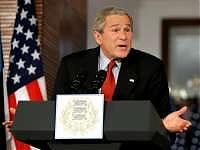
President Bush was in Estonia today, working that old Old Europe/New Europe divide. According to the President, old Europe are a bunch of weeny foot-draggers while New Europe is brash and willing, and not afraid to spill their blood in Bush's War on Terror. Years and gone by and the music is still the same: Bush is attempting to coerce Europe to get behind him and to pledge their armies.

In a press conference, Bush asked for thousands more NATO troops for the hinterland of Afghanistan, transforming the NATO stabilization force (ISAF) there into combat troops. Mr. Bush, who enjoys little credibility in France and Italy, especially after his cheerleading for Israel in its summer war on Lebanon, is pressuring those countries to provide more men and materiel. Italy reacted immediately to the President's words, saying it expected to be thanked for what it's already done in Afghanistan.

But New Europe is fertile ground for Washington, and it is relying on their nationalism and anti-Russian sentiment to challenge Old Europe. Reading the European papers, it appears that the EU Commissioners appointed from New Europe have formed a council within a council, promoting anti-Russian policies that have sunk EU economic/political partnership talks with Russia, much to the chagrin of France and Germany.

Labels: , , ,

Saturday, October 28, 2006

Go Team!


Go Team! Dieser Boney Afganers. German troops frolic in Afghanistan. See more images here.

Labels:

Friday, October 13, 2006

Revolt of Her Majesty's General Staff


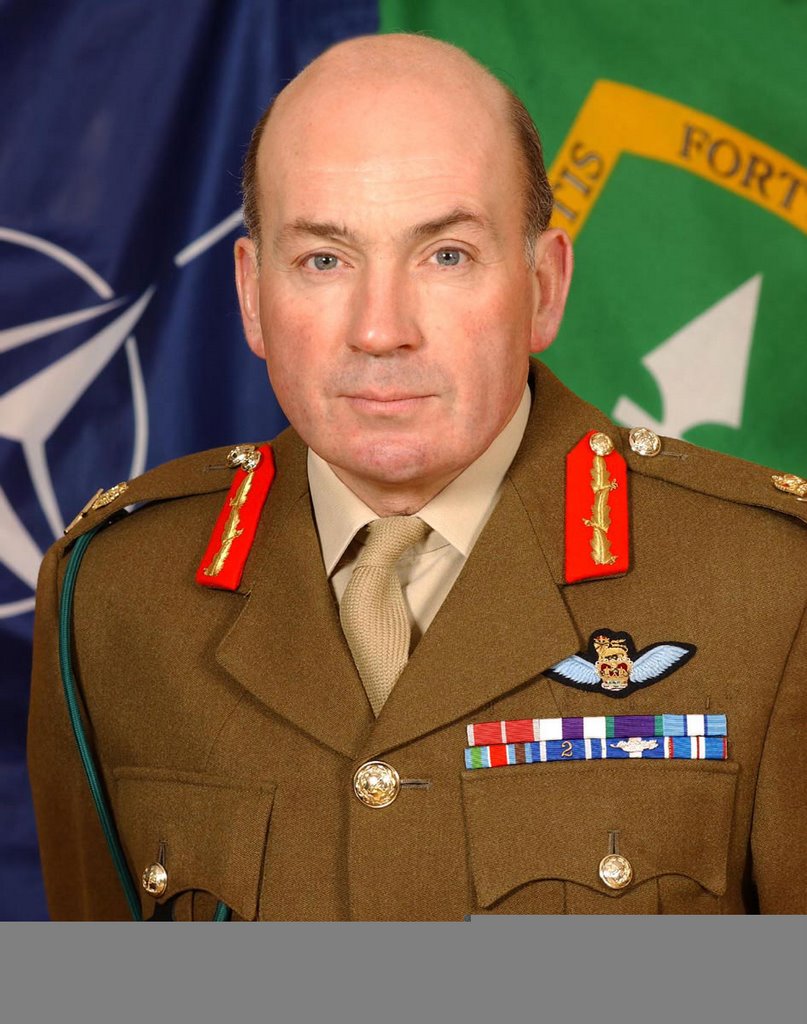
British General Sir Richard Dannett, Colonel Commandant of The King’s Division, The Royal Military Police and Army Air Corps, President of the Army Rifle Association and the Soldier’s and Airmen’s Scripture Readers Association, Vice President of The Officers Christian Union, Commander-in-Chief Land Command, Chief of the General Staff and a buncha medals and decorations says OUT OF IRAQ NOW!.

Big debate at "Have Your Say", the boards at BBC News website, where the Cheetoh Boys, i.e. US freepers, are chewing the British out. Of course, British reader comment is 95% pro General Dannatt and they're taking no guff from the wingers.

What's most amusing is Tony Blair's attempt to throw the military a bone: "Look chaps, no income tax!" But it's not about the money, is it?

Labels: , ,