Nur al-Cubicle

A blog on the current crises in the Middle East and news accounts unpublished by the US press. Daily timeline of events in Iraq as collected from stories and dispatches in the French and Italian media: Le Monde (Paris), Il Corriere della Sera (Milan), La Repubblica (Rome), L'Orient-Le Jour (Beirut) and occasionally from El Mundo (Madrid).

Monday, May 28, 2007

Interview with Hubert Védrine on US foreign policy

The former Foreign Minister of France, Hubert Védrine has just published a book: "Continuing History"
Interview in Paris conducted by Jana TAMER of L'Orient-Le Jour.

The former Foreign Minister in Socialist Lionel Jospin’s coalition government from 1997 to 2002, Hubert Védrine is esteemed in all political circles, both in France and abroad. He was recently sounded out by President Elect Nicholas Sarkozy, as well as other members of the French Socialist Party, about joining the new government. Author of a work that was published amidst the French presidential campaign, Mr. Vedrine has agreed to an interview with us to discuss the overall situation in the Middle East from the realistic standpoint contained in his book, “Continuning History” (Fayard).

Q - In your book you examine back to back US and EU policies toward the Middle East and you refer to these policies as unrealistic.

The overall theme of my book is that after the fall of the Soviet Union, the West went overboard with euphoria in the notion that it had won the battle of history. It believed that its notions would then be automatically applicable everywhere : its ideas of democracy, its conception of the market economy, its values –which it believes are universal. In its mindset, there will be no more policy problems because there will be no more fundamental disputes on anything. All that would remain is how the world would be organized. It has even been adopted World Bank jargon, talking about things like "governance" which suggests business management rather than policies.

This Western illusion is split into two branches: one is American and the other European. The American branch attributes primordial importance to military superiority. It is here where the Neocons suceeded in hijacking US foreign policy with their very peculiar understanding of the Middle East –an interpretation which they tried to foist on the rest of the world. In their minds, the Palestinian question is of no importance –it is merely a pretext invented by the enemies of Israel– and therefore it is necessary to transform Arab states willy nilly and make them democratic, which would naturally make them pro-Western. But this type of reasoning is borrowed from Dr. Strangelove. How in heaven’s name did the United States, a great country, –certainly very nationalistic but overall very smart– get hijacked in this way ? This is worth investigating.

The other branch, the European branch, is very different but I would lable it ingenuous. Modern Europeans believe that the world is made up of Boy Scouts who want to protect the overall well-being of humanity. They believe that we are part of an international community that works to prevent conflicts through the United Nations, etc.

These two irrealistic branches of thought, which are very different, really don’t work. Actually, a kind of multi-polar world is in the process of forming. This multi-polar world is not one of the grandiose rhetoric we deploy in France. And this world can very well progress without us, or even against us.

My main concern, –which regards not only foreign policy but also things that are more global and more historical in nature– is that Europeans do not possess the required energy to cooperatively build a power that could affect things. I try to redefine the contours of a modern school of realism. This is the work that I have been doing on the political and intellectual planes in France. With respect to Europe, I am also trying to introduce a more realistic approach. There is still quite a bit of irrationality and chimeric illusions. I’m one hundred percent pro-Europe myself, but there are several ways in which to be European. Moreover, I’m fighting against a sort of depressive tendency that has existed in France for several years. I maintain that it’s acceptable to look history in the face, including the darkest chapters –there are such episodes in the history of every nation– but it’s not a reason to sink into depression and permanent compulsive expiation.

As part of all this, I believe that Western policies over the last few years toward the Near and Middle East –spurred by the United States– have been completely idiotic. That’s quite clear.

Q - But how can the realism that you promote and which is similar to the approach offered to the United States by the Baker Hamilton report produce any better result? What comparison do you make between current US Middle East policy and that pursued by Bush Sr. And James Baker ?

You can’t compare the war waged for Kuwait with the events that are transpiring in Iraq. The war in Kuwait was impeccably managed with respect to legality and legitimacy. There was unanimity among the permanent members of the UN Security Council and many Arab nations in the Coalition. And this Coalition ceased combat to avoid exceeding its mandate.

Q - But there wasn’t only the war in Kuwait…

On the question of the Middle East, Bush père and James Baker were the only ones to put some pressure on Israel when they blocked financial guaranties at one point. They even succeeded in setting off a crisis in Israel and launched the process that led to Rabin's ascent to power. Without Rabin, there would have been no Oslo process. As we look back on that period, we see that Rabin was the greatest Israeli man of state in thirty years. Inside Israel, there is a cleavage between those who would use any pretext to avoid a peace process because, as they do not want to give back territory, they don’t want a process (they therefore claim that there are no partners for dialog) and those, like Rabin, who want to advance the process not through a sudden move driven by compassion for the Palestinians, but because they claim that the vital interests of Israel lie on making progress. While it is true that these two groups exist, Israeli foreign policy has been dominated by Likud for quite some time, a sort of twin of the American Neocons. We don’t know who influences whom.

The polices of Bush Jr. are the worst of any US policies since 1945. That said, the US reaction following 9-11 focusing on the Taliban and al Qaeda was completely justified and moreover, there wasn’t a soul in the world who criticized it. But the war on Iraq was a monstrous error, above all for the United States. The US should have done just the opposite –it should have pursued the peace process. We were told that Bush wasn’t interested in the subject (a Middle East peace process) but what really happened is that Bush backed Sharon to the hilt. Bush Jr.’s White House aligned with Sharon from the minute it took office, before 9-11.

Q - The so-called realist approach, such as the Baker-Hamilton Report, raises quite a bit of fear in the Middle East. Some think they will have to bear the brunt of any realistic policies pursued by the West which would then aim at transforming enemies into friends and striking deals with them.

I believe that the approach used in the past by Bush père and Baker, which was picked up by the Baker-Hamilton Report, is less insane and more serious. But there are several ways of implementing realistic policies. And within these realistic policies, there is plenty of choice. I’m with those who think that there should be no taboo on dialog. Realism means recognizing that Bush’s policies in the Middle East are ideologically-driven and Manichean. You should never tie your hands behind your back and declare, “I will never negotiate with the terrorists and the regimes which threaten us”. The United States and the Soviet Union negotiated throughout the Cold War despite the fact that they threatened nuclear annihilation on one another; Kissinger went to China…You should never prevent yourself from talking out of Manichean motivations, dogmatism or morality. You have to do what’s necessary, and not just out of obsession with discussion or diplomatic routine.

On the Israel-Palestine question, you have to adopt a realistic solution in the interests of the West but also in those of Israel. Not to mention that of the Palestinians, who live in deplorable conditions. Moreover, we know more or less what the solution looks like. Its a blend of the Taba Accords, the Clinton Criteria, the Geneva Accords... I recognize that it will be fraught with difficulty. To become engaged in the process, the Israelis need a powerful, reliable and convinced Prime Minister. Israel’s extreme right wing and especially certain actors on the Palestinian and Arab side will try to prevent a successful agreement. But if it is announced in advance that there will be obstacles but that there is determination to proceed… Well, it assumes another Rabin, who would be supported by another Clinton but in the space of a year the crisis would be under control ! Realism demands that the focus be placed there –not on Iraq or on other countries as the US Neocons would like. If their plans for Iraq had succeeded, they would have intended the same for Syria, Iran, Saudi Arabia… Because of the glaring defeat in Iraq, they no longer know what to do. US policy should now enter a transitional phase, but it’s not clear that this will actually occur. Realism would also command not to invade Iraq –and everything that President Jacques Chirac said was basically justified. We could question his tone, or his methods or his rhetoric but at the end of the day, he was correct.

(To be continued...)

Labels: , ,

Sunday, May 27, 2007

Insecurity in Afghanistan

It's not getting any better....

Report
Insecurity grows in the northern Afghan provinces, spared until now
LE MONDE | 21.05.07 | 14h57 • Mis à jour le 21.05.07 | 14h57
Our Correspondent in Islamabad

Violence has doubled in Afghanistan where a week after the announcement of the death of one of their military chiefs, Mollah Dadullah, the Taliban claimed credit for two suicide bombings that on Saturday 19 and Sunday 20 May killed 24 and wounded 50. Fourteen Afghan civilians were killed on Sunday in Gardez (southeast Afghanistan), two hours by car from Kabul when a man detonated his payload in a market after a US military convoy went by.

On Saturday in Kunduz (north) another man detonated his payload near a group of German soldiers who had stopped to shop. Three German soldiers and seven Afghan civilians were killed. These two suicide bombings follow three others that took place Thursday 17 May in Kandahar (South), killing nine and wounding eleven others, including the Afghan Information Minister Abdu al-Karim Khoram.

These bombings, where are less and less the prerogative of the south of the country where the Taliban are the most active, seem to confirm the desire of the militia's leaders to spread their struggle to the rest of the country. The bombing in Kunduz, the most serious since 2003 against German troops, 3,000 of which are deployed in the northern provinces follows another a month ago with killed nine Afghan police in training in a similar manner.

The Province of Paktia, of which Gardez is the capital, is also the prey of increasing insecurity. In this region, the influence of the Taliban, commanded by former Mujahedeen commandant Jalauddeen Haqqani, is asserted more and more.

For its part, NATO is multiplying its operations and has made pubic claims of impressive progress that is impossible to veryify. In a communiqué, NATO claimed to have “driven off or killed more than 100 enemy combatants" over the last two days in the eastern command zone that includes the Provinces of Paktia and Ghazni, where, according to Afghan security forces, “30 Taliban were killed” on Saturday. The Afghan security forces, who are participating in growing numbers in operations, are also taking very heavy casualties, but this is also unverifiable.

Since the beginning of the year, according to calculations from different sources, more than 1,600 people were killed in circumstances linked to the ongoing conflict. Civilians are paying a heavy price and the Red Cross stated on Sunday that 2,000 people are homeless following bombardment by coalition forces led by the United States, which at the end of April struck 14 villages in the Shindand District (west), killing 50 civilians.

Françoise Chipaux

Labels: , , ,

Saturday, April 28, 2007

A glimpse of the UN report on Iraq

I do not spend a lot of time watching US television outside of a late-night channel surf, but I haven't heard a word on the recently-released US report, much less seen anything in print. Le Monde, on the other hand, has a synopsis of the damning report.

Report
Insecurity, poverty and no rule of law: The devastating UN report on Iraq
LE MONDE | 26.04.07 | 14h57
BEIRUT CORRESPONDENT

On Wednesday 25 April United Nations Assistance Mission for Iraq (UNAMI) presented a devastating picture of the situation in Iraq, contradicting the claims of Nuri al-Maliki’s government that violence had declined in Iraq recently since the launch on February 14th of the “Security Plan” for Baghdad. In a report coving the period between 1 January to 30 March, UNAMI points out the deficiencies of the Maliki in defending human rights and restoring the rule of law, while it acknowledges the tremendous difficulties that continue to dog official efforts. It also paints a dire portrait of the humanitarian situation, which recalls the suffering of the Iraqi people when, under the dictatorship, the country was subjected to an extremely harsh international embargo that lasted 12 years.

The Iraqi government immediately rejected the report, saying that it had major reservations and deplored “the approximation and the lack of credibility with respect to several points" –which it does not identify– as well as the use of “unreliable sources”.

UNAMI refrains from declaring victims of violence for the period covered by the report, because, it underscores, the government refused to supply the needed data with the excuse that UNAMI had exaggerated the number of human lives lost in its previous report. But those figures had be supplied by the Ministry of Health and the Coroner’s Association.. Nonetheless, based on observations from its teams and testimony and meetings with the victims, UNAMI writes a damning report.

The number of civilian dead is extremely high, especially around the capital, Baghdad. Intimidation of the population continues as politicians interfere in judicial matters. The geographic cleavages along communitarian lines are growing wider. Ethnic and religious minorities are victims of intolerance. Freedom of expression is increasingly muzzled and women's rights ridiculed. These are only a few examples of the grievous shortcomings revealed by UNAMI (which does not spare the Kurdish regions), tasked to assist the Iraqi government in promoting human rights.

The most troubling report, drawn from sources with UN High Commissioner for Refugees (UNHCR) and the International Organization for Migration (IOM), concerns the humanitarian situation. Some 8 million Iraqis are in a vulnerable situation and require immediate assistance, says UNAMI. Two million have sought refuge outside the country and another two million are displaced within Iraq. The extreme vulnerability of four million other Iraqis derives from lack of food, the escalation in violence, the lack of basis services, rampant inflation and unemployment.

More than half of Iraqis (54%) live on less than a dollar a day and 15% of them have been reduced to extreme poverty, having to get along with 50 cents a day to meet their daily needs. In July 2006, the rate of inflation was 70% and unemployment 60%. Only 32% of Iraqi have access to potable water. Hospitals and clinics cruelly lack medicine and equipment. 12,000 of the 34,000-strong medical community have left the country and another 250 of them kidnapped and 2,000 murdered since 2003.

More than 700,000 Iraqis were forced to move following the attack on a Shi’ite place of veneration in Samara on February 22, 2006 which unleashed confessional violence. Hundreds of families have had to move several times. Three-quarters of the displaced are women and children. Most displaced persons do not have access to elementary services such as electric power, clean water and medical care.

Mouna Naïm

Labels: , ,

Saturday, March 17, 2007

Bio-Phooey Goes Ka-Blooey

No much when one counts the billions in Homeland Security boondoggles, however, BioShield may be about to bite the dust. Despite the Government's commitment to buy the wonder drug Neu-Mune (to rebuild our bone marrow have we've been dirty bombed, you see), the Health and Human Services Department raised the bar so high that the drug manufacturer, Brooklyn, Bridge and Poke (actually, Hollis) has thrown in the towel. This clever maneuver -demanding that the drug company spend $50 million in further research- is the back door on the way to putting an end the tomfoolery.

Labels: , , ,

Breathin' the Green

Fallujah, Iraq (Reuters)[Via Le Monde]

Medical sources report that two booby-trapped trucks transporting chlorine exploded Friday outside Fallujah, killing eight; the US military said 350 people were poisoned. A third blast releasing chlorine took place in Ramadi, west of Baghdad.

...The first truck exploded near the town of Amiria where two Iraqi policemen died and a hundred Iraqis were sickened by chlorine, with lesions to the skin and lungs, accompanied by vomiting. The second truck, which contained 900 liters of liquid chlorine, blew up approximately 5 kilometers from Fallujah 40 minutes later Friday evening.

...Earlier on Friday, a bomb releasing chlorine blew up ata US-manned checkpoint northeast of Ramadi, wounding a US soldier and one Iraqi.

Labels: ,

Mike Davis: The "Surge", a desperate gambit

A month or so ago, an editorialist for Beirut's L'Orient Le Jour, Christian de Merville, reflecting on the five brigades deployed to Iraq, observed that the contingent, too small for "pacifying" Anbar Province, was obviously destined for Sadr City. Nothing was lost on Moqtade al-Sadr, who, upon hearing the news, went to the maquis.

Writing in the Jan/Feb edition of New Left Review, Californian historian Mike Davis (because, you know, almost no American publication would actually allow an intrusion of the state of affairs), has come right out and spilled the beans in his article, The Democrats Return:
In a desperate gambit to appease the Sunnis and defend a zone of control in Baghdad, the Bush administration is currently weighing an all-out assault ("surge" is its military precondition) on the slum militias of Moqtada al-Sadr. A new war with the Mahdi Army (hugely enlarged and better trained since its first battle with American troops in 2004) would open up another Pandora's response from the entire Shi'ite world. (Inevitable US air strikes on Sadr City would produce grim scenes reminiscent of the Israeli bombardment of southern Lebanon...
You-know-who will be cheering all the way:
In the Senate, the hawkish Joe Lieberman...will be a powerful swing vote in favor of escalation.
As we now know, Pelosi and Reed have bought into Operation Desperate, which is also to escalate to $3 billion a month from the current $2 billion.

Labels: , ,

Sunday, March 04, 2007

Review: The General's War

BBC documentary that aired on February 28th, 2007 (UK)

The documentary nominally focuses on British Army's General David Richards, commander of ISAF and NATO troops in Afghanistan, in the last days of his command as he is about to be relieved by US General Dan McNeil. But it is not the general's story that is the real interest here, but the unlucky ISAF Canadians at the Martello base and their earnest commanding officer, a woman, whose mission is defeated...not by the Taliban, but by the Coalition.

The Canadians, charged with winning the hearts and minds of the locals, decide to repair the water pumps of a neighboring village. The water pumped would be for drinking, of course, but also for religious ablutions. The Canadians collect them all with a promise of a week's repair time but fail utterly, losing the wisp of confidence earned, because ISAF cannot find the gaskets, spark plugs and 4-kopek pieces to return them to operation. Adding to their embarrassment is the arrival of US Special Forces in armored vehicles flying the Jolly Roger. (No, I am not being rhetorical). The Special Forces proceed to kidnap a local from his home (one wonders how names could possibly be taken from this godforsaken village amid rock and scrub!) and bundle him, hooded, into an interrogation tent.

The hangdog Canadians return to the village, were they have to admit that they are not only unable to have the the pumps repaired but powerless to intervene with the US Special Forces. At this moment, a 9 year-old boy appears and from atop a pile of rubble delivers an angry and ominous exhortation: Rise up, o ye men of faith...

The Martello base is quickly shut down, and a parting shot shows the female officer, defeated and bereft of her command, sitting along the wwith her head in her hands.

As General Richard comments before the camera on his departure, he clearly is worried by his American relief. The Americans, he says, are too "kinetic", and by this he clearly means they shoot first and ask questions later. As we saw today...

It is doubtful that the BBC set out to capture the debacle of the Canadians in a film project that was meant be to a farewell tribute to the British commander. But the poignant subplot was poignant brings to the public a rare glimpse of the intractable mess on the ground in Afghanistan.

Labels: , ,

Bombing the capital you occupy

Something is terribly wrong and immoral, when you bomb the capital of the country you occupy. The US apparently using artillery and warplanes on south Baghdad.

Labels: , ,

Bloody Sunday in Afghanistan

"Destroy the evidence..."

Via Le Monde

LEMONDE.FR with AP, AFP and Reuters | 04.03.07 | 12h40

Sixteen Afghanis were killed and 25 wounded on Sunday 4 March following a suicide bombing targeting a Coalition convoy and return fire from US troops, who claimed they had fallen into a “complex ambush” on a highway in eastern Afghanistan. But the circumstances in which the civilians died remain ambiguous.

A booby-trapped vehicle driven by a kamikaze exploded near a Coalition patrol, which was then targeted by automatic gunfire “coming from all directions”, according to a coalition communiqué. The Taliban claimed responsibility for the attack. The communiqué also said that US troops had responded and that the killing of sixteen civilians and the wounding of another 25 occurred in the initial attack on a highway 45 km east of Jalalbad, near the frontier with Pakistan

But the wounded told AP that US troops had opened fire on cars and pedestrians on the highway. "They shot in all directions, even firing at 14 of 15 cars which happened to be on the road", says Tur Gul, 38, who was at a gas station along the highway and who has been shot twice in the right hand. They shot at everything and anything, as well as people traveling in their cars and pedestrians", he added.


The Afghani Ministry of the Interior says a “certain number" of civilians perished in the suicide bombing. "According to the coalition, the soldiers then came under fire, but their response killed ten people and wounded 25. An initial police estimate said 8 civilians were killed by the Coalition. The police made no mention of insurgent fire. Contradicting its own press corps, a Coalition spokesman told AFP that it “was not clear at the moment how many civilians were killed in the bombing and how many died from Coalition or insurgent gunfire. “An investigation is ongoing, he added.

Thousands of angry Afghanis then rushed to the scene and briefly blocked the highway. Demonstrators shouted “Death to America, Death to Karzai", before being dispersed. US troops at the scene, who are part of the ISAF coalition commanded by the United States and not by NATO, destroyed images taken by a photographer, an AP cameraman and Afghani journalists, said the AP.

Labels: , , ,

Wednesday, February 21, 2007

Italy, Prodi Resigns

Italian Foreign Minister Massimo D'Alema succeeded in bringing down the Prodi government today by drawing a line in the sand and challenging Italy's Left. D'Alema never seemed to me to be exceptionally astute, confirmed by his breach of the rule that you cannot be inflexibly arrogant in dealing with your coalition when you command a razor-thin majority. Foolishly, D'Alema went where no wise politician would have gone: he declared that the Government would resign if the vote of confidence failed (they're calling it the "Kabul or Bust" gamble.)

Today's vote in on Prodi's foreign policy lost in the Senate by two votes over troop presence in Afghanistan and extension of the US bases at Vicenza and Sigonella. Truth be told, until now the Left had swallowed the entire package of deregulation/liberalization measures, at odds with its historic positions, but was not prepared to surrender on war. The recent US action in Somalia, a former Italian colonial possession, probably did much in convincing Italy's Left to entrench in opposing Italy's cooperation with further US military undertakings. Already simmering because of Italy's participation in the war in Iraq, the Left and the Greens were pushed to the wall with the announcement of the NATO Spring Offensive in Afghanistan and saber rattling by Washington at Tehran.

Prodi tried to save the bacon by calling a hasty "summit" with Spain's Zapatero on the of Ibiza to placate the Left. It was something of a simple-minded pantomime, like Bush bussing the Saudi Crown Prince: "See, Zapatero is okay with keeping his contingent in Afghanistan, and so should we."

What is pathetic was that because of his decision to pull out of Iraq, Prodi was declared persona non grata in Washington, like Zapatero. [Note: Unprecedented: they are both NATO heads of government]. Pretending nothing was amiss in the rapporto speziale, Prodi soldiered on in traditional pro-American Demo-Christian fashion. But within Italy, where it matters, he apparently lost sight of the necessity of the support of the Greens and the Communists in keeping his government afloat. The resignation is unlikely to put the fear of God in them.

However, it may not be over: There will now be a second vote on confidence -this time whether Mr. Prodi should form a new government.

Labels: , , ,

Somalia, US botches coup

Having outsourced the coup in Somalia to the Ethiopians, the US has sent the country to hell.

"Somalia is actually becoming a more violent and chaotic place. That is not how it was supposed to be....confidence in the [new] government — never very high — is rapidly bleeding away....Somalia seems to be just shy of total collapse — again...Hundreds of families are streaming out of Mogadishu...." [Via the NYT]

Begs the question, just what did the Bush Administration think it was doing? The answer is same old, same old. Invade, then implement no plan at all. Notice that this took place during the Congressional recess/turnover.

Labels: , , ,

Saturday, February 17, 2007

The Return of the Taliban

Defense and security expert Etienne de Durand appeared for the second time in a week in the pages of Le Monde to discuss Afghanistan. The obsession of the US with the military effort in Afghanistan has caused a disillusionment among the population and an opportunity for the well-financed Taliban.

Chat
Afghanistan: NATO challenged by the Taliban Threat
LEMONDE.FR | 12.FEB.07 | 11:31 • Updated 15.02.07 | 16:04

Chat with Etienne de Durand, Fellow, IFRI, expert in defense and security matters, Thursday, February 15th, 2006

Q. What are the reasons for the initial withdrawal by the Taliban, then their return in force today?

A. This looks like an innocent question, but in fact this question raises the issue of Western intervention in Afghanistan. We should recall the context in which intervention occurred. The US invasion to place following 9-11 –a plot that directly implicated the Taliban in that they had close ties to the leadership of al-Qaeda.

This time, the Taliban were attempting to win a victory in the long civil war in Afghanistan and to put an end to the Northern Alliance for good. It was no accident that Commander Massoud was assassinated just before 9-11, on September 9th. Locally, the Taliban were in the process of winning their victory.

At the same time, the policies that they conducted alienated the vast majority of the Afghani people, including the Pashtoon. Consequently, when the Americans and the Westerners arrived, they were welcomed at first as liberators, both in the political sense (because of the extremely repressive measures put in place by the Taliban, especially the moral clampdown with prohibitions on music, film, dancing, and even kite flying, a traditional Afghani pastime) and in the economic sense-the Taliban period proved to have been a catastrophe.

In fact, the only satisfaction achieved by the Taliban in the eyes of the Afghani population was the restoration of security following the ravages of the warlords.

Once again, the Westerners were relatively well regarded by a population that is relatively suspicious of the foreign presence in Afghanistan. But the population had great expectations of the Westerners, most of which were unrealistic, as to reconstruction and economic development. The Afghanis had less desire for “civilization” –the Western political model– than for Western prosperity.

From this point of view, there was actually a window of opportunity in 2002 and 2003. Unfortunately, the window was not correctly leveraged by the West. On the one hand, the Americans were satisfied with merely pursuing al-Qaeda militants and the remainder of the Taliban as they turned their attention more and more to Iraq. On the other hand, the Europeans were at first extremely timid and contented themselves with patrolling Kabul.

But the expectations of the population, especially in the Pashtoon areas, were not satisfied and the progress achieved by the West in rebuilding the economy and stability was not rapid enough to compensate for popular disappointment. We now find ourselves in a situation in which the insurrection has been able to reestablish itself politically and therefore civically, especially in the Pashtoon areas, as the West concentrated on the military and financial aspects.

Q. Will the intensification in combat and the increasing losses lead to a retreat of the contingents of certain contributors? Can we expect the Taliban and their allies to strike Europe?

A. The first question is pertinent, because this is certainly the strategy of the Taliban. The Taliban know very well that they cannot take Kabul by force as long as the West and especially the Americans remain.

They have adopted a classic insurrectional strategy: discourage the Western powers by increasing the political costs of their presence, especially by killing Western troops, and generating an atmosphere of insecurity throughout the country in order to slow and even block the reconstruction of infrastructure and the Afghan economy, thus sowing discontent among the population and therefore stronger support for the insurrection.

The second question is far different -predicting what will happen if we abandon Afghanistan as we did after the Soviets withdrew. The first consequence would surely be the resumption of the civil war, with on the one side, a stronger Taliban supported by the Pashtoon and backed by Pakistan, and the other, a heteroclite alliance essentially composed of minorities (Tadjiks, Hazaras, Uzbeks) and supported to varying degrees by India, Iran and Russia.

If the neo-Taliban regain power, the fallout could be the reversion to the situation prior to 9-11 and the use of the country as a gigantic sanctuary in which Bin Laden's organization could recruit and train a new generation of Jihadists.

Q. It is certain that NATO will deploy troops to Afghanistan who can do the job? Should they convince or win a victory?

A. That’s a very good question! NATO has to do both. NATO cannot win until it convinces the Afghanis. NATO troops are perhaps in a position to do so. The main problem is the lack on a genuine agreement among the Western powers as to the objectives to be pursued. This fluid situation can be translated into rules of engagement (“caveats”) that vary widely, introducing losses in efficiency.

Q. Is NATO intervention sees as backing President Karzai? Is Karzai discredited? Is NATO doing the right thing?

A. The question is whether the West entered Afghanistan with a strategy in the first place. NATO deployed to Afghanistan only progressively and there was a dual chain of command between Operation Enduring Freedom and NATO until 2005.

Q. How do you explain NATO’s diverging objectives?
A. The aim of an alliance is to unite member states which could have very divergent points of view on the nature of the mission and the most suitable methods.

Q. Since it is known that the insurgents (the Taliban, al-Qaeda, Gulbuddin Hekmatyar) use Pakistan as a refuge, how can the conflict be settled in Afghanistan if Musharref does not “clean up" his own country?

A. It’s true that historically it is very difficult to defeat an insurrection that benefits from a cross-border refuge. From this point of view, the cooperation of Pakistan has been essential.

Unfortunately, given the instability in the country, the fragility of the Musharref régime, the existence of strong currents of extremism in Pakistan itself, and –last but not least- Pakistan’s possession of a nuclear arsenal, it is very difficult and dangerous to put heavy pressure on that country. We’ll have to get along with Pakistan’s half-measures.

Q. How long and at what price can Pakistan continue to support the Taliban?

A. As long as it takes, because Afghanistan represents a vital interest to Pakistan. Pakistan’s nightmare scenario is an alliance between India and a hostile regime in Kabul. Give this perspective, the Afghan government is going to have to make a few concessions to Islamabad, such as recognizing a permanent frontier between the two countries.

Q. You mention the support of Pakistan for the Taliban. So what about this “War on Terror” that the US and Pakistani government are allegedly waging together?

A. At the outset, Pakistan cooperated rather well with the West, probably until 2005. However, they were never prepared to go all the way given the political danger that overly repressive policies would pose to Pervez Musharraf.

But later, either the Pakistani government or certain elements within the ISI (Inter Service Intelligence, the Pakistani clandestine services) decided that the war was taking a new tack and that it was necessary to revert to the strategy prior to 9-11.
Given the Taliban’s weapons and training observed last fall, it is almost certain that these recruits were receiving high-level support from the other side of the frontier.

Q. Bin Laden is still at large. Do you suspect that the United States and Britain have no desire to capture Bin Laden? Could the US and the UK possibly be using Bin Laden and the Taliban in their strategy for the Middle East?

A. That’s just not believable. Number 1, because it is extremely difficult to pinpoint in a land of almost inaccessible deserts and mountains. With drone cameras or satellite images it is very difficult to discern an Afghan civilian from a Taliban: both would have a turban, a beard and a Kalashnikov.

Number 2, a cynical manipulation like that, if uncovered, would cause an unprecedented political scandal. In the United States especially, there are always leaks and in the end, everything is revealed (e.g., the political machinations preceding the war in Iraq).

Q. Would Iran use Afghanistan as a nursery and a lever against "The West”, despite the traditional schism between Sunnis and Shi’a?

A. It is certain that a Western military operation against Iran because of its nuclear program would create innumerable problems in Afghanistan, especially where it enjoys local support (the Western Tadjiks and the Hazaras). In general, the Iran’s main concern in Afghanistan, if not to counter Pakistan, it is to ensure that the regime in Kabul is not hostile to it (in 1997, Iran nearly went to war with the Taliban). In this situation, like many others, Iran is playing a double game at several levels (it sheltered Sunni extremist Gulbuddin Hekmatyar for quite some time).

Q. Is the Karzai administration, supported by Western forces, especially the United States, sufficiently solid to introduce reform across the country and begin rebuilding?

A. It is obvious that the Karzai government is very weak. That said, Afghan governments are traditionally weak, and it is not certain that it wouldn’t create more problems than it would solve should it attempt to build a strong central government.

Moreover, in the short term the country has more of a need for economic gains and improvements that would be apparent to the Afghani people rather than deep reform. It is up to the Afghani people whether to make these reforms.

Q. Opium production has recovered since the fall of the Taliban. How does this complicate NATO’s mission? Is it marginal or central?

A. There is a lot of debate about that. Some believe that the cultivation and trafficking of opium are at the heart of the instability in Afghanistan. If this is correct, then the revenue from opium permits not only the local warlords to assert their power to the detriment of the government but adds to the generalized corruption that rages throughout the country and provides financing to the Taliban.

Others believe that it is necessary to distinguish the "geographic security" of Afghanistan, i.e. the battle against the Taliban, and the repair of the internal situation. In other words, should the West become massively engaged in the prevention of opium trafficking, that carries the risk of alienating large swaths of the population, because the Afghanis heavily rely on opium revenue. But if this is so, then fighting opium trafficking plays politically into the hands of the Taliban.

Q. What is the role of the Afghani people in all this? Could they promote a new era, oriented to the West, or restore the Taliban to power?

A. Given the insurrectional context, the population is naturally a central strategic stake. It is their attitude that will determine whether the current pro-Western political system survives in power or whether the country is plunged back into civil war. That said, the Afghani people are less preoccupied by big questions of an ideological nature (rapprochement with the West or not) than with daily survival.

Once again, rapid and visible improvement in the conditions of daily life (economic growth, access to a minimum of health care, the safety of persons and things....) is likely to rally the population to the Karzai government. The West can only offer assistance to the rebuilding process, which is up to the Afghanis.

Chat moderated by Philippe Le Cœur and Gaïdz Minassian

Labels: , , , ,

Monday, January 22, 2007

Conversation with Bertrand Badie

I have tremendous respect for French political scientist (Sciences-Po) Bertrand Badie. In a chat session at Le Monde, Mr. Badie examines the current state of US hegemony (including the intelligence shakeup paving the way for "microsocial" intelligence).

Chat
The US hegemony: Failure or revision?
LEMONDE.FR | 10.JAN.07 | 18:19 • Updated 17.JAN.07 | 11:28

Debate with Bertrand Badie, Professor at Sciences-Po, Wednesday, January 17th, 2007

Q. What is the difference between hegemony and imperialism? Which of the two terms term better suits the United States?

A. The meaning of these two words is in constant evolution. But we are accustomed to use the word hegemony to designate forms of domination that are in part allowed and desirable through what we call "soft power". Etymologically speaking, imperialism means something else entirely, that is, any political project aiming at building an imperial order, either explicitly through conquest, and therefore involves the overt use of force, or implicitly by means of relationships, and that means client states, sometimes puppets, which sacrifice a substantial part of their sovereignty to the imperial power.

It is obvious that an empire held together only by force would be very costly to those who would undertake it and weak, subject to incessant challenges. But in any imperial project, hegemony plays a role. On the other hand, one can imagine forms of soft power that make occasional use of force and that build around them a network of influence that no longer fits the imperial model. So as entangled as they are, these two concepts concern two distinct practices.

Q. Do you think until political Europe comes to be, American hegemony will continue to expand?

A. That is undeniably an important consideration. I tend to think that in today’s world, hegemony has never been more difficult, costly and uncertain. But it is also certain that the absence of a countervailing power contributes to its success, or at least in imparting the illusion of success. When the Berlin Wall fell, the question was whether the United States would become an unrivaled empire. In the 1990s, Europe was the only player in a position to challenge it.

The United States quickly became very worried, and, through the active reform of NATO, sought to turn the EU into a vast NATO territory on the Old Continent. In attempting to superimpose itself on Old and New Europe, the United States demonstrated its desire to prevent Europe from becoming a countervailing power. From a certain standpoint, enlargement of the European Union has helped the United States in this enterprise: the Iraq crisis, in deeply dividing Europe, has contributed to more loss of unity and of the European diplomatic identity, and constitutes an encouragement to the United States to reaffirm its imperial policies.

Q. Does the US have choices in its hegemony?


A. Perhaps that is a fundamental question. There is a law of mechanics that induces the powerful to use their resources towards hegemonic ends. Undeniably, after having done strategic due diligence, not only the Neocons but by the whole of the US political elite since 1990 has shown the desire for hegemony and its use in the service of certain values and political projects.

The question is now whether, on the one hand, this hegemony in today’s world will become costlier and costlier and therefore less and less useful, and, on the other, whether hegemony still makes sense in the context of globalization. Let us not forget, moreover, that during the Cold War, the power of the Russian bear fed that of the American eagle. The disappearance of the bear makes a single hegemony far more weak and uncertain. We might ask ourselves if a unipolar world is achievable and if, following a period of hegemonic stability, we are now heading away from, that is, toward a new era of hegemonic instability.

Q. How is ideology important to the United States in its constant struggle to maintain its hegemony? Is it only a façade? Why are the Americans not happy with only its economic and geostrategic advantages?

A. This would take a very long time to explain. The messianic ideology created by the United States is also responsible for its unity and cultural development. It is very unlikely that this valorization of ideology would be abandoned –certainly not by the Neocons, who have made it their calling card– by any political current, specifically the Democratic Party, which resolutely deploys American values as a principal of their foreign policy. Let us recall how Jimmy Carter, in 1976, immediately after the defeat in Vietnam, completely revamped US foreign policy, and grounding it precisely in the founding principles of the rights of man and democracy. The difference does not result from the strength of ideological references but from the content, and above all, its insertion into concrete challenges which American foreign policy must face.

Q. Does the stinging embarrassment of American intelligence services caused by 9-11 and their further discrediting by various scandals and events constitute proof that US hegemony is in decline, compared to other blocks of nations?


A. Intelligence is a fundamental and commanding weapon in modern forms of international competition and conflict. This is why it appears today to be a tool undergoing complete technological revision and policy transformation. Every country in the world must come to terms with this necessary upgrade in resources in modern intelligence warfare.

This readjustment is not easy, because intelligence has relied until only recently on the classic and reassuring figure of the enemy. To transform intelligence into an instrument of microsocial, even individual, investigation, is a tremendous task that involves a transition time far longer than the interval that separates us from the Cold War. The intelligence crisis must be followed and periodically causes the White House to modify the institutional and human profile of its services. Of course, it will be in its reactive capability that most of its challenges, quite real, will play out, but let's not forget that there are also imaginary challenges with which US policymakers believe they face.

Q. Following the collapse of the Doha Round of trade talks, is the US is now oriented toward the signature of bilateral conventions with no end in sight. Does this strengthen or weaken the position of United States in the short and medium term?

A. You are correct to bring up this issue. It should not be forgotten that one of the constants of US policy, all things being equal, is to discard multilateralism the moment it becomes no longer useful. We see this tendency again today, especially in trade, but not only in this area. We see it at work in privileging bilateral agreements.

This constitutes three tremendous advantages: It allows the United States to reap the dividends of inequality of resources and power in its favor; it permits the United States to disrupt various forms of regional integration that we are witnessing around the world, to the point of transforming trade negotiations into interregional negotiations; last, it allows the United States to selectively inject doses of political conditionality that is very attractive to the countries with which the US deals and which a global agreement could never produce. The advantages are so significant that we will see this tendency endure.

Q. Can Iraq be compared to Vietnam? And independent of that, could we see another US failure?

A. Any comparison is dangerous. The defeat of the US in Vietnam was that of a superpower losing to a small, determined state, which is not the case in Iraq, where the US is facing a society, or, more precisely, a multitude of social actors who are intermingled with the purveyors of violence. The cost of the Vietnam War was far greater in human life compared to the costs of today’s war: 60 000 GI’s in Vietnam and 3 000, for the moment, in Iraq.

But the Vietnam War belonged to a two-pole world and was a result of competition with the Russian and Chinese enemies, while Iraq has thrust the United States at the center of the Middle Eastern crater owing to totally different strategic considerations. There remain, however, three elements of similarity: First, it has earned the distrust, even the hostility, of the entire international community together with causing embarrassment to the oldest allies of the United States; second, we see, once again, the reflex of an injured great power in two manifestations: Military escalation and the almost desperate desire to get rid of the client government, which compels Washington to talk of the Iraqization of the conflict as it once did of Vietnamization. Finally, we are going to see the same skepticism take hold of the American public, which, after every election, is going to make the US political elite more an more cautious concerning the Iraq commitment and, like the Vietnam quagmire, is going to be resolved only with time. There are major strategic differences, but similarity in the political vectors.

Q. What lies beyond a simple US failure in Iraq?

A. Decisive stakes are being played out in Iraq. The United States is in the process of discovering the extremely high cost of unilateralism and the usefulness of “burden sharing”, which Neoconservative enthusiasm had always discounted. Defeat in Iraq means above all else defeat for unilateralism. But it’s also a defeat of intervention in its simplest formulation: the thinking that that copious political resources can solve any societal crisis.

The Americans are also discovering in Iraq that the greatest power in the world can do nothing against societies and that inter-nation war cannot transposed to conflicts that derive from the collapse of social compacts. These last few years, especially in Iraq, have been black years for the idea of intervention. In the future, the Iraq Syndrome will have a far deeper impact than the Somalia Syndrome years ago.
In the short term, perhaps Iran and Syria will escape the politico-military enterprise planned against them by the United States. In the long term, it is the idea of intervention, and therefore, at the end of the day, the idea of a duty to protect that risks being weakened. Finally, Iraq is the fermata of the great misunderstanding that divides the United States from the Middle East. We are already sensing the tremors of a complete revision of US policies in the region, at a time when some in the United States are beginning to question the cost of the unconditional support of the state Israel by Washington.

Q. But do you not seriously think that things in the Arab World would have remained at a standstill if Uncle Sam hadn’t decided to kick over the anthill?

A. Things are at a standstill more than ever in the Arab world, and it is probably because of the intervention in Iraq. There has been no "regime change" anywhere. The idea of the Greater Middle East Initiative has already been discarded. The timid elections which burgeoned here and there only delivered success to the Islamists and to denunciation of them by the Western “conscience”.

None of the conflicts that have been roiling the Middle East for years have been seriously tackled. Israel-Palestine relations, Darfur, Iran and Syrian have never been more at an impasse. The Jordanian and Egyptian regimes are weaker and sicker than ever. The Lebanese crisis has never been more acute. I see only negative and funereal consequences for the Arab world because it is crystal clear that knocking over the anthill has sent the ants scurrying everywhere, joining in the incredible imbroglio within each of these societies.

Q. Current US policy toward the Middle East serves neither the interests of the Americans nor those of the West. Is the United States a victim of its alliance with Israel? Is Iran the next target of US “hawks”?

A. Concerning the US-Israel alliance, I believe and have said that the United States is questioning more than ever the consequences of its policy of unconditional support for Israel since 1967. The balance sheet is very disappointing: this alliance has blocked any voluntary and cooperative action vis-à-vis Arab states. Any cooperation displayed by certain Arab governments has immediately created rejection and impasse within those societies; anti-Americanism has spread to every part of the Arab world and has reached a peak, especially where local governments have compromised with Washington.

Simultaneously, the efforts at mediation pursued by US diplomacy and in which it has a great deal vested have produced meager results. The failure of Camp David in the summer of 2002 bringing together Clinton, Arafat and Barak, was one of the bitterest diplomatic defeats America has ever faced. In short, the US has been weakened in all its endeavors in addition to its military and diplomatic efforts.

Added to this is the weight of a significant event: the failure or quasi failure of Israel in Lebanon during its war of July/August 2006 has profoundly troubled the Pentagon and the White House. The brutal discovery of the impotence of Israeli power has led US strategists to believe that the use of force, at the center of Israeli strategy, cannot be taken for granted. This has given way to strategic revision but it is too early to tell where it is going. But I think that in August 2006 something broke and that his rupture will be become apparent in the annals of this long conflict.

As to Iran, it is well known that more than one strategist at the Pentagon has made the country the mechanical target of the next stage of US policy in the Middle East. The departure of Donald Rumsfeld, which was far more important and significant than widely believed, the slow and inevitable revision of US policy in Iraq and the policies of support for Tel Aviv are likely leading to a reconsideration of what formerly appeared to be inevitable. But there is reason for caution. The diplomatic game is also very dependent on rhetoric. The United States has too often and too explicitly threatened Iran to reverse course to the point of completely eliminating the idea of military action. I’m afraid that the White House is a prisoner of the diplomatic discourse it created at the outset that is far too compelling to be purely circumstantial.

Q. Do you think the ballistic defiance of North Korea and Iranian intransigence are evidence of a significant erosion of the power of dissuasion of the United States? Has the United States lost its position of policeman of the world and is incapable of containing the recent proliferation revival?

A. This is a complicated question. Non-proliferation arrangements clearly belong to the era of bipolar policies, when the US-soviet diarchy had the means to guarantee them. I am not sure that in the post-bipolar era non-proliferation can work in the same way. The NPT is perhaps, in fact, far more obsolete than generally admitted. In any case, it is too late to brandish non-proliferation instruments as a means of dissuasion. Too many exceptions, of which everyone is aware, have been chalked up: India, Pakistan, Israel.

As to India, its violation of the NPT has been rewarded by the United States, which has signed a nuclear cooperation agreement with Delhi.

Finally, nuclear weapons have entered into the realm of political contest as opposed to military challenge. Over the years a nuclear aristocracy has been built up that constitutes a genuine global oligarchy and a club of prestigious states to which all weaker powers aspire—like playing football in a better conference.

The Middle East became nuclear at very fast pace and has placed Iran before a nuclear power on its western flank, a nuclear neighbor on its eastern border, and an old nuclear power on its northern frontier.

The same observation is true for eastern Asia, dominated by Chinese power, where the survival of North Korea no longer depends on the the display of political power. Acquiring a nuclear arsenal represents its last chance to survive, after it has failed in every other domain. This is why the quest for nuclear capability is increasingly a political contest, that is, the worst of practices to which the US must face up and which condemn it to powerlessness.

Q. Regionalism (Europe, Asia, Russia, South America) could legitimately counter US hegemony. But how much does NATO interfere with a common European foreign policy?

A. First, the United States has always been distrustful of regionalism. It came very late and timidly, and solely for economic advantage, to the table on NAFTA. As a superpower, it has everything to fear from a coalition of others and the risk of losing its ability to control such coalitions. An interregional world is far more difficult to dominate than a world comprised of 194 individual sovereignties. This is the reason why the United States has been seeking to substitute large continental entities that are looser and more controllable to more limited and stronger regional constructions. Thus, it today backs the OAS or NAFTA against MERCOSUR. And it has mobilized for EU enlargement to the maximum and the integration of Turkey. This is why it promotes the policies of India of overture to the east and its long-term integration in one large Asian structure. This is why it backed the Asia-Pacific Economic Cooperation project –to block the start of Southeast Asian regional integration– then enlarged it more or less formally to include China, Japan and South Korea.

As to Europe, the challenge is in its size. NATO has expanded faster than Europe and constitutes a vast entity under US domination. In having European enlargement coincide with NATO enlargement, the US hopes to attain a dual goal: injecting pronounced diversity into the political options available to the European Union, making common European foreign policy an impossibility, and having European integration coincide with the political-military integration of the NATO alliance. Javier Solana, the EU's High Representative for Common Foreign and Security Policy and former Secretary General of NATO, is a case study and we should observe his statements and policy choices.

Q. Does American economic exceptionalism translate into hegemony? How much longer can the United States continue to spend borrowed money without creating goods?

A. That’s a real question. The United States suffers from several imbalances, but most of all from a hegemonic position that is too exclusively dependent upon military superiority. Empires are weakened when they cannot rely on a single sure resource. Today, the military resource allows the US to distinguish itself form the rest.

As to trade, the US is threatened by the European Union, whose volume of exports exceeds that of the United States. As to economy and finance, it is subject to the rules of interdependence which, obviously, limit its sovereignty, including in the direction of Asia and, in particular, China. Culturally, whatever the strength of its hegemony, the United States is increasing aware that soft power doesn’t mobilize consumers to support policies.

A colossus with singularly shackled feet, the United States suffers from an imbalance in leadership that not only costs it dearly but places it increasingly in contradiction with the rigors of a globalized economy. All empires come to an end…

Chat moderated by Gaïdz Minassian

Labels: , , ,

Tuesday, December 26, 2006

Somalia: A self -fulfilling crisis?

Le Monde's Washington correspondent Corine Lesnes looks into the new front in the War on Terror, Somalia, which looks as if it is manufactured, just like Iraq.

BTW, The Duck of Minerva reports that the invasion of Somalia by Ethiopia is underway.

:::
When General John Abizaid, head of CENTCOM and the regional commander of US forces in the Middle East went to Addis Abeba at the beginning of December, he warned those with whom he met of the humanitarian consequences of an invasion of Somalia. But sources in the US media say the General did not demand the withdrawal of Ethiopian troops.

Since then, the media have been throwing around the fig leaf, “tacit support”. The Ethiopia of Prime Minister Meles Zenawi has the “tacit support” of Washington in protecting the transition Somali government -the result of long and arduous negotiations among the different factions organized by the United Nations- against attack from the Islamist Courts, a movement installed in Mogadishu since July 2006.

Has the United States done the right thing by choosing a camp? Has it exaggerated the threat posed by the Islamic Courts so that it might manufacture the danger it most fears? As the conflict intensifies, certain questions must be asked of Washington.

In a December 14th press conference, the US Under-Secretary for African Affairs, Jendayi Frazer, expressed the fear of seeing al-Qaeda install itself in Mogadishu. She then went on to declare that the Islamic Courts were “controlled by individuals belonging to al-Qaeda’s East African cell.”

According to some sources, this intelligence was deployed by the government of Meles Zenawi, who is worried that Islamists may destabilize the Ethiopian border area of Ogaden, over which Addis Abeba and Mogadishu have fought three wars since 1960. Interviewed by the Washington Post on Thursday December 21sth, Director of National Intelligence John Negroponte was more cautious. He did not indicate if the Courts are the “New Taliban”. I do not believe that we yet have the right answer to this question, he said.

In any case, the support of Washington for the Ethiopian regime in the name of the war on terror has been reported by some experts. Matt Bryden of the International Crisis Group says that there are certainly some al-Qaeda members among Somali Islamists but on "a small scale".

By pushing the United Nations on December 6th to adopt a resolution authorizing the deployment of a regional force in Somalia to support the weak transitional government, the United States has added oil to the fire, Mr. Bryden explained while on NPR. Because of its desire to consider the Somali problem as a new front in the war on terror, the United States is in the process of manufacturing a new front in the war.

The two sides in the conflict have described their struggle in ideological terms, Bryden explains. The transitional government and Ethiopia have painted Somalia as an emerging front in the global war on terror to attract the attention of Western capitals. The Courts have drawn the sympathy of the Islamic world in presenting themselves as victims of Ethiopian aggression and Western Islamophobia. The United States must, says Bryden, avoid falling into the trap while there is still time.

Labels: , ,

Tuesday, November 28, 2006

War with Iran by the Back Door

You would think that Bush and Cheney would be seized by reality by now but that is a vain hope. This delusional pair actually believe that they can persuade Sunni Arab states into a Shi'ite-Sunni war. God help us.

Josh Landis writes:
Israel and the US are hoping to shore up support from their friends in order to better avoid negotiating with their enemies: Syria and Iran. Thus it is significant that both Jordan and Egypt are insisting on wider negotiations, despite Washington's efforts to draft them into a Shiite-Sunni war.

Labels: , , ,

Global Strike Force Eastern NATO


Update: Dateline RIGA
More combat troops for southern Afghanistan, where the British have sustained heavy losses over the last few months:
Germany: No. We're in Northern Afghanistan and we are staying there.
Italy: No. We're in Herat and we are staying there.
Spain: No. We're in Herat too and we are staying there.
France: No we're in Kabul and we are staying there. And we're pulling out our Special Forces, all 200 of them. But hey, you could ask the Japanese, Australians, New Zealanders, the Pakistanis and the Iranians.

p.s. We'll air drop you supplies if you getinto trouble

:::

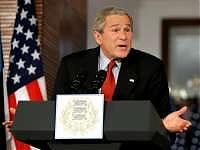
President Bush was in Estonia today, working that old Old Europe/New Europe divide. According to the President, old Europe are a bunch of weeny foot-draggers while New Europe is brash and willing, and not afraid to spill their blood in Bush's War on Terror. Years and gone by and the music is still the same: Bush is attempting to coerce Europe to get behind him and to pledge their armies.

In a press conference, Bush asked for thousands more NATO troops for the hinterland of Afghanistan, transforming the NATO stabilization force (ISAF) there into combat troops. Mr. Bush, who enjoys little credibility in France and Italy, especially after his cheerleading for Israel in its summer war on Lebanon, is pressuring those countries to provide more men and materiel. Italy reacted immediately to the President's words, saying it expected to be thanked for what it's already done in Afghanistan.

But New Europe is fertile ground for Washington, and it is relying on their nationalism and anti-Russian sentiment to challenge Old Europe. Reading the European papers, it appears that the EU Commissioners appointed from New Europe have formed a council within a council, promoting anti-Russian policies that have sunk EU economic/political partnership talks with Russia, much to the chagrin of France and Germany.

Labels: , , ,

Friday, November 17, 2006

More Big Bucks for Clusterf**k

Compared to Peter Pace's request for ANOTHER $130 BILLION for Iraq, Reagan's MX railroad missile defense system was a highly deserving project.

Labels: ,

Wednesday, November 15, 2006

Correcting the course of US foreign policy

There are so few assessments on what is likely to change with the Democrats having taken control of Congress, that I had to resort to foreign America watchers. My big question was, given the traditional closeness of the Democrats to Israel, would Middle East foreign policy change at all? Guillaume Parmentier casts some light on the subject. If you don't feel like reading it all, nothing is likely to change unless the Administration is willing to negotiate with Congress, and that does not appear to be the case. The Administration will cast the Democrats as responsible for the resulting gridlock.

Chat: Will there be a new US policy toward the Middle East?
LE MONDE | 13 November 2006 | 18:42 • Updated 15 November 2006 | 12:57

Debate with Guillaume Parmentier, Director, French Center for Study of the United States, the French Institute of International Relations (IFRI), Wednesday 15 November, 12:00

Q. How are the results of the mid-term elections going to change US policy in the Middle East?

Relatively very little. Most Americans view Israel as the potential victim of a possible mobilization of the Arab world. In other words, they see Israel as isolated from the region, and threatened. Traditionally, the Republicans, who are more sensitive to the influence of oil interests, are more independent of Israel than the Democrats. But that does not mean that they are closer. Over the last few years, the Republicans have come under the influence of the evangelical wing of Protestant activism, which is unconditionally favorable to Israel from their reading of the Bible. This has led the Administration of George W. Bush to unconditionally back all Israeli initiatives, even when these actions have undermined the traditional peace process conducted by the United States. From this point of view, the November 7th elections may produce some softening, because the evangelical wing of the Republican Party has been weakened. But this softening shouldn’t be overstated because there could be compensation for it by the degree of support that the Democrats general give to Israeli initiatives.

Q. What element could modify US policy in the Middle East?

The United States has always been viewed in the region as the power responsible for the degeneration of crises. But this is less so during the presidency of George W. Bush, although he is often apt to foot-drag before addressing conflicts. Since his reelection two years ago, we have nevertheless witnessed a return to a more traditional posture. Mrs. Rice regularly visits the region and the United States has adopted an attitude that, without being as engaged as that of President Clinton during his second term, is not as distant as it was during Mr. Bush’s first term.

Q. Do you believe that the foreign policy of the United States has been changed by the radical behavior of Iranian President Ahmadinejad or do you believe that the United States has fixed rules for dealing with any country belonging what has been termed the “Axis of Evil” since September 2001?

Truth be told, both statements are true. On the one hand, there is no doubt that since September 11th, the US tends to view in the dictatorial nature of the Iranian regime and its possession or desire to possess weapons of mass destruction as a threat to its security. On the other, the bellicose and racist statements of the President of Iran have provided credibility to the assertions of the Bush Administration and reinforced the mistrust of all Americans and political circles concerning the regime. But this does not mean that all Americans believe that there should be no relations with Iran. The leaks coming from the Baker-Hamilton Commission, which was appointed recently to find a solution to the Iraqi conflict, suggest the establishment of dialog, albeit informal, with Iran.

Q. Does the US Jewish community more or less support the Bush Administration?

The Jewish electorate is largely Democrat. On the one hand, it is true that when American Jews, as well as all other Americans, witnessed the consequences of suicide bombings targeting civilians by Palestinian extremists, they rallied to the stern position of the Administration. The Jewish community supports Israel. But it is wrong to say that it supports Israeli policies unconditionally. Remember the 1996 statement by the American Jewish Committee that condemned the policies of Mr. Netanyahu, whose government fell a few weeks later.

Q. What exactly is the amount of influence of the American Jewish community has on Republicans and Democrats?

The Jewish community is very powerful because it is composed of successful individuals in terms of education and enviable affluence. But I repeat, the Jewish community is very largely loyal to the Democratic Party. But its influence in intellectual circles, the media, etc. is undeniable. Above all, Americans, beyond the Jewish community, see Israel as a democratic, Westernized country, which is obviously not the case for the Arab countries that surround it. The reflex reaction of support for Israel extends far beyond the Jewish community. The “pro-Israel lobby” is not a Jewish lobby.

Q. Is it true that without the United States, Israel is powerless?

Israel is a difficult country to defend from a strategic point of view. Its land mass is very small. But it was able to achieve peace with Egypt and Jordan, which gave it a certain peace of mind that it did not enjoy before. But the United States played a major role in establishing that peace. However, it remains in a perilous situation. One the one hand, it has a large Arab minority living within its borders which is unhappy with their status because the Palestinians do not yet have a viable state, which they believe is their right. Moreover, several states in the region (Syria, but above all Iran) have had a consistently hostile attitude towards Israel. In these circumstances, Israel is heavily dependent on political and military support from the United States. But it is an overstatement to say that Israel can do nothing without the United States. We recently saw the Israeli government go far beyond the wishes of the United States in Palestine and in Lebanon. But the strategic dependence of Israel on the United States is undeniable.

Q. What is the United States doing to improve its negative image in the Middle East and, more generally, in the Arab world?

This is a very difficult task. President Bush is hated throughout the area and this has carried over to the image of the United States. But let us entertain no illusions: the image of the West and Westerners is also negative. The most effective steps to counter this situation would be in the use of more balanced rhetoric and, above all, to force a certain number of concessions from Israel so that the fledgling Palestinian state has a chance to develop under satisfactory conditions. In other words, so that the state is viable. Such a policy could be implemented by the current administration. Let us not forget that President George W. Bush is the first United States President to have officially evoked the need for a Palestinian state. However, it is also true that the personal image of the President in the Arab and Muslim world is extremely negative to the point that, in my opinion, it is unlikely that esteem for the United States would return under his presidency.

Q. Can we hope that one day Americans will adopt a more objective position on Israel? I refer to the veto imposed on the UN resolution condemning Israel for Beit Hanoun.

It’s possible, but it is far from certain. It’s difficult to read the tea leaves, but I repeat, for the great majority of Americans, Israel is seen as the victim. So its harsh policies are viewed as a natural response to the de facto situation. The fact that this perception is different in Europe does not change the reality.

Q. Will there be a change in US policy toward Turkey (Iraq, Cyprus, and the Southern Caucasus)?

The problem with Turkey is that the American Right has never forgiven it for prohibiting the transit of US aircraft through its airspace and the passage of ground forces through its territory during the invasion of Iraq in 2003. That is far less the case with the Democrats, who have arrived at a far different stance on the war since then. I don’t doubt for a minute that Congress will seek to restore cordial relations with Turkey given the new circumstances. However, although the Turkish elite continue to view the United States with a certain amount of benevolence, Turkish public sentiment in this regard is extremely negative. It is not certain that relations can return to the status enjoyed previously.

Let’s not kid ourselves, this situation will only encourage the United States to continue to use demagogic rhetoric concerning the entry of Turkey into the European Union. And when I say demagogic, I am obviously referring to the statements of the United States urging the European Union to admit Turkey rapidly and under relaxed criteria.

Q. And where are the Europeans in all this? Can they influence the position of the United States in the Middle East? Can the Middle East become an area for reconciliation between the EU and the United States or will it be a casus belli?

I hope it will not become a casus belli, or even the stage for verbal clashes. But there will be no real rapprochement unless Israel is directly threatened. This would lead the Europeans to reaffirm their support for the existence of Israel, which would then bring them closer to their US partner. Beyond such circumstances, which are certainly not desirable, I don’t see how the positions of these transatlantic partners, which are now far apart, can be reconciled.

Q. Do the United States or the UN really have the means to carry out their threats of sanctions against Iran, following the reports issued by the IAEA?

The international community recognizes that Iran is playing a very dangerous game. For this reason, the position of the United States is not isolated. It remains to be seen what policy it will implement. Until now, the United States has acted relatively distantly from certain statements by the Administration, which has enabled the US to escape isolation. The reality is that the US Administration cannot tolerate Iranian attempts to acquire nuclear weapons, nor can it use force. This has created for the United States, as for the rest of the world, extremely powerful constraints. The occupation of Iran is inconceivable and targeted strikes would have little likelihood of destroying Iranian nuclear potential and would render ineluctable an acceleration on the part of Iran of its nuclear program. It is a problem that can be resolved only by convincing Iran that a nuclear arsenal is not in it interests But for this, flexible individuals or groups in Iran must be sought out. It is not certain that the US and the rest of the world can do so.

Q. What is the Bush Administration prepared to offer to the Democratic majority in Congress in terms of foreign policy?

It is the President who possesses the initiative for foreign policy. If the Administration wishes to lead effective foreign policy, it has to engage its Democratic partners in Congress in a genuine and systematic fashion. If it fails to do so, it's going to find itself in a very difficult position. The Senate is going to put obstacles in the way of nominations to the Defense Department and the Department of State and the House will cut funding for initiatives which it does not support. Everything depends on discovering whether the Bush Administration is willing to compromise. The least that can be said is that, given its natural persuasion until now, it will seek to push the Democrats into a trap, which consists of assigning them the blame for a possible governmental gridlock. However, from this point of view, domestic issues will be far more important than international issues.

Q. What transformations do you predict in US policies on the Middle East in the next 15 years?

I can’t read the tea leaves. However, I hope that the recent tendency to adopt generic recipes for all the countries which the United States has involved in the ambiguous and hazy “Greater Middle East Initiative” will give way to policies that are far more differentiated. Many Democrats have expressed strong reservations on the validity of the initiative. If the Administration is willing to compromise, we can hope for positive change. As to 15 years from now, remember that Harold Wilson, the former British Prime Minister, used to say that a week is a long time in politics....so, 15 years are….

Chat moderated by Gaïdz Minassian

Labels: , ,

Tuesday, November 14, 2006

Iraq: Bush ups the ante on a brutal occupation

US troops attacked Shi'ite northwest Baghdad, Shouala, killing 6 civilians with assault helicopters and bombs.

Labels: , ,

Monday, November 13, 2006

Bush rejects the Baker Report

Get ready for a battle royale when the new Congress convenes. Bush has rejected the Baker Report. Don't expect help from Gates.

Labels: , ,