Nur al-Cubicle

A blog on the current crises in the Middle East and news accounts unpublished by the US press. Daily timeline of events in Iraq as collected from stories and dispatches in the French and Italian media: Le Monde (Paris), Il Corriere della Sera (Milan), La Repubblica (Rome), L'Orient-Le Jour (Beirut) and occasionally from El Mundo (Madrid).

Tuesday, July 24, 2007

The "Surge" extended...

...until 2009.

Meanwhile, Chester Crocker continues his conversations with Hassan Kazemi Qomi, which Crocker is apparently (according to L'Orient-Le Jour )using to bash Iran as he presents a new slate of accusations daily. The latest is that Iran is responsible for sectarianism in Iraq.

In Ramallah, Mahmood Abbas's Presidential Guard beats the crap out of Qassam Barghouthi, the son of Marwan Barghouthi (Fatah Secretary-General in an Israeli prison), who was inquiring about his sister, Rouba, arrested for driving too near the Presidential residence.

Labels: ,

Monday, May 28, 2007

Hubert Védrine: Part 2


Finally found the time to finish this intersting exchange with Hubert Védrine

Q - What about other issues?

I do not think that on the Israeli-Palestinian question, the Israeli-Lebanese question and the Syrian-Lebanese question there can be any resolution without realism. The startup of a process to find a solution between Israel and the Palestinians would remove pretexts from Syria and the others.

Q - Don’t you think that the process could aggravate demands and ambitions, if only because the peace process calls for a Palestinian state and that several regional regimes would want to control it?

The longer Israel waits, the more problems will arise. If the Israelis had negotiated seriously with the Palestinian nationalists, they would have had a ready-made barrier against against Islamism. The longer they wait, the greater the chances are that the Palestinian movement will weaken and fall under the control of hostile forces. In my opinion it was a tremendous error to push the Palestinians into elections then to boycott the results. It’s one of the worst errors the West ever made and one that both Europe and France accepted. Either you don’t want the Islamists in government, for good reason, so you don’t ask the Arabs to hold free elections or you believe that the democratic process is more important and you accept the results. The West destroyed its own message. As to Iraq, I agree with the Baker-Hamilton Report. In any case there are no perfect solutions, only flawed solutions. A regional approach is required so that Iraq’s neighbors gradually have less interest in maintaining or increasing the chaos in Iraq.

Holding talks with Iran doesn’t mean supporting the Islamist government or that you’ll agree to whatever they’ll ask you. It means betting on something else. You have to think dynamically, not statically. If you impose preconditions, that’s arrogance or pretentiousness. Things don’t work that way. You have to bet on a changing circumstances. The United States would have done well to reopen dialog with Khatami. Khatami was weak, but his hand would have been strengthened had there been dialog. By reopening the dialog, there was a chance that other forces in Iran would have come to the fore; the idea is to talk to nationalist Iran, not Islamist Iran. If dialog restarts, these forces will appear. But you cannot manage the dialog naively. While negotiating, you have to distinguish the normal regional desires of Iran –to become a regionally important power- from outrageous demands. Little by little, and it won’t happen in 24 hours, Iran must receive recognition of its regional status so that it will reduce its investment in Hezbollah and Hamas.

As to other questions, between Syria and Israel, Lebanon and Israel and Lebanon and Syria, I believe that progress can be made, including progress in Lebanese reconstruction and sovereignty, by relying on different mechanisms. If not, it’s all a waste of time.

Interview conducted by Jana TAMER

Link: (subscription required)

Labels: , , , ,

Interview with Hubert Védrine on US foreign policy

The former Foreign Minister of France, Hubert Védrine has just published a book: "Continuing History"
Interview in Paris conducted by Jana TAMER of L'Orient-Le Jour.

The former Foreign Minister in Socialist Lionel Jospin’s coalition government from 1997 to 2002, Hubert Védrine is esteemed in all political circles, both in France and abroad. He was recently sounded out by President Elect Nicholas Sarkozy, as well as other members of the French Socialist Party, about joining the new government. Author of a work that was published amidst the French presidential campaign, Mr. Vedrine has agreed to an interview with us to discuss the overall situation in the Middle East from the realistic standpoint contained in his book, “Continuning History” (Fayard).

Q - In your book you examine back to back US and EU policies toward the Middle East and you refer to these policies as unrealistic.

The overall theme of my book is that after the fall of the Soviet Union, the West went overboard with euphoria in the notion that it had won the battle of history. It believed that its notions would then be automatically applicable everywhere : its ideas of democracy, its conception of the market economy, its values –which it believes are universal. In its mindset, there will be no more policy problems because there will be no more fundamental disputes on anything. All that would remain is how the world would be organized. It has even been adopted World Bank jargon, talking about things like "governance" which suggests business management rather than policies.

This Western illusion is split into two branches: one is American and the other European. The American branch attributes primordial importance to military superiority. It is here where the Neocons suceeded in hijacking US foreign policy with their very peculiar understanding of the Middle East –an interpretation which they tried to foist on the rest of the world. In their minds, the Palestinian question is of no importance –it is merely a pretext invented by the enemies of Israel– and therefore it is necessary to transform Arab states willy nilly and make them democratic, which would naturally make them pro-Western. But this type of reasoning is borrowed from Dr. Strangelove. How in heaven’s name did the United States, a great country, –certainly very nationalistic but overall very smart– get hijacked in this way ? This is worth investigating.

The other branch, the European branch, is very different but I would lable it ingenuous. Modern Europeans believe that the world is made up of Boy Scouts who want to protect the overall well-being of humanity. They believe that we are part of an international community that works to prevent conflicts through the United Nations, etc.

These two irrealistic branches of thought, which are very different, really don’t work. Actually, a kind of multi-polar world is in the process of forming. This multi-polar world is not one of the grandiose rhetoric we deploy in France. And this world can very well progress without us, or even against us.

My main concern, –which regards not only foreign policy but also things that are more global and more historical in nature– is that Europeans do not possess the required energy to cooperatively build a power that could affect things. I try to redefine the contours of a modern school of realism. This is the work that I have been doing on the political and intellectual planes in France. With respect to Europe, I am also trying to introduce a more realistic approach. There is still quite a bit of irrationality and chimeric illusions. I’m one hundred percent pro-Europe myself, but there are several ways in which to be European. Moreover, I’m fighting against a sort of depressive tendency that has existed in France for several years. I maintain that it’s acceptable to look history in the face, including the darkest chapters –there are such episodes in the history of every nation– but it’s not a reason to sink into depression and permanent compulsive expiation.

As part of all this, I believe that Western policies over the last few years toward the Near and Middle East –spurred by the United States– have been completely idiotic. That’s quite clear.

Q - But how can the realism that you promote and which is similar to the approach offered to the United States by the Baker Hamilton report produce any better result? What comparison do you make between current US Middle East policy and that pursued by Bush Sr. And James Baker ?

You can’t compare the war waged for Kuwait with the events that are transpiring in Iraq. The war in Kuwait was impeccably managed with respect to legality and legitimacy. There was unanimity among the permanent members of the UN Security Council and many Arab nations in the Coalition. And this Coalition ceased combat to avoid exceeding its mandate.

Q - But there wasn’t only the war in Kuwait…

On the question of the Middle East, Bush père and James Baker were the only ones to put some pressure on Israel when they blocked financial guaranties at one point. They even succeeded in setting off a crisis in Israel and launched the process that led to Rabin's ascent to power. Without Rabin, there would have been no Oslo process. As we look back on that period, we see that Rabin was the greatest Israeli man of state in thirty years. Inside Israel, there is a cleavage between those who would use any pretext to avoid a peace process because, as they do not want to give back territory, they don’t want a process (they therefore claim that there are no partners for dialog) and those, like Rabin, who want to advance the process not through a sudden move driven by compassion for the Palestinians, but because they claim that the vital interests of Israel lie on making progress. While it is true that these two groups exist, Israeli foreign policy has been dominated by Likud for quite some time, a sort of twin of the American Neocons. We don’t know who influences whom.

The polices of Bush Jr. are the worst of any US policies since 1945. That said, the US reaction following 9-11 focusing on the Taliban and al Qaeda was completely justified and moreover, there wasn’t a soul in the world who criticized it. But the war on Iraq was a monstrous error, above all for the United States. The US should have done just the opposite –it should have pursued the peace process. We were told that Bush wasn’t interested in the subject (a Middle East peace process) but what really happened is that Bush backed Sharon to the hilt. Bush Jr.’s White House aligned with Sharon from the minute it took office, before 9-11.

Q - The so-called realist approach, such as the Baker-Hamilton Report, raises quite a bit of fear in the Middle East. Some think they will have to bear the brunt of any realistic policies pursued by the West which would then aim at transforming enemies into friends and striking deals with them.

I believe that the approach used in the past by Bush père and Baker, which was picked up by the Baker-Hamilton Report, is less insane and more serious. But there are several ways of implementing realistic policies. And within these realistic policies, there is plenty of choice. I’m with those who think that there should be no taboo on dialog. Realism means recognizing that Bush’s policies in the Middle East are ideologically-driven and Manichean. You should never tie your hands behind your back and declare, “I will never negotiate with the terrorists and the regimes which threaten us”. The United States and the Soviet Union negotiated throughout the Cold War despite the fact that they threatened nuclear annihilation on one another; Kissinger went to China…You should never prevent yourself from talking out of Manichean motivations, dogmatism or morality. You have to do what’s necessary, and not just out of obsession with discussion or diplomatic routine.

On the Israel-Palestine question, you have to adopt a realistic solution in the interests of the West but also in those of Israel. Not to mention that of the Palestinians, who live in deplorable conditions. Moreover, we know more or less what the solution looks like. Its a blend of the Taba Accords, the Clinton Criteria, the Geneva Accords... I recognize that it will be fraught with difficulty. To become engaged in the process, the Israelis need a powerful, reliable and convinced Prime Minister. Israel’s extreme right wing and especially certain actors on the Palestinian and Arab side will try to prevent a successful agreement. But if it is announced in advance that there will be obstacles but that there is determination to proceed… Well, it assumes another Rabin, who would be supported by another Clinton but in the space of a year the crisis would be under control ! Realism demands that the focus be placed there –not on Iraq or on other countries as the US Neocons would like. If their plans for Iraq had succeeded, they would have intended the same for Syria, Iran, Saudi Arabia… Because of the glaring defeat in Iraq, they no longer know what to do. US policy should now enter a transitional phase, but it’s not clear that this will actually occur. Realism would also command not to invade Iraq –and everything that President Jacques Chirac said was basically justified. We could question his tone, or his methods or his rhetoric but at the end of the day, he was correct.

(To be continued...)

Labels: , ,

Sunday, May 27, 2007

Palestinians in Lebanon


There for 60 years! And they are forbidden to work in any decent-paying job.

Report
The camps are ghettos with rudimentary infrastructure.
LE MONDE | 22.05.07 | 14h56 • Mis à jour le 22.05.07 | 14h56
BEIRUT CORRESPONDENT

The approximately 400,000 Palestinians registered in Lebanon by UNRWA, the UN agency specialized in issues relating to Palestinian refugees, live in 12 camps scattered around Beirut, the south, the north and the east of the country. The estimated 16,000 refugees of the 1967 Arab-Israeli war are not included in this statistic in that UNRWA considers a refugee any Palestinian having lived in Palestine two years before the 1948 exodus and who was then expelled, including his or her descendants.

An agreement concluded in 1969 with Lebanon sponsored by Nasserite Egypt granted Palestinians the right to continue their struggle against Israel from the Arkub region in the south of the country. This agreement, drafted by Cairo, forbade the Lebanese to enter the refugee camps where the Palestinians were in charge of security. This agreement, of which the special section relating to the south, is in de facto lapse after the departure of the Palestinian fighters from Lebanon following an Israeli invasion, was abrogated by the Lebanese Parliament in 1987.

The mainstream Palestinian organizations are nevertheless well established and the predominance of one group or another depends on the geographical location. Thus, since the time Damascus exercised it hegemony over Lebanon, and considering its geographic proximity to Syria, the two refugee camps in the north of the country, Nahr al-Bared and Baddawi, have been dominated by Fatah-Intifada, which grew out of a pro-Syrian splinter group in 1982 from Yassir Arafat's Fatah.

But since the end of the 1990’s, Salafist networks have sprung up inside the camps in a sort of osmosis Lebanese Salafists in the Akkar region, further north, as noted by Bernard Rougier, in Le Jihad au quotidien [Everyday Jihad] (Presses universitaires de France). This event does not seem to have preoccupied the Syrians, who were already wooing the Lebanese Salafists in northern Lebanon. At the other extremity of the country, far from Damascus, in the Aïn Al-Helowi camp east of the town of Sidon, Jihadist Islamism ten years later and is part of global Islamism, opposed to the PLO and Palestinian nationalism, including Hamas and Islamic Jihad. In the other refugee camps, Fatah is dominant.

Built on land granted by the Lebanese state in the aftermath of the creation of Israel, they lack basic infrastructures and are ghettos where the population lives in growing misery, denied economic and social rights. In exchange for the “organization" of security inside the camps and the disarming of Palestinian outside the camps, the government of Fouad Siniora has begun to offer this guest population a decent life.
While awaiting the outcome of discussion on this topic, a Interior Ministry circular made timid headway in reducing the number of professions [such as law, investment, accounting] that are forbidden to Palestinians from 72 to 20. This is the only fragile achievement to date coming out of extremely intensive dialog.

M. Na.

Labels: , ,

Sunday, May 06, 2007

Another Bloody Sunday: 6 May 2007

I used to do a hour-to-hour timeline of daily violence in Iraq and around the Middle East. I have a few spare moments today, lest we lose sight of the carnage:

21:01 Diyala. Six US soldiers and a journalist die when their car hits a roadside bomb in Diyala Province.

18:25 Tunceli, Turkey. Kurds and Turkish troops in firefight. 5 Kurds and 2 Turkish soldiers dead.

16:34 Shubara, Pakistan. 2 Shi'ite clerics murdered.

16:20 Gaza, Palestine. Radical Islamic militants attack an elementary school, killing Majid Abu Shamallah, an MP for Fatah. Another 6 wounded, including a child and the Vice Principal.

15:32 Baghdad. US raids Sadr City, killing 10 people. The US military said they were importers of explosive from Iran.

15:29 Algiers. Intelligence unit warns Islamist suicide bombers about to strike again.

14:21 Baghdad. Three US Marines die in al-Anbar province, bringing total military deaths to 3,365 since 2003.

13:48 Al-Gurah, Egypt. French military training aircraft crashes shortly after takeoff on a highway in the Sinai Peninsula. 9 dead, including 8 French military personnel and an officer of an undisclosed nation.

13:32 Gaza, Palestine. UN-run school attacked.

12:48 Baghdad. Ansal al-Sunna beheads Iraqi soldier and uploads video to the 'net.

12:37 Samarra. Two suicide bombings targeted different police stations 120 km north of Baghdad as mortar and machine gun fire heard. A suicide carbomber rammed the central police station. A second rammed the barracks of the special emergency police unit. 12 police killed, 6 wounded, including the Police Chief, Abd al-Yalil Nahi. The 3rd Brigade of the 82nd airborne rushed to the scene where they came under machine gun fire. A US Humvee took a direct rocket hit, wounding one US solider. A suicide bomber blew himself up in front of a second US Humvee. No word on casualties.

11:49 Ramallah, Palestine. Militants blow up a fuel truck, wounding an Israeli security guard.

10:42 Baghdad. 35 killed and 80 wounded the al-Bayaa quarter of Baghdad as a booby-trapped car explodes on 20th Street. In the same quarter, residents have been moving out over the last 3 days as al-Mahdi Army militants take over.

09:17 Al-Asriyah. 13 wounded in marketplace bombing 40 km south of Baghdad

09:15. Baquba. 3 killed in a marketplace firefight between gunmen and Iraqi troops 60 km northeast of Baghdad.

09:04 Gaza. Four rockets launched at Israeli settlements in the Neghev Desert.

07:53 Baghdad. US bombs 4 residences in Sadr City, wounding 6 people, including children.

07:43 Ghazni, Afghanistan. 5 police killed by roadside bomb.

06:41 Herat, Afghanistan. 8 Afgani police and 4 Taliban die in firefight.

02:29 Washington. Bush requests "responsible" funding for the "war against al-Qaeda" in Iraq.

Labels: , , , , ,

Tuesday, December 26, 2006

A Christmas Tale of Two Cities

From L'Orient-Le Jour (Beirut)

Christmas in Baghdad

For the first time, the Christians of Baghdad are celebrating Christmas without Christmas trees: tree growers from outside the city no longer dare to face the gauntlet of checkpoints set up by the militias and resellers fear becoming a target of Muslim extremists.

Muslim retailers used to wish me a Merry Christmas before selling me my choice of tree, regrets Marie Hanna, mother of two children. This year there’s neither their wishes nor a tree. Without the green of Christmas trees, Christmas isn't Christmas, especially for the kids, chimes in Ban Zaki, also a mother. What a shame, we’ll have to get along with an artificial tree, she says with disgust.

Normally, many retailers in the capital make a tidy profit during this time of year selling hundreds of Christmas trees to the Christian minority. Growers in the city’s verdant northern suburbs used to line Saadoun Street in the Karrada quarter selling these symbols of the Nativity. About a week before Christmas, they’d drive into town with trucks loaded with fir trees and stake out a location in front of the churches or in the Christian neighborhoods of Karrada and Riyadh (central and southern Baghdad). But this year there is no one selling trees with the exception of a lone farmer on the corner of Saadoun Street. They are afraid to come to town, because they risk being shot by those who don’t like to see Muslims selling Christmas Trees to Christians, deplores Sammer Yunan, a Christian. The numerous checkpoints in the neighborhoods of Baghdad set up by militias and extremists discourage tree growers from coming to town this year. Resellers are also fearful of attacks on their shops. The tradition is dying and the Christmas tree no longer has a place amid the confessional violence tearing Baghdad apart. They want to divide our society, interjects Sammir, with a disgusted look. The Christian minority of Iraq has lived in harmony with the country’s other communities and remains spared by most of the violence perpetrated by mostly Shi’a militias and Sunni insurgents. With the invasion, many Christian families have gong into exile.

The Christians of Iraq, who represent 3% of the population, are almost all members of the Chaldean Catholic Church. As everywhere in the Christian world, Christmas is a big holiday for us. But this year, it’s different; life has become difficult, laments Bassam Sami, a legal adviser to one of Iraq’s ministries. We are constantly praying for the violence to end, he explains, his eyes turned to heaven and his hands joined over this chest, asking God to “end the bloodbath”. We are afraid that something really terrible will happen this year to ruin the holiday, he adds with a murmur, as if to ward off bad luck.

In January 2006, coordinated bombings against seven Baghdad churches and the residence of the Papal Nuncio killed three and wounded 17. Because of the danger, offices are now said on Sunday afternoon, instead of at night. This year, Christmas will be bitter, says Anwar Khudhir, a retiree. How can you celebrate Christmas in this kind of atmosphere, when our neighbors and Muslim friends are in constantly in mourning? We would like to invite our Muslim friends to our table, to celebrate with us, like we used to do, he adds.

Christmas in Gaza

The Christians of Gaza this year are not interested in celebrating. The years Christmas Parade as well as Midnight Mass were canceled. The giant Christmas tree that used to dominate the main square in Gaza City is gone.

This is a joyless Christmas, says Oum Tarket, an Orthodox Christian woman. This is our first Christmas under the Islamist Hamas government, marked by an unprecedented upswing in violence between Palestinian factions and a tremendous degeneration in economic conditions. The general atmosphere in Gaza is sad. Before, Palestinian children were dying under Israeli bullets. Today they are dying from Palestinians bullets. How could we celebrate Christmas under these circumstances?, laments Manuel Mussallam, a Catholic priest. It is estimated that there are 3,000 Christians in the Gaza Strip, living side by side with 1.4 million Palestinians. But most Christmas festivities were canceled this year owing to clashes between President Abbas’ Fatah and Hamas, which controls the government.

Gaza’s annual Christmas Parade used to bring together hundreds of people, including Muslim religious dignitaries and government officials. A giant Christmas tree used to gleam with multicolored lights. Most Palestinian Christians live in Gaza City, where they own shops and go to one of two churches on Sunday. The most well known and respected physicians, lawyers, jewelers and magistrates are Christian. Most of them are orthodox Christians, but Gaza is home to 200 Catholics, including refugees from Israel who left during the Arab-Israeli war of 1948.

Christians in Gaza rarely drink alcohol and observe the Muslim dress code. None are Hamas supporters but some back Fatah or Marxist organizations. But the violence of the last few months, aggravated by the call for early elections by Abbas, has resulted in the death of several schoolchildren, classmates of Oum Tarek’s children. They were slain by militants because their father was head of intelligence for Abbas. My children are still traumatized by what is happening among Palestinians. We’ve never seen this before., she says.

Labels: ,

Tuesday, November 14, 2006

Massacre at Beit Hanoun

Sabbah has a slide show of the Israeli-spawned carnage at Beit Hanoun.

Labels: ,

Monday, November 13, 2006

New Prime Minister for Palestine

Academic Muhammad Shbeir is to assume the post of Prime Minister, replacing Ismail Haniya.

Labels:

Friday, November 03, 2006

Popular Resistance


From L'Orient-Le Jour (Beirut).

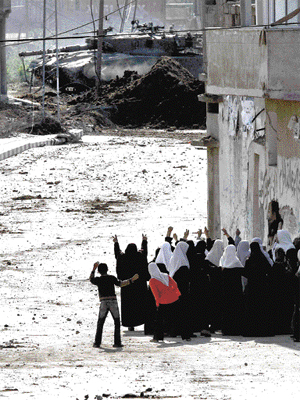
Women in Hanoun, Gaza Strip, offer themselves as human shields to save their sons and husbands, inside a mosque, from Tsahal. The Israelis shot dead two of them. How many of us love so much that we would have the courage to pay the price in blood?

Labels: